
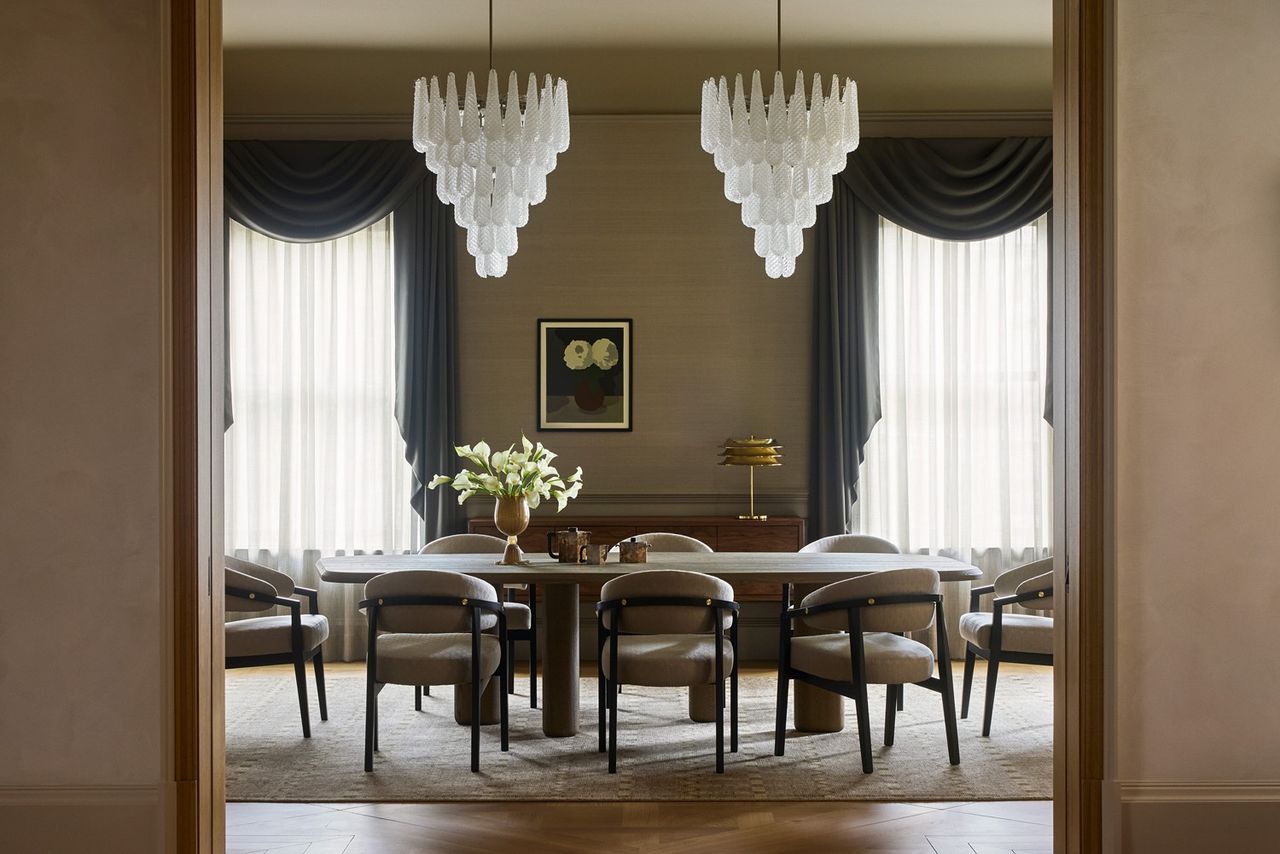
Vintage is no longer a finishing touch – it’s become the foundation many designers are drawing upon for depth and detail that’s unique to found objects. As homes move away from fast furniture and fleeting design trends, there’s a renewed appetite for sought-after pieces with soul, substance, and story. Designers are increasingly turning to antiques and vintage finds not only for their craftsmanship and patina, but for their ability to instantly lend individuality to a space.
Market performance reflects this shift. According to 1stDibs, antiques and decorative collectibles are showing their strongest demand increases in years, while sculptural elements like glass lighting and furniture with expressive curves are among the fastest-growing categories. Anthony Barzilay Freund, Editorial Director at 1stDibs, says this is part of a broader recalibration: ‘People want interiors that feel personal and intentional – and decorating with vintage delivers that in ways new furniture simply can’t.’

Spanning expressive glass, nostalgic patterns, and curvaceous forms, these are the vintage-led trends set to define interiors in 2026.
1. Curvy and Irregular Silhouettes

For 2026, designers are embracing curvature as a way to soften spaces and break from boxy minimalism. From rounded coffee tables and free-form mirrors to biomorphic lighting and generously shaped lounge seating, gentle geometry brings comfort and flow to interiors.
Pointing to a growing interest in iconic curved sofas and expressionistic furniture, Anthony predicts ‘a real emphasis on sculptural forms that feel tactile and welcoming,’ noting that curves help to humanise a space – with vintage mid-century and post-modern pieces in particular driving the shift.
‘There’s a natural warmth to curvy vintage silhouettes – they immediately make a space feel more welcoming,’ says interior designer Rachael Gowdridge. ‘Their fluid lines ease the harder edges of a room, softening the overall geometry and helping the eye move more gently through the space.’
That emotional pull is part of a wider rediscovery of organic form, according to design consultant Eleanor Taylor-Roberts, who reveals that ‘designers are rediscovering the emotional resonance of curves and irregular vintage silhouettes.’ In an era of strict minimalism, she explains, these forms feel ‘deeply human – imperfect, tactile and expressive’ offering a counterbalance that softens a space’s edges.
How to use at home: Introduce curves gradually. A rounded armchair, free-form mirror, or vintage ceramic can soothe a space without overpowering it.
A sculptural centrepiece from Proisy Studio’s Modern Cowboy collection, the Jim Sofa XL Size is an oversized, hand-crafted curved bouclé-upholstered sofa.
A sculptural wall mirror crafted from honed Black Bulgari marble with a gently curved silhouette and substantial frame, where the natural veining of the stone ensures each piece is unique
With its soft curves and organic elegance this vintage-style wall light would instantly soften any room. Flank a bed or add something unexpected to a kitchen.
2. Murano Glass

Statement vintage lighting isn’t new, but this year, Murano glass commands the spotlight as both light source and centerpiece. Whether gleaming pendants or colorful blown-glass clusters, these pieces act like functional art.
As noted by Anthony, ‘Murano lighting is one of the single biggest drivers of vintage demand right now. Collectors and designers alike are drawn to its combination of color, craftsmanship, and expressive shape – it’s a sculpture that defines a room.’
This is supported by Duncan Campbell and Charlotte Rey of Campbell-Rey, who have ‘worked in Murano glass for the past 15 years and have not stopped marveling at its beautiful texture, color, and versatility. Working alongside Murano craftspeople – who are at the height of European craftsmanship – is a constant source of inspiration to us.’
How to use at home: Think beyond lighting. Alongside chandeliers and sconces, display Murano glassware – vases, bowls, or sculptural objects – as collected moments that radiate vibrancy and personality shaped by hand.
Individually hand blown by artisans in Murano, each of these tumblers is a piece of art for your table.
A pair of hand-blown Murano glass wall sconces defined by elegant, curved forms and a softly luminous finish, celebrating the enduring craftsmanship of Venetian glassmaking.
A vintage Murano glass vase from 1960s Italy, hand-blown with a distinctive tortoiseshell pattern and wavy rim.
3. Pre-1920s Antiques

The most successful maximalist interiors begin with a sense of order – and that order often comes from pre-1920s antiques. Hand-carved furniture, patinated woods, and architectural silhouettes are increasingly used to ground layered schemes rich in color, pattern, and texture.
Anthony explains: ‘In the current mix of expressive palettes and materials, early antiques act like visual gravity – they calm a scheme and make it feel intentional. Designers are increasingly centering rooms around a single great antique.’ Designers like Ann Wolf and Ashley Holden of Wolf Holden echo this, noting that ‘these earlier pieces introduce essential visual order. Their architectural lines and time-worn finishes anchor the composition and keep exuberant rooms grounded in history.’
How to use at home: Anchor a room with one serious antique – a refectory table, an early chest, or a carved armchair – then layer bolder elements around it. The contrast makes both feel more intentional.
An early 19th-century Austrian Biedermeier sleigh daybed, finely crafted with walnut veneer and clean, flowing lines that exemplify the period’s exceptional woodworking.
A rare pair of dining chairs, crafted in steam-bent wood with distinctive loop-shaped leg braces and woven cane seats, exemplifying the technical innovation and refined lightness of early Viennese furniture design.
An early 19th-century two-door cabinet, beautifully finished with curl mahogany veneers, brass wire grilles with original silk backing, and pilasters crowned by finely carved lotus-leaf capitals.
4. Floral and Botanical Motifs

Florals are blooming again – but with more nuance, history, and artistry than ever before. In 2026, floral and botanical motifs rank as the most favored vintage pattern, according to 1stDibs, with Victorian florals, Arts & Crafts botanicals, and mid-century nature prints all resurfacing.
Decorative artist Tess Newall attributes their staying power to emotion and memory: ‘Nature has always been a huge source of inspiration in my work. The enduring appeal of florals and botanicals in interiors is due to the softness they bring to a room, and the fact that they are so timeless.’ Rather than feeling overly decorative, today’s florals are layered thoughtfully – on walls, ceilings, and textiles – often drawn from archival sources and adapted for contemporary living.
How to use at home: Treat vintage florals as you would artwork. Look to archival prints, historic textiles, or botanical illustrations, and let one considered application – a wallpapered alcove, hand-painted ceiling, or upholstered heirloom piece – carry the narrative of the room.
A set of three early 20th-century Swedish folk art pieces featuring hand-crafted forms and painted decoration that reflect the charm and regional traditions of Scandinavian vernacular art.
A trompe l’oeil wallpaper featuring painterly, folk-inspired florals and stylised foliage, framed within a panel-effect border to evoke the look of traditional Tyrolean painted furniture and decorative wall panels.
Hand-painted and inspired by vintage floral patterns, these decorative boxes can store jewelry, photos or corral clutter on your bedside table.
5. Color-Drenching with Vintage Palettes

Color-drenching continues to evolve in 2026, with designers increasingly embracing the technique, but now through a vintage lens. Color trends are gravitating towards historically inspired palettes, such as moody greens, burgundy, chocolate brown, and porcelain blues.
Rather than chasing a single ‘it’ shade, palettes are becoming richer, more considered, and rooted in decorative history, says Ruth Mottershead, Creative Director of Little Greene. ‘This contemporary, cohesive approach delivers high impact by painting woodwork, radiators, ceilings, and doors in the same color as the walls,’ as part of a growing confidence with color that marks a clear shift away from default white. ‘There is a move away from white woodwork and ceilings in favor of contrasting or coordinating colors to create cohesive design schemes,' Ruth adds.
For Jennifer Pelzig of Parsnip Design, color drenching is also a powerful spatial tool. ‘Color drenching a space, particularly a room that is a more awkward shape or that may not be blessed with period or interesting architectural features, softens and blurs the edges a little,’ she says. When combined with a gentle, vintage-inspired palette, the effect becomes even more compelling, ‘building on that cocooning feeling and giving the space an established, more lived-in feel.’ Jennifer often turns to historically rooted shades such as Little Greene’s Pale Wedgwood Blue – derived from 18th-century Jasperware – which works wonderfully when paired with related neutrals.
How to use at home: Take cues from paint brands that mine the past. Look to historically researched shades – those drawn from archival houses, museums, or period interiors – and blanket-apply them across surfaces.
A deep stone-toned paint shade inspired by the pantry door at Wimpole Hall, reflecting the practical, muted hues traditionally used in back-of-house interiors and recreated in partnership with the National Trust.
A light, traditional green with gentle yellow undertones, Saxon Green has a soft, timeworn quality and draws on historic paint colors commonly used before standardized palettes were introduced in the early 20th century.
A rich velvet purple with cool blue undertones, this moody shade features a smooth matte finish and draws inspiration from the creative energy of 1960s and 70s Brooklyn, reflecting the artistic heritage and industrial character of its namesake.
6. Skirted Seating

Skirted sofas and chairs are resurfacing as an intentionally relaxed, romantic counterpoint to rigid frames, bringing a sense of ease back into upholstered furniture. Once a hallmark of 1940s interiors, skirted seating is being reintroduced as a way to balance structure with comfort – a shift that reflects a broader desire for warmth and livability at home. According to Anthony, ‘Furniture with skirts gives upholstery a cozy, personalized quality – it’s a way of tempering hard edges without feeling too precious.’
That sense of ease is exactly what draws designers like Emma Sherlock to the style. She notes that adding a skirt is an effective way of ‘softening upholstered furniture and adding a bit of charm and interest to a room,’ especially when working with seating that has harder-edged backs and sides. For designer Sally Wilkinson, the appeal lies in the familiarity skirted pieces bring. Whether tailored or gathered, she says, a skirt ‘instantly adds warmth and a relaxed, lived-in quality that feels timeless,’ while also offering practical benefits when used as a loose, washable cover.
How to use at home: A single skirted piece can feel quietly considered, while multiple skirted sofas or chairs work beautifully in more decorative, chintzy interiors – especially when fabrics and proportions are thoughtfully coordinated.
A late 20th- to early 21st-century vintage accent chair and ottoman by North Carolina’s Highland House, upholstered in red-and-white plaid with overstuffed cushions and tailored skirts on both pieces, finished with wood legs and casters.
This modern stool nods to the vintage trend for skirts, adding a touch of whimsy to living room or bedroom. It's available in 16 different fabrics to you can pick depending on how vintage to want the piece to feel.
Inspired by classic upholstery, the Calliope armchair features gently sloped arms and a skirted base in a compact silhouette, upholstered in fern green brushed velvet for a rich, tactile finish.
7. Wallpapered Ceilings

Ceilings are being drawn into the design conversation like never before, with the use of wallpaper quite literally on the up. Carrying vintage prints or archival patterns overhead creates an enveloping effect that adds intimacy and intrigue, particularly in rooms with architectural quirks. This sense of immersion is central to how designers are using the technique today.
Ariel Okin follows Mario Buatta’s long-held belief in treating the ceiling as a fifth wall, often continuing wall coverings overhead to make a room feel ‘extra cozy,’ while contrasting papers, textured finishes, or even specialty paint techniques can ‘draw the eye up and create different effects – from making a ceiling feel higher and airier, to grounding and creating a feeling of being ensconced.’
In more challenging spaces, this approach can be especially transformative. Anouska Cave, Head of Design at Cave Interiors, points to the power of scale and continuity when working with awkward architecture. ‘Small-scale patterns work beautifully on sloped ceilings,’ she says, advising that larger prints can feel overpowering, while a delicate repeat creates a gentler, more cosseting atmosphere. In an attic bedroom project, the studio chose Howe London’s Rambling Rose, carrying the wallpaper seamlessly across both walls and ceiling so that ‘the angles were softened,’ and the space felt ‘intentionally intimate.’
How to use at home: Look to historically scaled patterns – 18th- and 19th-century florals, ditsy repeats, or Arts & Crafts motifs – which were designed to sit comfortably overhead.
A refined small-scale print named for the Victorian era, Alma features a diamond trellis framing a delicate sprig motif, presented on powder blue, grey, sand and ecru grounds.
Based on an original fragment discovered at Bayham Abbey on the Sussex–Kent border, this wallpaper features a rich red ground with Gothic overtones, echoing early machine-printed designs made from cellulose wood pulp.
Inspired by ancient frescoes uncovered in a French villa, Leonidis features a medium-scale ogee stripe printed on a softly mottled ground, giving the wallpaper depth and a distinctive hand-painted character.
Ultimately, the power of decorating with vintage trends lies not in rigid rules, but in its flexibility. These vintage trends are less about recreating a particular era and more about learning how to mix them – pairing sculptural glass with inherited furniture, layering patterns and textures, or letting a single, characterful piece lead the room. Whether you start small with a lamp, mirror, or decorative object, add a skirt to your sofa, or take a bolder step with a fully color-drenched space, the most compelling interiors are those that feel considered rather than overly curated.
There’s also pleasure in the process itself: the slow search, the unexpected find, the piece you didn’t know you were looking for until it stops you in your tracks. Embracing vintage invites a more intuitive way of decorating, one that allows homes to evolve over time and reflect taste that feels distinctly personal – favoring instinct over impulse.
If you would like more advice on what specific vintage pieces to look out for, our monthly series Better Vintage is an exploration of treasured finds that just get better with age. We explore why certain pieces work better as vintage, what to look for when scouring markets, and how treasured, handed-down pieces find new life in contemporary homes.







