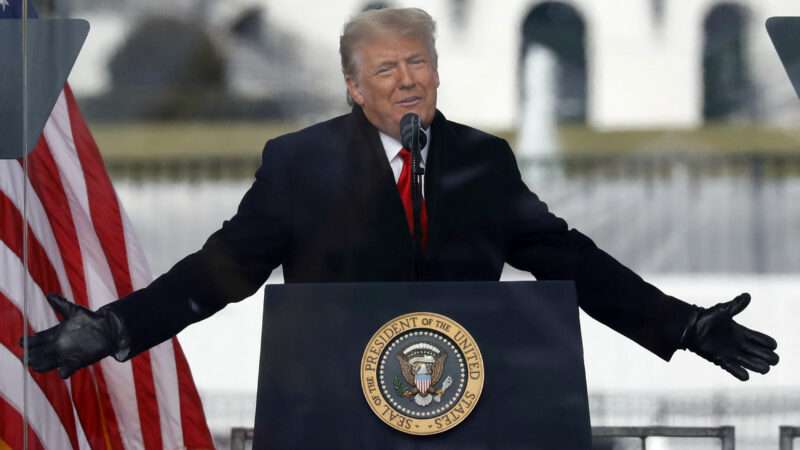
On Monday, the U.S. Supreme Court is scheduled to hear oral arguments in Murthy v. Missouri, which raises the question of when government efforts to suppress "misinformation" on social media violate the First Amendment. Neglecting that central question, The New York Times portrays the case as part of a conspiracy by Donald Trump's supporters to undermine democracy by promoting false claims that mislead voters and threaten the peaceful transfer of power.
"In a world of unlimited online communications" where "anyone can reach huge numbers of people with unverified and false information," Times reporters Jim Rutenberg and Steven Lee Myers ask, "where is the line between protecting democracy and trampling on the right to free speech?" This is not the first time that Myers has described freedom of speech as a threat to democracy. Last year, he worried that "the First Amendment has become, for better or worse, a barrier to virtually any government efforts to stifle a problem that, in the case of a pandemic, threatens public health and, in the case of the integrity of elections, even democracy itself." The purported conflict between free speech and democracy is a bizarre and highly misleading way to frame the issues raised by Murthy.