It's a familiar tale: A once-grand house finds itself in financial straits. Facing destitution, the inhabitants look around to see what they can sell (perhaps a coat?). Typically, though, selling that heirloom means parting with it – and that's where this particular tale gets interesting.
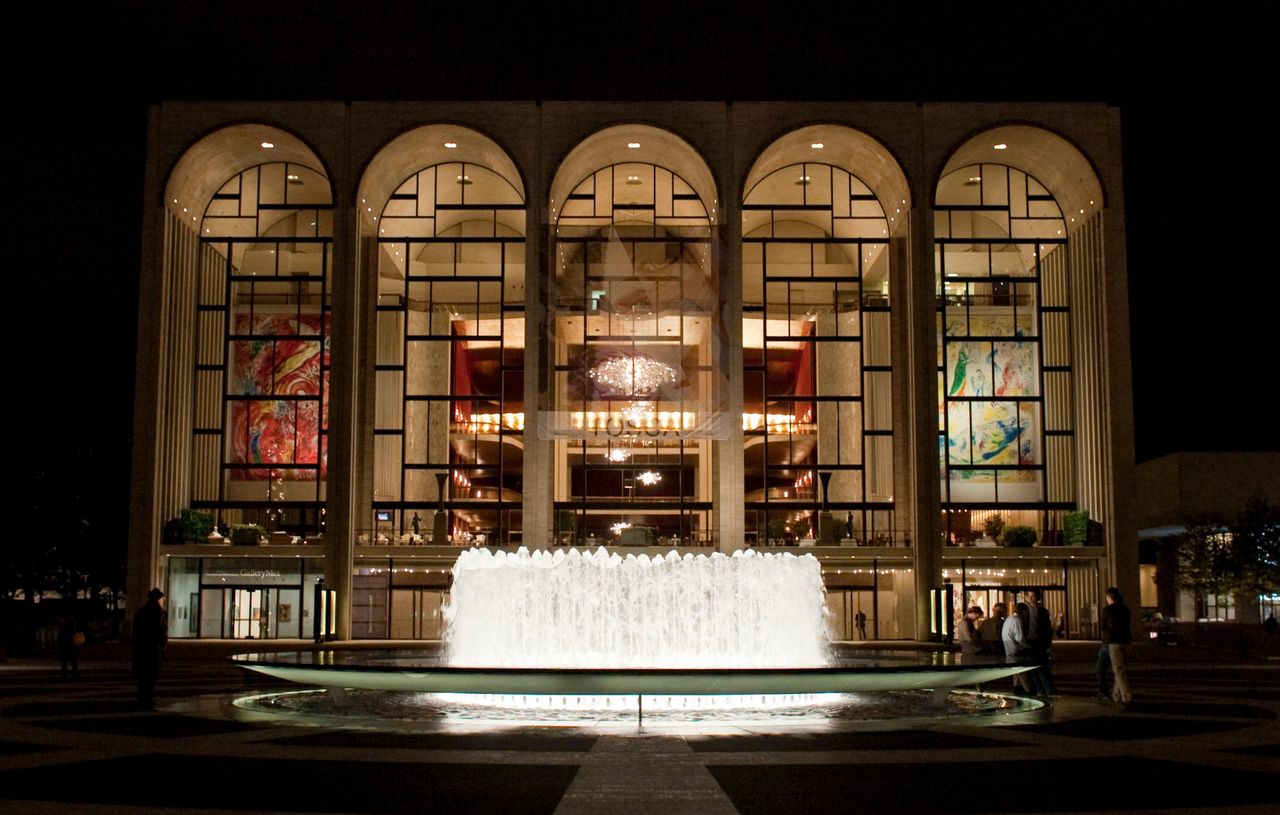
After years of financial trouble, especially in the wake of the COVID-19 pandemic, the Metropolitan Opera in New York City is taking some extreme measures. On top of layoffs, pay cuts for executives and the postponement of a new production, the Met is considering putting some assets up for sale, the New York Times detailed last week. That includes the naming rights to its theater – and the two massive murals by Marc Chagall that frame the building to the public.

Standing at a sweeping 30 by 36 feet and facing the windows to Lincoln Center Plaza, the murals, "The Sources of Music" and "The Triumphs of Music," were created for the building when it was erected in 1966 and are valued together at $55 million. Their mammoth size makes an interesting case: You'd be hard-pressed to find a buyer, especially in New York City real estate, with a 36-foot-high wall from which to display them. That's where the Met has another idea: They'd sell them, the Times reports, with the condition that the buyer agrees to leave them in place.
Theoretically, then, you spend $55 million on paintings, and all you get in return is a plaque on the wall at the Met with your name on it. So, is it worth it? That depends on what you want out of the purchase.
An eye for charitable deductions
Buying something special and not being able to actually hold it "somewhat defeats the purpose for most buyers," Thomas Ruggie, founder and CEO of Destiny Family Office in Florida, tells Kiplinger.
A sports memorabilia collector himself, Ruggie says a benefit he got out of buying a pair of Muhammad Ali's boxing trunks is that "I get to see them every time I'm in my office. It's an investment, and it increased in value, but I also get the enjoyment of seeing it, which you don't get buying stocks and bonds and private equity."

In part because of the leave-in-place stipulation, he suspects that a potential Chagall buyer would be someone whose interest first and foremost is philanthropy. But there are several ways that could play out.
For instance, a person could buy the works, hold them for a year, and then donate them back to the Met, which is a nonprofit. They could be purchased through a foundation or donor-advised fund, and you could, for tax planning purposes, purchase parts of it in different years. A buyer could also pay more than the $55 million, where additional funds are considered a donation.
If you are considering making this $55 million purchase for charitable deduction purposes, it's important to know that there have been major changes to charitable deductions in 2026, including a 35% cap for high-income donors. (Also, if you are considering making this purchase, please give me a call, I'd love to catch a show.)
Another elegant option for tax deductions is through leasing. Say you purchase the murals and, as part of the agreement to leave them in place, lease them back to the Met. What you could then do is donate the lease – so if it's valued at, say, $3 million to lease the works for a year, rather than having the Met pay, you would make the lease an annual donation. With any option, a buyer should consult with a financial adviser and tax professional to help assess what's doable.
The Chagalls as an investment
Aside from tax benefits, there's a question here about the value of the art as an investment. Of course, many people use art as alternative investments, and returns are mixed. The art market has been having a bit of a slump lately, but there were positive signs last year that it was picking up; one week in November 2025 saw auctions in New York that totaled $2.2 billion, Artnet reported.
So, are the Chagalls a good investment tool?
Well, back in 2009, in the face of the financial crisis, the Met actually did put the murals up as collateral for a loan, CBC reported. At the time, their reported appraisal was $20 million total. That amount of money is equivalent, per the Bureau of Labor Statistics, to about $30 million today, adjusting for inflation. That means, given the $55 million valuation, the murals' value has outpaced inflation.
But was that a better bet than investing in the stock market? No. If you'd instead invested $20 million in the S&P 500 in spring 2009, you'd have somewhere in the region of $150-200 million now.

Plus, in order to get the increased value of the art after owning it for some time, you'd need to find someone to buy it – likely with the same stipulation that it remain in place in the opera house, which creates a more limited pool of buyers, Ruggie points out. (There is a possibility that the art is sold not as a whole, but in fractional investments. That would open it up to a wider buyer pool and create a different kind of market for it.)
Even so, he says, these works are "blue-chip investments. The price can fluctuate, but long-term, Marc Chagall's going to hold, maintain and in all likelihood, at least in the long-term, increase in value."
Somewhat ironically, that's especially true because of their location. The fact that they're the Met Opera Chagalls that everyone can see from Lincoln Center Plaza gives them more prestige, which increases their value, rather than if they were on private display.
And one more point on the murals as investments – as the Met did, you could theoretically use them as collateral on a loan. That could be useful in the event of a liquidity issue or if another opportunity came up that made a loan useful, if allowed under the purchase stipulations.
Other considerations for the Met's Chagalls
There are some beyond-monetary benefits to buying the Chagalls. For one, you get ownership without the hardship and logistics of caring for art. Because the Met will continue to house them, you know they're already well-maintained in a secure, climate-controlled environment, where a lease or other agreement could include them covering insurance.
One would also hope that the person buying the Chagall murals actually likes them, which is a different type of value. They're not to everyone's taste – Cher, as Lorettta in Moonstruck, famously declared them "a little gaudy," while Nicolas Cage's Ronny thought Chagall was "having some fun." You can see an informational video about them here.
Then there's the prestige of it. Buying the murals could raise your social capital and help place you in certain circles. It's akin to making a donation to get your name on a building – how much that's worth, really, is up to you.
While there are financial considerations, what's at stake here is art, whether you love Chagall or opera or architecture. The Met is clearly in a crunch. The institution dipped into its endowment in the wake of the pandemic and was relying on a deal with Saudi Arabia, which is apparently in flux, per the New York Times' reporting – leading to the measures being taken now, which have struck many in the opera-loving world as existentially alarming.

As a finance publication, Kiplinger would recommend an individual in this position take steps the Met is now taking. Rein in your expenses and find reasonable ways to increase your liquidity so you can stop dipping into your savings. With a $330 million annual operating budget, a $55 million sale would help, especially if smartly utilized, although there are also risks to selling the paintings, as the Wall Street Journal detailed.
But it would only help in the longer-run if the Met keeps costs down and increases revenue, whether through ticket sales, smart gambits like renting out the theater, or philanthropy, to find some stability. That's a tricky proposition, as the Met is physically one of the largest opera houses in the world, which makes operating costs higher, and, let's face it, opera is not a hot ticket – the 3,800-seat theater sold at 72% capacity the last two seasons, the Associated Press reported.
Opera houses in Europe typically get more governmental support, but American houses rely more on private donors. San Francisco Opera is now getting $5 million a year from Nvidia (NVDA) CEO Jensen Huang; Lyric Opera in Chicago got $25 million last year from philanthropist Penelope Steiner; Dallas Opera just pulled off a $54.5 million fundraising campaign, thanks in large part to a $25 million matching gift challenge from the O'Donnell Foundation.
For someone who would've made a major donation anyway, the Chagalls actually do represent a unique opportunity – you get an asset in return, even if you can't see it in your home every day. Is that worth it? The answer, in this case, is somewhat intangible.