A Bird the Size of a Fist, With a Call That Carries
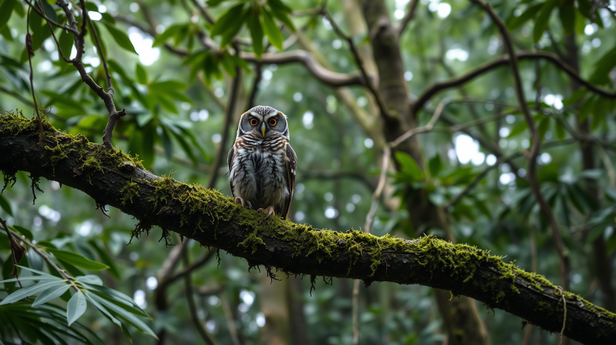
The jungle owlet (Glaucidium radiatum) measures roughly 20 centimetres from bill to tail and weighs between 75 and 110 grams, lighter than most smartphones. It is endemic to the Indian subcontinent, found across the Western Ghats, central Indian forests, the Shivalik foothills, and pockets of deciduous woodland from Rajasthan down to Sri Lanka's border. Unlike most owls, it is partly diurnal: it hunts and calls in the late afternoon, which is why birdwatchers in Satpura or Bandipur often hear its rapid, churring kurroo-kurroo before they see it perched, upright and unblinking, on a bare branch at eye level.

Its small size is not a disadvantage. The jungle owlet preys on large insects, lizards, small frogs, and occasionally small birds, a diet that positions it squarely in the middle of the forest food web. It is a predator, but also prey for larger raptors. That dual position makes it a sensitive register of what is happening above and below it in the food chain.
What Makes It a Forest Health Indicator
Ecologists use the term "indicator species" for animals whose population status reliably signals the condition of their environment. The jungle owlet qualifies on several counts. It nests in natural tree cavities, old woodpecker holes, hollow branches, which only exist in mature, undisturbed forest. Plantations of eucalyptus or teak monoculture, which have replaced large tracts of natural forest in Karnataka and Madhya Pradesh, offer no such cavities. The owlet simply does not breed there.
A 2019 study published in the journal Oryx, examining bird communities across forest fragments in the Western Ghats, found that cavity-nesting species, a group that includes the jungle owlet, were among the first to vanish from degraded or fragmented patches, even before larger, more conspicuous species showed decline. Their absence flagged habitat deterioration that ground surveys alone would have missed. The owlet's dependence on old-growth tree structure means its presence confirms not just that trees exist, but that the forest has had time to age.
Its prey base adds another layer of sensitivity. Healthy insect populations require intact leaf litter, functioning soil, and minimal pesticide runoff, conditions that collapse quickly when forests are thinned or when agricultural land pushes to the edge. A jungle owlet hunting successfully is evidence that several rungs of the food web below it are still functional.
The Threats Compressing Its Range
The jungle owlet is currently listed as Least Concern on the IUCN Red List, which is accurate at the species level but can obscure what is happening locally. In the forests around Pench and Kanha, naturalists report stable sightings. In the fragmented scrub forests of Andhra Pradesh's Eastern Ghats, the bird is increasingly difficult to find. The difference is not the owlet's adaptability, it is the degree to which the forest has been broken into disconnected patches too small to support the full prey and nesting structure the bird requires.
Habitat fragmentation is the primary pressure. Roads, powerlines, and agricultural expansion cut forest into islands. The jungle owlet does not cross open ground readily; it moves through canopy. An isolated patch of 20 hectares can hold a pair temporarily but cannot sustain a breeding population over generations. Forest fires, increasingly frequent in dry deciduous zones of Maharashtra and Chhattisgarh, destroy the standing dead wood that cavity-nesting birds depend on. Legal and illegal timber extraction removes precisely the oldest, largest trees, which are the ones most likely to carry the hollows the owlet needs.
How Birdwatchers and Citizen Scientists Are Filling the Data Gap
India's formal wildlife monitoring system covers tigers, elephants, and a handful of other Schedule I species in detail. Small birds occupy a different category: they are numerous, mobile, and difficult to census at scale. The gap has been partly filled by citizen science platforms, particularly eBird India, which aggregates sightings from birdwatchers across the country. The jungle owlet has tens of thousands of logged observations on eBird, and the data reveals something useful: the bird is consistently reported from forested areas with a closed canopy and low human disturbance, and almost never from open or degraded sites within its known range.
This kind of presence-absence mapping, built from amateur observations rather than formal surveys, has become a practical tool for conservation planners. When a forest patch stops generating owlet sightings over multiple seasons, that absence is a signal worth investigating, not because the owlet is rare, but because its disappearance from a previously occupied site suggests the site has crossed some threshold of degradation.
What Protecting the Owlet Actually Protects
The jungle owlet does not need a dedicated conservation programme. What it needs is old forest, forest with large trees, intact canopy, functioning insect communities, and enough connected area for birds to move between patches. Those conditions are not specific to the owlet. They are the same conditions that support leopards, giant flying squirrels, Malabar pied hornbills, and hundreds of invertebrate species that never appear on any watchlist.
Protecting the habitat the owlet requires is, by definition, protecting a functional forest. This is the practical value of indicator species: they give conservationists a concrete, observable target that stands in for a much larger set of ecological conditions. A forest where the jungle owlet breeds is a forest doing its job, cycling nutrients, holding water, sequestering carbon, and supporting the biodiversity that makes all of that possible.
The owlet's call at dusk is not a rarity to seek out. It is a reading, and the forests that still carry it are telling you something the satellite maps and timber surveys cannot.