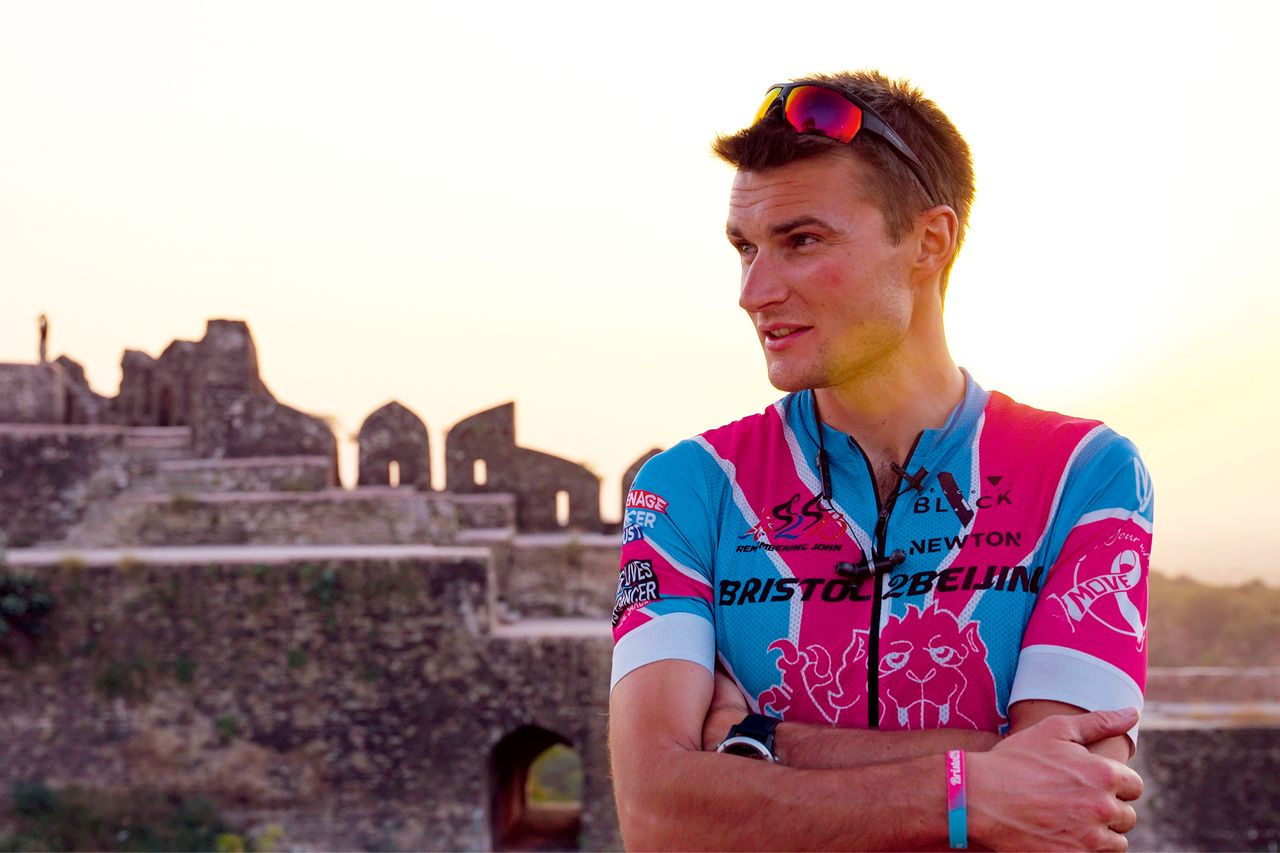
The ache in his shoulder had been lingering for months, but Luke Grenfell-Shaw, just 23 at the time, shrugged it off as not worth fretting about. Besides, he was too busy to worry, working as an English teacher in Siberia, Russia. Each day began with a run around the park, followed by a short bike ride to the school. He remembers not being able to lean back in his chair without wincing in pain. Eventually, it got too bothersome and he sought out the school nurse, pulling up his shirt to expose the painful shoulder. Her reaction – “oh my God” – confirmed this was no normal ache.
Curious to see what was so shocking, Grenfell-Shaw stood in front of a mirror and took a photo of his back. His left shoulder, he could see, bulged like a powerlifter’s – far bigger than the opposite side. “Ah, that doesn’t look right,” he remembers thinking – still not panicking. Within two days, however, he was back in the UK receiving a life-changing diagnosis: the lump was a rare form of cancer that had metastasised to his lungs and was now stage four – advanced and aggressive. The doctors called it a malignant peripheral nerve sheath tumour, and the medical literature did not offer much hope.

“You can see the survival rates for yourself,” he tells me, not wanting to repeat the figures. Patients with this type of cancer typically have a less than 50% chance of surviving beyond five years. Grenfell-Shaw received a prognosis of months – “two years maximum” – and yet, that was eight years ago, in 2018. Come his 26th birthday, in 2020, he was riding a tandem across the world, from his hometown of Bristol to Beijing in China, raising money for cancer charities. “I didn’t know if I’d live to the end of that year [2020],” he says. “The fact that I’m alive now is totally remarkable, and immensely...” his voice stalls. “I’m just very, very lucky. By luck more than anything else, I’m still here.”

Worst news imaginable
Grenfell-Shaw, now 31, is speaking to me over video call from Guangzhou, a three-and-a-half hour flight south of the Chinese capital, where he is visiting his girlfriend. Casting his mind back to the day he received “the worst news imaginable”, he begins to chuckle. “I’m laughing about it now because that’s the only thing you can do,” he says. “Your world breaks down. [It's] nothing less than a death sentence, being told you’re going to die [and that] your time is very limited. There’s nothing you can do about it. I was just crying. It felt like an abyss.”
From that deep pit, however, came a small epiphany. “That same day, my dad and I went for a run, and he said to me: ‘You don’t have a choice about whether you’ve got cancer, but you can choose how you live with it’,” Grenfell-Shaw remembers. “I wanted to live in a way that I believed would give me the best possible chance of survival.” That meant keeping as active as he could.
Already an avid runner and cyclist since childhood, Grenfell-Shaw cycled to and from each of his six rounds of chemotherapy, and set up a turbo trainer in the hospital ward so he could spin his legs while his arm was rigged up to the drip. Midway through his treatment, he ran the Bristol Half Marathon, clocking 80 minutes – a good time for a fully fit amateur, let alone one with stage-four cancer.
Once he had finished chemo, Grenfell-Shaw set about organising his tandem ride to Beijing. He would take the front, leaving the stoker’s seat empty for whichever family, friends or strangers felt moved to join him along the way. “If I only had one year left to live, then that was probably the most interesting, experience-filled way of living it,” he reasoned.
The story of the ride is told in the documentary A Life in Tandem (available to watch for free on YouTube from 8pm UK time today), in which Grenfell-Shaw speaks candidly about his diagnosis, the sudden death five weeks later of his older brother John, aged 25, on a hiking trip in the Lake District – “when John died, I knew I had to survive” – and his parents’ subsequent separation. It is a story of a family’s remarkable resilience in the face of unimaginable adversity.
Leaving his old school in Bristol on New Year’s Day 2020, Grenfell-Shaw headed east through Europe, beyond Ukraine, Turkey and Kazakhstan, across Central Asia, and south into India. Covid restrictions prevented him from crossing into China, halting his dream of reaching Beijing. He flew back to the UK and completed the 30,000km distance as a fundraising effort on a turbo trainer. The whole adventure took two-and-a-half years, and saw him accompanied by more than 800 people on his tandem – including a standout character of the documentary, a 17-year-old called Dev who joined him for 1,000km across India. In total, the campaign raised £131,000 for charity and earned Grenfell-Shaw an MBE in 2024.

Take two
Beijing remained the totemic goal for Grenfell-Shaw: a symbol of how far he could go after being told he had just months to live. He returned to normal life after his tandem ride in summer 2022, but in the years since, he says, something felt “incomplete”. That’s why, last October, he took his gravel bike and tent, and bikepacked the remaining leg – 5,600km from Tashkurgan in China’s west, skirting the Gobi Desert through snowstorms and biting wind, to Tiananmen Square in Beijing.
“I was covering my feet in plastic bags to keep them warm,” he says. “At night, it seemed like the wind would find every single gap between the tent and the ground. It was freezing.”
Grenfell-Shaw arrived at China’s Forbidden City last December, just days before Christmas. After six years of waiting, it was set to be a momentous arrival. Then, 100m from his finish line, a police checkpoint threatened to spoil the party. “It was quite funny,” he says as he remembers asking the officials, “Do you really want me to get out my tent and my sleeping bag?” Eventually, after a tense back-and-forth, they let him through. He recalls attempting to take photos in Tiananmen Square, scene of the 1989 student uprising. “I only stopped for two seconds, and they [the police] were shouting at me.”
The moment may have been rushed, but it didn’t dampen the “deep, deep sense of satisfaction” of having finally arrived in Beijing. “It wasn’t the feeling of closure that was [strongest],” he says. “It was the feeling that I could start something new. The next chapter could now begin.”
Life as a pro
Today, Grenfell-Shaw’s cancer is in remission, his six-monthly scans clear. “That’s very atypical, and not what the doctors expected,” he says, then pauses and smiles. “But, I’m still here. I’m fine right now.” Not only is he fine, he is now a professional athlete. The figure in front of me on the screen is wearing bluetooth earphones, a colourful sports watch, and an orange running jacket from his sponsor, Brooks. Grenfell-Shaw is a full-time trail-runner and spends his days training and racing in off-road ultra-marathons. He has even represented Great Britain at the Trail Running World Championships.
“Running had always been my first love,” he says, “which you don’t need to publish in Cycling Weekly.” During his recent two-month cycle across China, he ran for an hour every morning, before then riding his bike for up to eight hours – “that’s my off-season training block,” he smiles.
“I remember when I was about 19 or 20 writing in my diary a few goals I wanted to achieve by the time I was 30, and one of them was to become a professional Ironman triathlete,” he says, identifying the seed of his current exploits. That ambition fell away after the doctors removed the milk-bottle-sized tumour and surrounding muscle, surgery that left his swimming ability “subpar” – and an eight-inch scar. “I’m trying to re-orientate my life towards looking more to the future,” he says.
As we come to the end of our conversation, I ask Grenfell-Shaw if there’s a lasting message he hopes others will learn from his story. “It took me having cancer and my brother dying for me to take risks to go and live my dreams,” he says. “I suppose what I’d like people to take away is: make those changes that you feel the voice inside is telling you and you'll be happier doing what you really want to be doing. Follow those voices, actively shape your life’s path, make those tough decisions.” Having cycled across the world, he intends to keep making those tough, rewarding decisions for many years yet.

Friend's view: TJ Mitchell
TJ Mitchell, a university friend of Grenfell-Shaw’s, joined for three weeks during the initial ‘Bristol2Beijing’ tandem ride, crossing Pakistan.
When Mitchell first found out about Grenfell-Shaw’s diagnosis, he struggled to believe it. “I’d never had a friend or family who’d been through cancer, so, naively I assumed, ‘He’ll be fine. He’s Luke’,” says Mitchell. “He’s incredibly charming, he’s charismatic, he’s very handsome. He can speak English, Russian and Arabic, and he’s a scientist. If anyone was going to be a secret agent, it would be Luke. He always just seemed like an all-round super guy.”
Reflecting today on what his friend has achieved in the last seven years, Mitchell says he feels enormous pride. “I think it’s really remarkable to be able to do that and come out of it as a professional athlete,” he says. “He’s one of the people in my life that I always champion. If I was going to a dinner party, Luke would be one of the top three guests I’d always want to bring with me. [His story] shows that the world is scary, but it doesn’t really have to be. You can seize the day. You can go on an epic adventure.”
A Life in Tandem premieres for free on YouTube at 8pm UK time this evening, 26 February.
This feature originally appeared in Cycling Weekly magazine on 19 February 2026. Subscribe now and never miss an issue.







