Get all your news in one place.
100's of premium titles.
One app.
Start reading
Golf Monthly
Golf Monthly
Sport
Roderick Easdale

The Essential Accessory Guide For The Modern Beginner

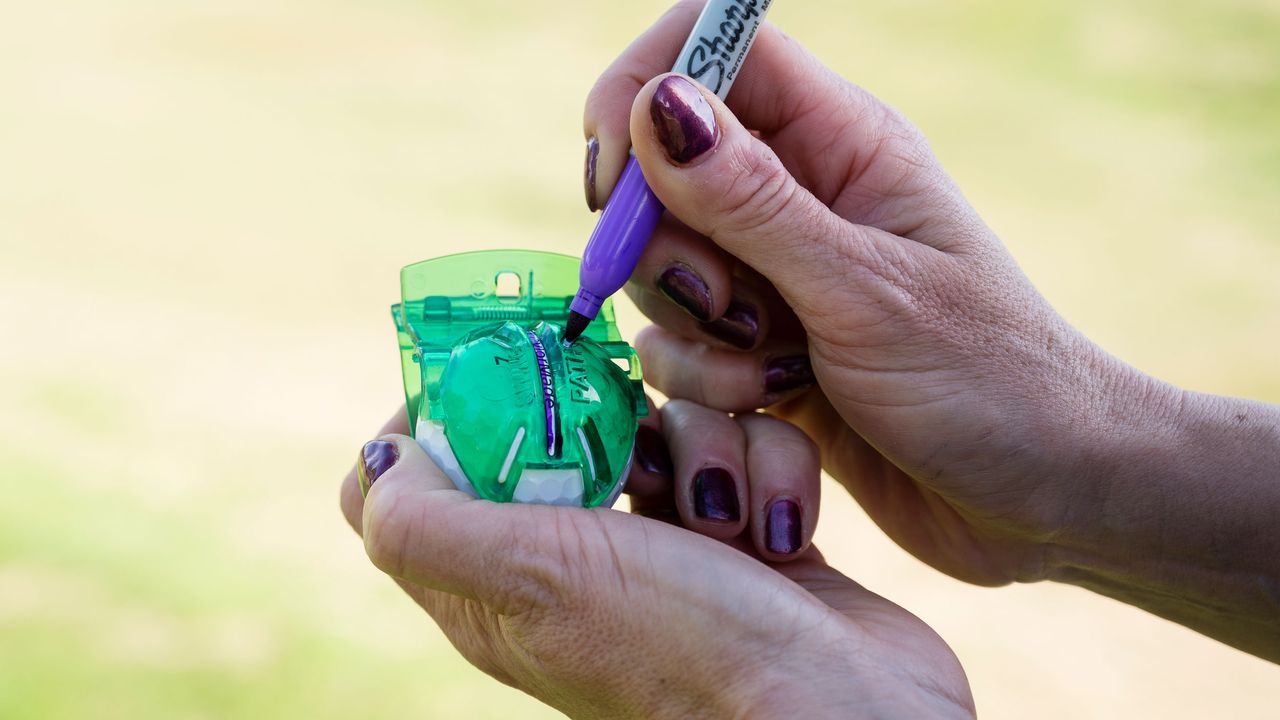
Sharpie and stencil being used to draw a line on a golf ball.

There is so much golf gear out there that is quite confusing for the beginner to work out what they will find most useful when they are starting out. So we have canvassed our experts and this is the collation of the most common suggestions.


Single-prong pitchmark repairer

(Image credit: Future)

Repairing pitchmarks is a good way for the beginner to show they understand golf and make them welcome at someone's else course or club.

When a ball lands on the green from a height, especially on soft greens, it will often leave a dent in the green, a pitchmark. If you repair a pitch mark straight away, it will start to recover within 24 hours. If that indent is left unrepaired for 24 hours, however, it can take as long as three weeks to repair itself.

Traditionally pitch mark repairers were made of two prongs, but now a single prong is favoured because it reduces the risk of breaking grass roots. Two-prong tools can tear the turf at the bottom, whereas a single-prong tool forces golfers to move turf together rather than just lifting the surface, resulting in a smoother, faster-healing putting surface.

Towel

(Image credit: Future)

A golf towel can be clipped onto your bag and used to clean the ball when you have fished it out of somewhere you’d rather it had not gone, such as a water hazard, when you clean the ball when it is on the green (you’ll need a ball marker for this operation – see below) or to clean the clubface after hitting from a muddy lie or a bunker. Or it can be used simply to dry your hands.

Golf towel technology has evolved and some golf towels, such as the trifold Under Armour towel feature two different sections – a plush section for water absorption or polishing, and a textured one for cleaning loose dirt or mud off your equipment.

Ball marker

(Image credit: Mental Markers)

When your ball is on the green, you can mark it and pick it up to clean it, as any dirt, grit or mud on it can affect the roll of the putt. Also, if your ball is at risk of being hit by another putt (which will incur a two-shot penalty for that player) you should mark it.

A ball marker could simply be a coin you have in your pocket, if indeed you are one of the dying breed who still carry coins. But there are also purpose-made ball markers, including those which unclip from a cap or from a divot repairing tool. Some, like those pictured above, even have reminders of things to focus on while others, like the Trident Align, can help with aim on your upcoming putt.

Castle tees

(Image credit: Getty Images)

The drive is what most beginners care most about; indeed many golfers do, whatever their experience. It is the shot all your playing partners see, and on the 1st tee, sometimes others waiting around, too.

A castle tee, sometimes also called an hourglass or eggtimer tee, will ensure that you consistently tee the ball up at the same height each time for more predictable results. They are colour-coded by height with pink or orange designed for the driver and shorter red or green for lofted woods and irons.

GPS device

(Image credit: Shot Scope)

Knowing the distance to the target can be key to a good shot, but judging distance is not necessarily an innate skill in all humans, least of all those starting out in golf. So a way to train oneself is to use a GPS device which will give you the distance to the target.

But, almost as useful, is how many GPS devices or golf watches can also track shots with the help of GPS tags, and measure your last shot. This helps give you an idea of how far you hit the ball with each club, thereby giving you a better understanding of your game.

It can also help in locating lost balls. I have often played with beginners who had hit their drive off into the rough and have gone to look in the wrong place for it, and I have had to gently point out that they are looking about 30 yards further on than they usually hit the ball, so they are unlikely to find their ball there!

Putting mirror

(Image credit: Getty Images)

This training aid will help you tell whether the putter face is square on to the intended target line and whether you move the putter straight back and through during the stroke.

They can also provide invaluable feedback of your eye position and are generally a very useful tool to have and use to engrain a more consistent putting stroke.

Sharpie/Stencil marker

(Image credit: Future)

A Sharpie is a pen that will put a mark on a ball that is clearly visible and will not wear off quickly. Golfers use it to place a mark or their initials on a ball so they can recognise it as their own, which is particularly handy if two golfers in your group are using the same make of ball, or when searching for your ball in areas where others have previously lost balls.

A stencil mark on a ball can help to line up putts and see how the ball rolls after you have hit it. Unlike in other sports, golfers are allowed to realign their ball on the putting green (or the tee) and using a line helps to point you in the right direction. Also using a mallet putter, which typically has extra alignment cues, is a good idea for beginners.

Alignment sticks

(Image credit: Future)

These sticks are extremely versatile and simple training aids. Alignment sticks can help with all sorts of drills, and even warm-up routines. They are very good when on the ground at reinforcing fundamentals like alignment but can also be used to encourage a certain swing path. Having a couple of these in your bag at all times is a good way to ensure your practice enforces good habits.

Synthetic golf glove

(Image credit: Future)

Synthetic golf gloves are generally kinder on the wallet than leather alternatives and last longer. Designed to perform well in wet, rainy, or humid conditions, they offer a strong, tacky grip in conditions when leather becomes slippery or stiffens.

Because they are durable and often feel less restrictive, they are excellent for beginners. The downside is that they offer less feedback from the club for experienced players.

Cap

(Image credit: Getty Images)

A cap has many benefits. Prime among them is the protection it offers against the weather, hopefully the sun, but also the rain. The peak of the cap also helps improve vision clarity in bright conditions.

So there you have it, the essential accessories for the modern beginner. Did we miss any? Let us know in the comments.

Sign up to read this article
Read news from 100's of titles, curated specifically for you.
Already a member? Sign in here
Related Stories
Top stories on inkl right now
Our Picks
Fourteen days free
Download the app
One app. One membership.
100+ trusted global sources.