
Get all your news in one place.
100's of premium titles.
One app.
Start reading
Motor1
Motor1
Business
Jonny Lieberman

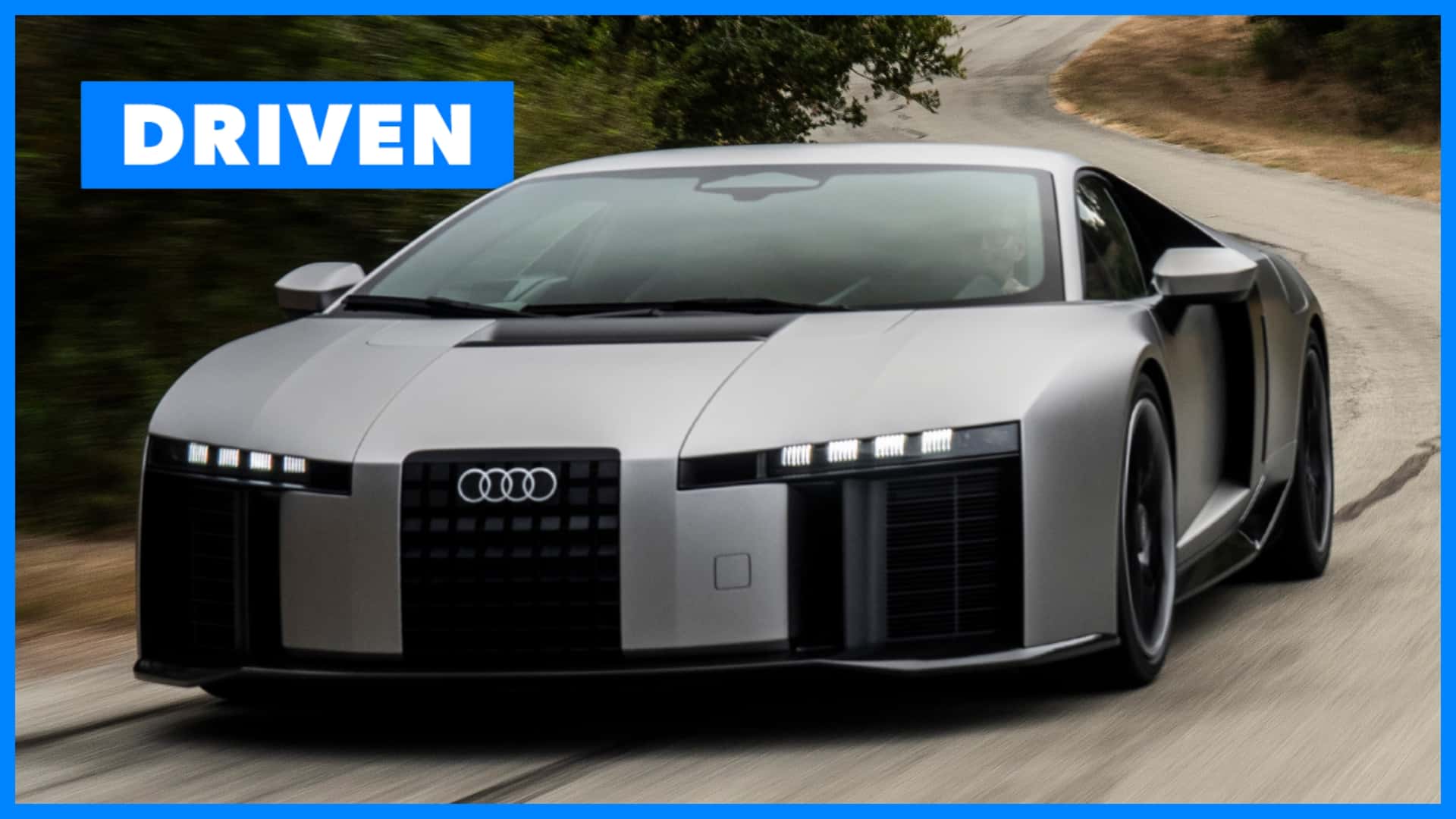
The Audi Nuvolari Is Supercar Excess At Its Best: Driven

Audi made the internet heave when it introduced its Nuvolari halo car in June. A sibling to the Lamborghini Temerario, the Nuvolari heralded the news that Audi has reversed its decision to quit building internal combustion engines.

What an engine to reverse course with: displacing 4.0 liters and being force-fed by two turbochargers, the V8 produces 789 horsepower and revs to a glorious 10,000 rpm. One more time, 10K with turbos!

Plus, there are three axial-flux motors—two on the front wheels and one pancaked between the engine and transmission—that bring the total system output to 987 hp, the same as the Bugatti Veyron made when new (1,001 PS = 987 hp). Not bad for the same company that makes the A3.

Pros

  • Nearly 1,000 Horsepower
  • Screaming V8
  • Excellent Ride Quality

Cons

  • Astronomical Price Tag
  • Still Too Early To Tell…

Audi's $700,000 Flex

The Audi Nuvolari is many things. First and foremost, it is by far the most expensive street car Audi has ever produced. Based on today’s exchange rate, we’re talking $701,000. Though by the time the car is actually delivered to American customers in early 2028, the price will probably be a touch or two higher.

Let’s not forget options, either. If the Lamborghini Temerario is any sort of guide, add-ons for the Nuvolari won’t be cheap. Odds are that many of them will transact at around $1,000,000, a huge number for the brand. The Nuvolari is also the first limited edition, with only 499 units up for sale.

An Audi supercar being a twin of a Lamborghini is nothing new. Think back to the first-generation R8 and the then-contemporary Lambo Gallardo. The second-generation R8 arrived with the introduction of the Huracan. In a bit of role reversal, the Nuvolari is now positioned above the contemporary Temerario, in terms of price, power, and presumably prestige.

Other differences include carbon fiber body panels, as opposed to the Temerario’s aluminum ones, and three-way, or pre-programmed dampers from suspension specialists KW. Also, the Audi sports a "radically simplified" interior, though unlike the Concept C prototype, one with hard points defined by the Lamborghini. There’s an angled touchscreen, for example, instead of a slick, disappearing screen like the one in Concept C.

A Temerario With Manners

Climbing behind the steering wheel, you’d really have to know what a Revuelto or Temerario’s wheel looks like to make the connection. You’ll find the same four key button layout as the Italian cousins. One of the buttons even has a red bezel, but that’s been relocated from the upper left to the lower right-hand side of the wheel.

The rest of the cabin is essentially night versus day. Most Temerarios seem to be done up in the full Lambo—patterns and bold colors and loud stitching. The Nuvolari is calm, Teutonically cool, and for the money, perhaps too simple. That said, I dig the big hunks of aluminum that make up the door handles. Just like those in the Concept C, which hopefully fully previews all future Audis.

The Nuvo I’m in is number 000 out of 499; it’s a pre-production car. According to Audi, it’s about 98.5 percent representative of what the production car will be like. That said, it’s the only roadworthy example on planet earth in the middle of August 2026.

I’m instructed to leave all the nannies on; "please don’t push the car." Also, the private road we’re on is actually a neighborhood. Not only that, the road is old and narrow. So, this is not a full, complete review—expect to read that in a year or so.

All of that out of the way, what an intriguing supercar.

The Nuvolari makes around nine percent more horsepower than the Temerario, all via those aforementioned three electric motors. At the pace I’m driving, there’s no way I can feel the difference. We’re not doing launches or roll racing—not that kind of morning.

That said, I remember being on the launch of the Temerario in Portugal on the Estoril Circuit, hitting 190 mph on the front straight, and being freaked out at how quick it was. Adding extra electric torque that will get you going even quicker? I think the technical term for that is: nuts.

The Nuvolari is calm, Teutonically cool, and for the money, perhaps too simple.

The big wheels are shod in the same rubber as the Lambo—sticky custom Bridgestone Potenza Sports. Not that I’m getting anywhere near the limit, but I’m sure the grip is prodigious.

One major change up is the ride quality. Audi and Lamborghini did a hell of a job differentiating the R8 from both the Gallardo and Huracan. Even a true cynic would admit the two cars drove very differently, despite sharing a body-in-white and a powertrain.

Audi’s gone even further here with the fancy KW dampers. The ride quality is more mature; just as sporting as the Lamborghini, but any excessive body movement—that delivers the sort of thrills a Lamborghini driver is surely seeking—is ironed out. This, says Audi, is partially the result of the “Quattro predictive ride” that uses all sorts of fancy computing power to manipulate individual wheels in terms of torque flow and braking, as well as select the appropriate preset for each individual KW shock.

Whatever the tech, the result is an imperious feeling of road ownership. Quite impressive.

Verdict: Ask Us Again Later...

It’s difficult to draw any concrete conclusions—beyond superior damping—from my short, not fast enough, supervised drive of the Nuvolari. Based on what I know about the Temerario, adding power, lightening it via carbon fiber, and improving the dampers can only add up to an extraordinary driver’s car. I just can’t say for certain at this point—I am, however, 98.5 percent sure.

What I’m also sure about is getting to see a Nuvolari in any color other than silver. I know it’s a German / Audi thing, but come on; grayscale is inherently dull. After speaking with a member of the Nuvolari’s design team, I was assured much more colorful versions are coming (whatever the owner wants is totally possible), including exposed and colored carbon, as well as a livery inspired by Audi’s nascent F1 team.

What I am left wondering is how we classify the Audi Nuvolari? Hypercar? Supercar? Baby Hypercar?

It’s difficult to draw any concrete conclusions—beyond superior damping—from my short, not fast enough, supervised drive of the Nuvolari.

The Bugatti Veyron is generally considered the world’s first hypercar, just like how most folks agree that the Lamborghini Miura is the first supercar. Several factors went into the Veyron getting the title: four-digit horsepower, seven-figure price tag, limited production, a top speed well over 200 mph, and a bespoke chassis not shared with any other car.

The Audi Nuvolari ticks three of those boxes (1,001 PS!) but misses two because of its shared chassis and relatively low price tag. Will any of that matter to the 499 owners? Doubtful, but time will tell. Time will also reveal exactly how the Nuvolari drives.

Consider the above an educated guess until then.

Gallery: Audi Nuvolari First Drive Review

2028 Audi Nuvolari Specs

2027 (Europe); 2028 (US) On Sale $700,000 (est.) Base Price 2 Seating Capacity 5 Miles (est.) EV Range 217+ Miles Per Hour Maximum speed 2.6 Seconds Speed 0-60 MPH All-Wheel Drive Drive Type Eight-Speed Dual-Clutch Automatic Transmission 987 Horsepower Output 7.3-Kilowatt-Hour Lithium-Ion Battery Three Axial-Flux Electric Motor Twin-Turbocharged 4.0-Liter V8 Plug-In Hybrid Engine
Sign up to read this article
Read news from 100's of titles, curated specifically for you.
Already a member? Sign in here
Related Stories
Top stories on inkl right now
One subscription that gives you access to news from hundreds of sites
Already a member? Sign in here
Our Picks
Fourteen days free
Download the app
One app. One membership.
100+ trusted global sources.