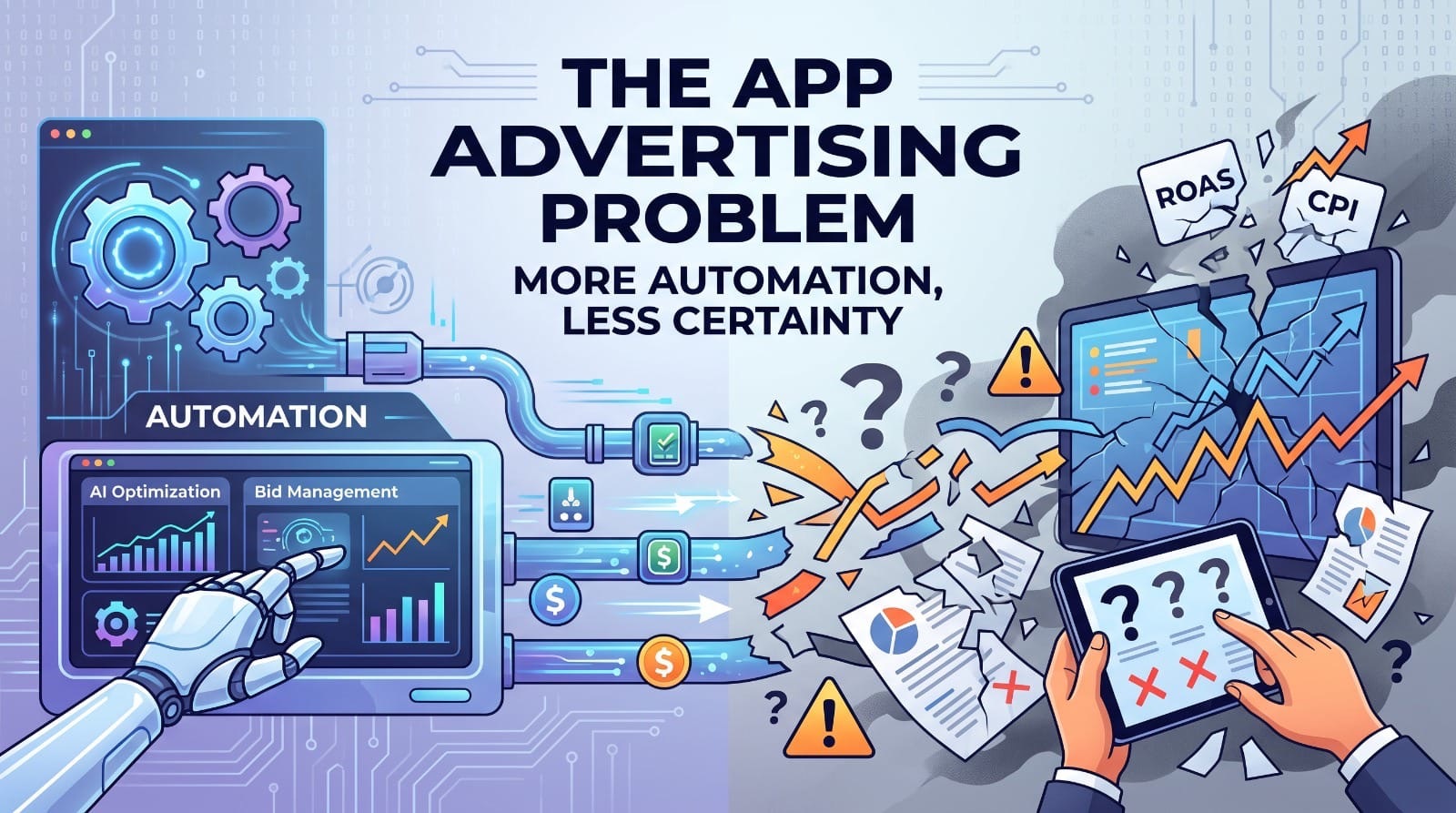
For an industry built around measurement, mobile app advertising has entered an unusually uncertain period.
Marketers have never had more technology at their disposal. Media buying is increasingly automated. Creative production can be accelerated with generative AI. Campaigns can be launched globally in hours. Machine-learning systems can process behavioral signals at a scale no human media buyer could reasonably match.
Yet ask an experienced growth team a deceptively simple question — Which part of your advertising budget actually created your most valuable users? — and the answer is often considerably less precise than the dashboards suggest.
That contradiction defines app marketing in 2026. Advertising platforms have become better at finding users, while marketers have become less certain about why those users arrived, which advertising exposure deserves credit, and whether a low-cost acquisition today will become a profitable customer six months from now.
The problem is no longer simply buying media efficiently. It is building enough reliable information around an increasingly automated advertising system to know what “efficient” actually means.
The Install Is Losing Its Status as the Primary Outcome
For much of the mobile advertising industry's history, cost per install was an intuitive performance metric. An advertiser spent money, someone clicked an ad, downloaded an application and appeared in an attribution report.
That model was never perfect. Today, it is increasingly inadequate.
An install tells a company that a user was persuaded to download something. It says very little about what happened afterward.
A campaign producing $1.50 installs may look substantially better than one producing $4 installs until the cohorts are examined. If the inexpensive users disappear after the first session while the more expensive group completes onboarding, subscribes and remains active three months later, CPI has not merely provided an incomplete picture. It has pointed management toward the wrong conclusion.
This is why sophisticated app marketers increasingly think in terms of post-install economic behavior: activation, retention, subscription, purchase frequency, revenue and lifetime value.
“The install used to be treated as the finish line of mobile advertising. It should probably be treated as the starting line,” says Andrii Zhurylo, founder of Dijust Development, a Cyprus-based company. “You can optimize an acquisition campaign until the CPI looks beautiful, but if those users do not produce meaningful product activity afterward, you have optimized the appearance of performance rather than performance itself.”
This distinction becomes particularly important when automated advertising systems are instructed to pursue the wrong event. An algorithm asked to generate inexpensive installations will become exceptionally good at finding people likely to install applications. That does not necessarily mean it will find people likely to become profitable customers.
The optimization event, therefore, is increasingly a strategic decision rather than a technical campaign setting.
Attribution Has Become Probabilistic
The second major change is measurement itself.
Apple's privacy architecture illustrates the direction of travel particularly clearly. Apps that track users across other companies' apps and websites must obtain permission through AppTrackingTransparency. At the same time, Apple's AdAttributionKit provides privacy-preserving campaign measurement without requiring individual cross-app tracking. The system deliberately limits some attribution information and applies privacy thresholds to certain data returned to advertisers. citeturn0search0turn0search2
That is an important distinction. Advertising measurement has not disappeared. But the expectation that every advertising interaction can be connected deterministically to an identifiable user journey is increasingly incompatible with the architecture of major consumer platforms.
Apple says AdAttributionKit now forms a substantial part of the App Store advertising ecosystem and uses mechanisms including crowd-anonymity thresholds and restrictions on the information returned to advertisers. citeturn0search1
For marketers accustomed to user-level attribution, this represents more than a technical migration. It requires a different philosophy of measurement.
A customer might encounter a video advertisement, ignore it, see the brand again several days later, search for the product, visit its website, read reviews and eventually find the application directly in the App Store.
The eventual installation is real. So is the advertising influence. But the neat linear journey presented by traditional attribution models may never have existed outside the analytics interface.
Different systems can consequently produce different versions of the same customer journey. The advertising network reports one number. A mobile measurement partner reports another. The App Store provides another set of signals. The company's own backend records actual registrations and purchases.
The instinctive reaction is to ask which number is correct.
Increasingly, the more useful question is whether the combined measurement architecture is reliable enough to make a business decision.
The Algorithm Is Only as Intelligent as the Signal It Receives
Automation has changed the role of the performance marketer just as profoundly.
Campaign managers once spent considerable time adjusting bids, placements, audience definitions and other tactical variables. Advertising platforms now perform much of that work algorithmically.
The apparent bargain is attractive: give the platform an objective and enough data, and machine learning will find the users most likely to achieve it.
The overlooked phrase is the right objective.
“The biggest mistake in app advertising today is treating acquisition purely as a media-buying problem,” Zhurylo says. “It is increasingly a data architecture problem. If the advertising platform is optimizing against an event that has little relationship with long-term customer value, increasing the budget simply allows the system to make the wrong decision at a greater scale.”
That observation captures one of the central tensions of contemporary performance marketing.
Optimization requires volume. Valuable business events are often relatively rare. An application may generate thousands of installs, hundreds of registrations and only dozens of high-value purchases. Moving the optimization event deeper into the funnel improves its economic relevance but reduces the amount of data available to the algorithm.
Moving it upward produces more data but a weaker proxy for revenue.
There is no universal solution to that trade-off. What matters is recognizing that it exists.
It also explains the growing importance of first-party data. Google, for example, explicitly positions consented first-party data combined with machine learning as a foundation for advertising in an environment with fewer individual identifiers. citeturn0search8turn0search9
In practical terms, the quality of the feedback loop between product behavior and advertising systems can now be as important as the quality of the advertisement itself.
Creative Has Become a Production System
At the same time, the useful life of advertising creative appears to be getting shorter.
Successful concepts are copied rapidly. Audiences encounter the same visual grammar repeatedly. Short-form video has trained both users and platforms to reward immediate attention. A creative that performs exceptionally well this month may be exhausted next month.
This has transformed creative development from a periodic campaign exercise into something closer to continuous production.
The interesting consequence of generative AI is that it has not necessarily solved this problem. It has reduced the cost of producing variations, but it has also reduced that cost for everyone else.
The result is a peculiar form of creative inflation.
There is more content, more rapidly produced imagery, more video, more copy and more variation. But an increase in advertising supply does not create a corresponding increase in human attention.
In fact, it may make distinctive creative more valuable.
A technically polished advertisement generated from the same visual conventions, hooks and structures as hundreds of competing advertisements can be perfectly competent and almost completely forgettable.
The competitive question is therefore shifting from How quickly can we produce an ad? to How quickly can we discover an idea worth producing?
The App Store Is Part of the Advertisement
There is another measurement mistake that remains surprisingly common: separating paid acquisition from the store page.
For many campaigns, the actual funnel is not Ad → Install.
It is:
Ad → App Store → Decision → Install.
The product page is effectively the second half of the advertisement.
That makes message continuity critical. If an advertisement promotes one particular use case and sends users to a generic store listing that emphasizes something entirely different, the advertiser has introduced friction immediately before the conversion.
Screenshots, preview video, ratings, reviews, positioning and localization therefore belong in the acquisition discussion. They are not merely ASO assets.
This also changes how teams should interpret poor conversion rates. The advertising campaign may be doing its job perfectly well by delivering qualified attention. The failure may occur one step later.
Retention Is Becoming a Marketing Metric
The traditional organizational distinction between acquisition and product teams is becoming harder to defend.
Suppose two campaigns acquire users at exactly the same cost. Users from Campaign A retain at twice the rate of users from Campaign B.
Those campaigns clearly do not have equal value.
Now suppose the company improves onboarding and Day 30 retention increases materially without changing its media strategy. The economics of every subsequent acquisition campaign improve.
Was that a product improvement or a marketing improvement?
Financially, the distinction is irrelevant.
This is one reason growth organizations increasingly examine cohorts rather than campaigns in isolation. Acquisition quality is ultimately expressed through behavior over time.
“The strongest acquisition teams I see are becoming much less obsessed with winning the click,” Zhurylo says. “They are interested in what happens thirty or ninety days later. Once you start thinking that way, product analytics, CRM, monetization and advertising stop looking like separate systems. They become parts of the same growth model.”
The New Competitive Advantage Is the Feedback Loop
The mobile advertising industry is not becoming less measurable. It is becoming measurable in a different way.
The era of apparently perfect user-level visibility encouraged marketers to believe that attribution and causation were almost interchangeable. Privacy-preserving systems make that assumption harder to sustain — and may ultimately force the industry toward more sophisticated thinking.
Campaign-level attribution remains useful. So do controlled experiments, cohort analysis, incrementality testing, first-party behavioral data and marketing-mix analysis. None provides perfect knowledge independently. Together they can provide something considerably more useful: decision-grade evidence.
That distinction matters because access to advertising inventory is no longer a meaningful competitive advantage. Every serious advertiser can access essentially the same major platforms. Increasingly, they can also access similar AI systems, bidding technology and creative tools.
What competitors cannot copy as easily is the quality of an organization's learning system.
The durable advantage in app advertising is becoming the speed and accuracy of a repeating cycle:
Hypothesis → Creative → Distribution → Behavior → Measurement → Insight → New hypothesis.
The companies that shorten that cycle without corrupting the underlying signals will have an advantage over those that merely increase media spend.
Mobile advertising was once largely a business of buying attention.
It is becoming a business of learning what that attention was actually worth.