
As the country’s commander-in-chief recently discovered, there’s a whole world of cool, interesting cars that exist outside the US. But you can’t just import whatever you like. American foreign car collectors must wait 25 years from the date an overseas vehicle was manufactured before it can be imported here.

This means every year, there’s a new graduating class of 25-year-old, former-forbidden-fruit cars that become legal to import and register for road use in America. All of the vehicles on this list began production sometime in 2001 and weren’t sold stateside, meaning you’ll be able to import one very soon or perhaps even right now, depending on when you’re reading this.
There’s a pair of diametrically opposed E46 BMWs, two Renaults in a similar vein, two legendary Type R Hondas, and perhaps a Fiat and Toyota you’ve never heard of. While this year may not be as robust as last year's list, there are still some very interesting vehicles on offer.
Here are 10 of the coolest and most interesting cars you can legally import to the US starting in 2026.
BMW 3 Series Compact (E46)

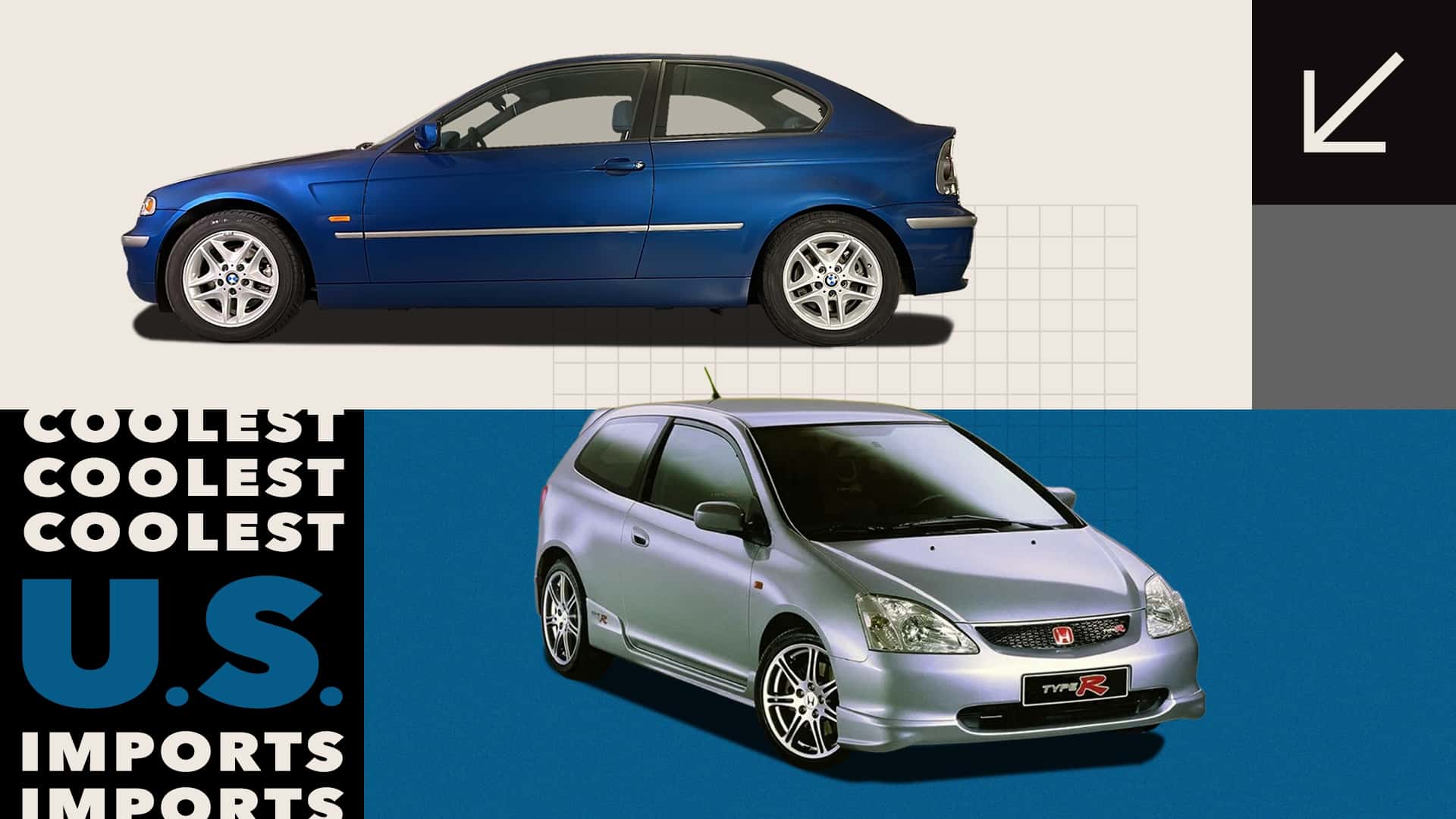
The E46 BMW 3 Series is, at this point, a staple of the used enthusiast car market. Good handling, handsome looks, huge aftermarket support, and now perfectly affordable. One variant America didn’t get, however, is the Compact, a three-door shorty version made for the young urban European professional with a smaller budget and modest rear-seat needs.
The Compact’s steering rack was given a quicker ratio than that of the regular E46, and the most powerful 325ti version used a 189-horsepower straight-six that sounds like a mild riot. But the E46 Compact’s most notable deviation would probably be that front-end design. If the E46 were a person, seeing the Compact’s front headlights would feel a bit like seeing them without glasses for the first time. You don’t want to be rude, but what the heck is that?
BMW M3 GTR Strassenversion

On the complete opposite end of the E46 3 Series spectrum, meanwhile, is the M3 GTR Strassenversion (or "Straßenversion," if you’re the sort of person who pronounces it "bay-em-veh" out loud).
That suffix is German for "street version," and BMW only built 10 of these road-legal monsters purely to fulfill homologation rules. The 4.0-liter race car V-8 never appeared in any other production car and it made 350 horsepower. That helped the GTR reach 183 miles per hour. It was attached to a six-speed manual transmission with a variable, limited-slip diff.
The M3 GTR’s real cultural claim to fame, however, is arguably being on the cover of 2005’s Need for Speed: Most Wanted. The first person to import a Strassenversion, wrap it in that livery, and pull up to Cars & Coffee wins all of the automotive gamer points.
Fiat Stilo

You’ve likely heard of Stilo helmets, but did you know Fiat made an unrelated small hatchback called the Stilo in the 2000s? No? Admittedly, neither did I until I started doing research for this list, but it’s one of the more interesting-looking normie European cars that entered production in 2001.
There was also a hot hatch Abarth version that made 170 horsepower and got from zero to 60 miles per hour in 8.5 seconds. It also topped out at 136 mph. A manual gearbox was introduced in 2004, but the initial 2001 Abarths came with the SMG-style "Selespeed" semi-auto that was, shocker, panned for being too slow. For more practically minded enthusiasts of obscure Italian compacts, there was a Stilo MultiWagon, uh, wagon and a five-door hatch version with lots of room for stuff.
Honda Civic Type R (EP3)

If the Stilo Abarth is spiritually up your alley but a little too obscure, there’s the EP3 Honda Civic Type R. A blue-chip classic hot hatch if there ever was one, this is the "breadvan" generation of CTR—the one after the OG EK9 but before it slowly started turning into a cyborg.
A K20 four-cylinder with VTEC made 197 horsepower and a noise the new Type R could only dream of, while its six-speed shifter famously jutted out from the dash longitudinally instead of vertically. In case the steering wheel being on the wrong side doesn’t give it away after you import one onto US soil, red Honda badges, red seats, and Championship White wheels mark this car out as not just any old Civic.
Honda Integra Type R (DC5)

While the Civic may win on name recognition, real Honda heads recognize the DC5 Integra Type R as the Honda sport compact to have from this era. Mechanically similar to the EP3 but rocking a decidedly different aesthetic, this car used a K20 four-pot making 217 horsepower going to the front wheels through a standard limited-slip differential.
This car’s dynamic trump card, however, might have been its hydraulic steering system, which offered more feedback than the EP3 Civic’s electric rack. I’ve also always been a fan of the way this car looks, too. Yeah, Honda did rebadge this gen of base Integra and sell it in the US as an Acura RSX, but you can finally import and drive the real, red-badged deal here through legal means.
MG ZR

If a hot Honda hatch is a little too mainstream, perhaps the less well-known MG ZR is more your speed. It’s essentially Britain’s answer to cars like the Civic Type R and VW Golf GTI, taking a Rover 25 supermini and making it lower, quicker, and louder. Hell, it even came with a "K-series" four-cylinder engine (that’s the Rover K-series line of motors, mind you).
Several variants were offered, but the most powerful 1.8-liter 160 model made 158 horsepower, hit 62 miles per hour in 7.4 seconds, and topped out at 131. With a vaguely kidney-esque grille and four round headlights that look a notch too small, the pre-facelift ZR’s front end is strangely reminiscent of the E46 Compact above. In any case, this car was built in Longbridge, Birmingham, but can now be registered legally in Birmingham, Alabama, where it should be quite a rare sight.
Renault Avantime

A portmanteau of the French word for "ahead" and the English word for "time," the Renault Avantime really did drop 25 years too early for its own good. It’s a two-door coupe that isn’t a coupe, a van that isn’t a van, and a wagon that isn’t a wagon. Nix the weird articulating door thing, give it plastic SUV-style fender covers and an electric powertrain, and it’d likely fit right into today’s new car landscape.
Alas, it dropped in 2001 and will forever be remembered as one of the oddest creations in automotive history, and that one car Top Gear once tried to modify to be as fast as a Mitsubishi Evo. Import one if you like huge windows, funky French things, and being photographed every time you stop for gas.
Renault Clio V6

As for a Renault that’s more racing line than punchline, there’s the Clio V6. As you likely already gathered or know, it’s a high-performance version of the Clio compact, but Renault did a bit more than just give it a bigger engine and more aggro suspension and bodywork.
Believe it or not, the 3.0-liter V-6 engine is in the back where the rear seats normally go, making this a rear mid-engined, rear-wheel-drive car. Renault did something similar when it made the iconic R5 Turbo in the 1980s. On paper, the Clio V6 may sound like a hot hatch that was more stunt than grunt, considering it made just 227 horsepower and weighed more than a regular Clio.
But in practice, this car was a handful, with automotive journalist Andrew Frankel once calling it "a menace" and "the scariest car [he’s] ever driven." Import one if you like unexpected engine placement, funky French things, and going into a spin every time you stomp on the gas.
Toyota WiLL VS

Around the turn of the century, a whole bunch of Japanese companies came together to create goods under "WiLL," a brand marketed specifically toward young people. There were WiLL beverages by Asahi, WiLL electronics by Panasonic, and Toyota built three cars under the WiLL name. The range of cars was effectively Scion before Scion was a thing, and the VS hatchback will soon be open to import under America’s 25-year rule.
Functionally, it’s an early 2000s Corolla hatch with a sharper, more futuristic body. Fun fact: this car was unveiled at the 2001 LA Auto Show despite only ever being sold in Japan, where it’s said to have gained a cult following. As for the other WiLL cars, the 2000-built Vi became eligible for import in 2025, while the 2002 Cypha will be OK to import in 2027.
The VS, Vi, or Cypha may not be the easiest JDM cars to get ahold of, but where there’s a WiLL, there’s a way.
Volkswagen New Beetle RSi

It’s always funny to me when companies incorporate the word "New" and a stylized, lower-case "i" into proper names of stuff, but this car bravely does both. In any case, the Volkswagen "New" Beetle RSi is now 25 years old—see how that works?
It was a high-performance version of VW’s roundest car. A narrow-angle 3.2-liter VR6 V-6 made 221 horsepower, a six-speed manual had tiny, very slick throws, and four-wheel drive kept it in line on both the road and VW Group’s overall approach toward performance. Notably, Volkswagen only ever made 250, making it rarer than the Bugatti Veyron, the German auto giant’s next (and wildly more expensive) swing at a performance car that vaguely resembles a bug.