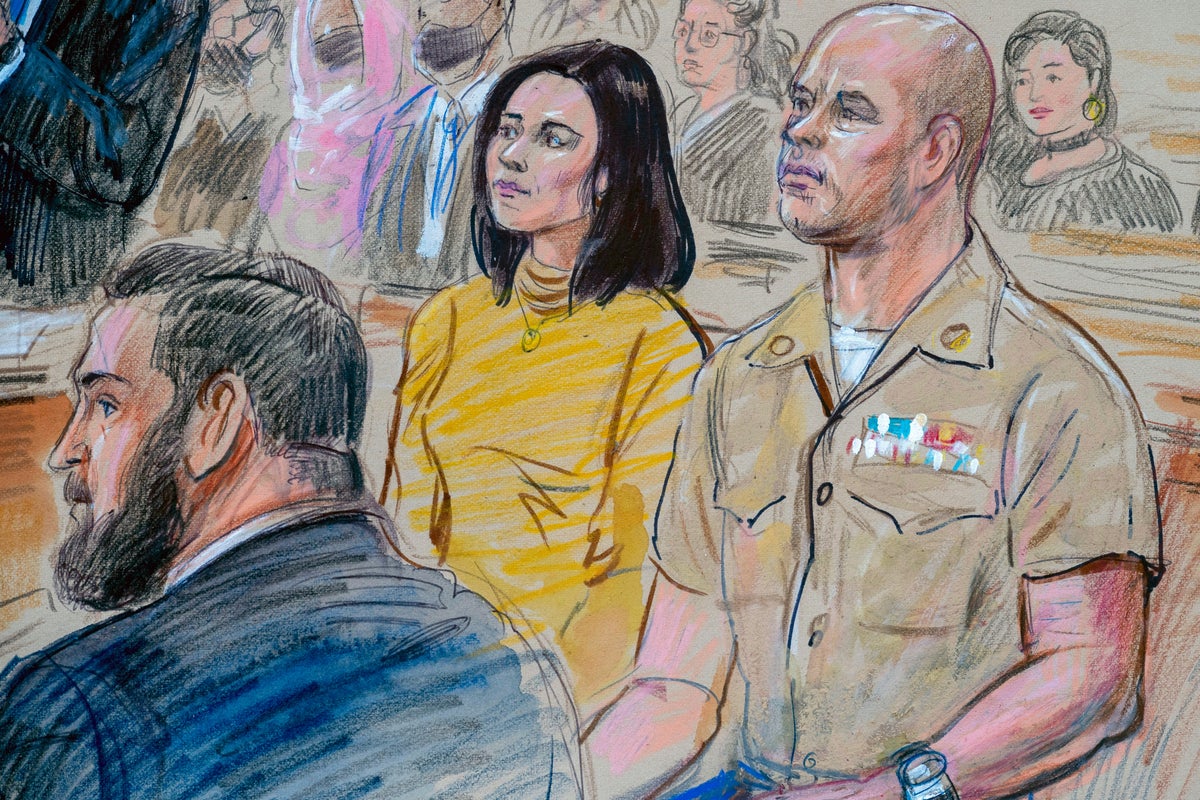
Thousands of pages of once-secret court documents show how federal officials and a Virginia court helped an American Marine adopt an Afghan war orphan, in defiance of the U.S. government’s official policy to unite the child with her family.
The Associated Press fought for three years for access to the documents, which reveal how the country’s fractured bureaucracy enabled Marine Joshua Mast and his wife, Stephanie, to adopt the child who was halfway around the globe, being raised by a couple the Afghan government decided were her family.
The records reveal that the federal government and the court have blamed each other for what has become an international incident, which the government says threatens America’s standing in the world and appears as an endorsement of child trafficking.
The baby was orphaned on the battlefield in Afghanistan in 2019. U.S. soldiers pulled her from the rubble and took her to the hospital at an American military base. The U.S. State Department, under President Donald Trump’s first administration, worked with the Afghan government to locate her family.
But the Masts were determined to bring her home, convincing a Virginia judge to grant them an adoption of the girl, who was 7,000 miles away. They then used those adoption documents to take the child from the Afghan family as they fled their homeland during the U.S. military’s chaotic withdrawal in the summer of 2021.
Here are takeaways from the documents.
How did a court in Virginia adopt out a girl in Afghanistan?
The documents reveal that the adoption the Fluvanna County court granted the Masts skipped legal safeguards meant to protect children. There is no Virginia law that allows a judge to adopt out a foreign child without her home country’s consent.
Yet Fluvanna County Circuit Court Judge Richard Moore did just that. He relied on the word of Mast to declare that the child was “stateless.”
Lawyers representing the government, the Afghan family and the child would note many defects in these proceedings; the attorney representing the child’s best interests described the flaws as “glaring.” A child must be put up for adoption by a parent or agency, and this child had never been. The court waived the requirement that the child be present when social services visited the adoptive parents’ home, that someone investigate her history, that whoever had custody be told this was happening.
Even Moore acknowledged the flaws in the adoption he’d granted. He wrote in a 38-page opinion he published before retiring that there was “procedural irregularity, defect or deficiency in the case.”
“I’ll probably think about this the rest of my life whether I should have said, sorry, that child is in Afghanistan. We’re just going to stand down,” Moore said at a hearing. “I don’t know whether that’s what I should have done.”
What the court didn’t know
Moore said there were things he wished he’d known when he granted the adoption in December 2020, declaring the child “an undocumented, orphan, stateless minor.”
The federal government insisted it received no notice of Mast’s bid for adoption, the recently released records show. Had it been notified, government lawyers said, they would have told the judge that the child was not stateless, the government was at that time searching for her family and would soon decide she was Afghan and not the child of foreigners.
She was also not in a medical crisis: A month before, exhibits show, her doctor described her as “a healthy healing infant who needs normal infant care.”
The judge said he never knew that a federal judge had rejected the Masts’ attempt to block the U.S. government from sending the girl to her Afghan relatives. Mast told Moore the child was given to an unmarried teenage girl whose relationship to her was unclear. He testified that he maintained the child was the daughter of foreign fighters.
The federal government’s “inconsistent” approach
An Army colonel wrote in a court declaration that the military had decided Mast was “attempting to interfere inappropriately,” and the military and State Department worked to keep him away from the child.
But others within the same agencies helped him.
At Mast’s request, the military evacuated the Afghan family from Afghanistan during America’s chaotic withdrawal in the summer of 2021. They were put in line with Afghans who had helped the U.S. military. They never had; their only reason to be added to the list was Mast’s desire to bring the baby to the U.S.
Government employees working at a refugee resettlement center in Virginia took Mast’s adoption documents at face value, never learning their own government had already dismissed them as “flawed” and rejected Mast’s claim to the child. A State Department employee was ordered by her supervisors to physically take the child from the Afghans and hand her to the Masts, as the Afghan woman collapsed onto the floor weeping.
—-
Contact AP’s global investigative team at Investigative@ap.org or https://www.ap.org/tips/.
Trump endorses Takaichi in rare intervention ahead of Japan election
US government worked against itself to let Marine adopt Afghan girl, documents obtained by AP show
Newly obtained emails undermine RFK Jr.'s testimony about 2019 Samoa trip before measles outbreak
Trump shares late-night video depicting Barack and Michelle Obama as apes
Three African countries agree to take back UK migrants after visa penalty threat
Mass executions in Iran being planned after Trump talks end, lawyers claim