
Get all your news in one place.
100's of premium titles.
One app.
Start reading
TechRadar
TechRadar
Samuel Woodhams

Surfshark fixes broken post-quantum VPN protocol after TechRadar investigation

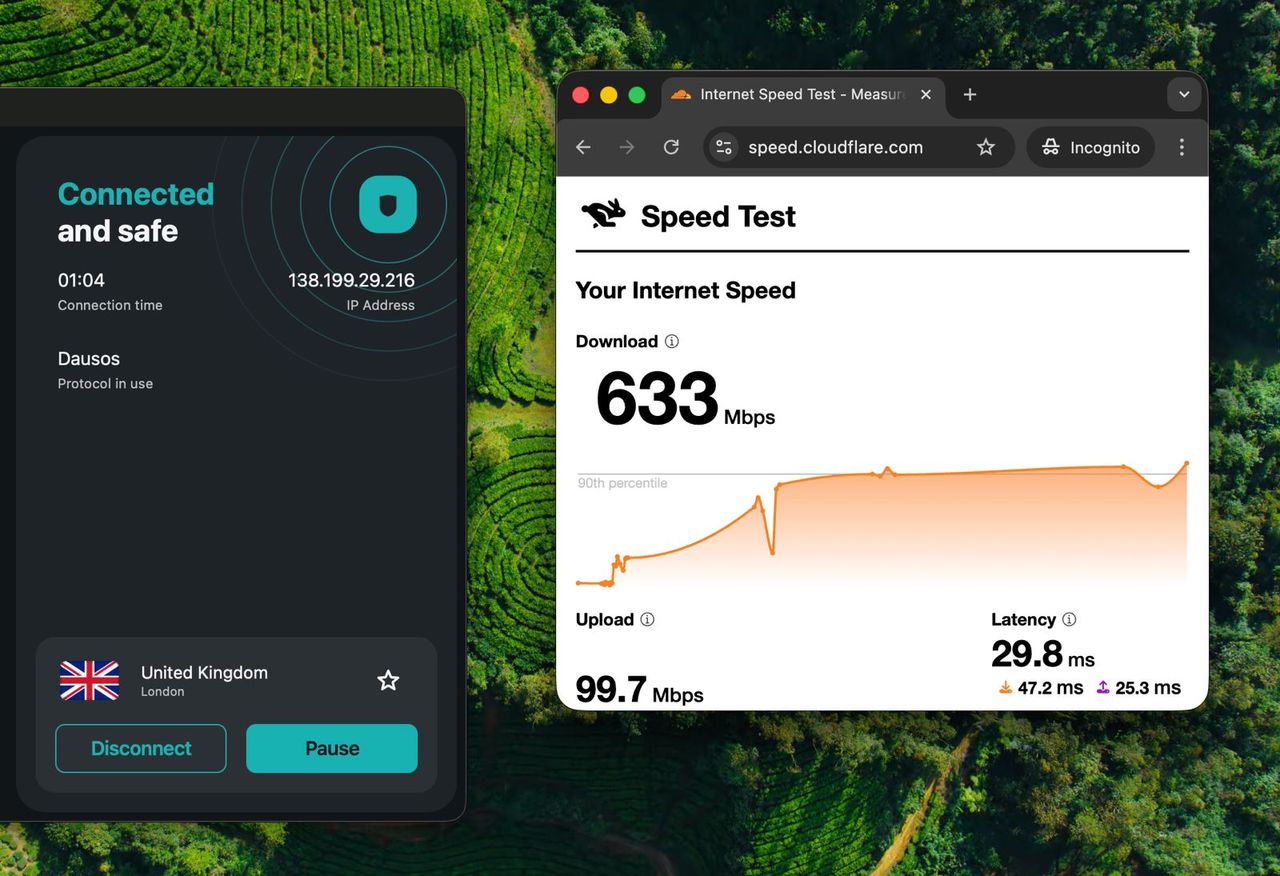
Screenshot showing Surfshark's new protocol and a live speed test.

Following tests by TechRadar, Surfshark has issued a patch to its new, proprietary VPN protocol, 'Dausos.' The update ensures the protocol now functions correctly on specific residential fiber connections, which were previously unable to handle the protocol’s packet overhead.

Earlier this week, we published an article that revealed Surfshark's post-quantum protocol was too bulky for the residential fiber lines we tested it on. That meant we could only access small, non-encrypted HTTP web pages — not ideal for a modern privacy protocol.

After sharing our technical data with Surfshark, the provider fast-tracked a fix. With the release of version 4.27.1, the protocol is fully functional and our initial speed tests have yielded some surprising results.

What went wrong?

When I went to test the new protocol earlier this week, I found I could only access small, unencrypted HTTP web pages and use existing connections (Google Sheets, WhatsApp, etc).

The culprit was a lack of optimization for PPPoE (Point-to-Point Protocol over Ethernet) connections. This specific configuration is the standard for millions of residential broadband users, particularly across the UK.

When we reached out to the company they acknowledged the issue, saying: "You seem to have an edge ISP case that our global teams haven’t caught." Our tests were conducted using a BT/EE connection — a group that serves more than 30 million customers and is the largest ISP in the UK.

The protocol has now been patched and works well even on these "edge" UK cases. So I finally could get on with what I had wanted to do all along and test the protocol's speeds.

Speed test analysis

In our initial tests, Dausos performed 5.8% faster than WireGuard. That's a notable achievement given the heavy computational overhead associated with post-quantum encryption. While it falls short of the 30% boost Surfshark initially claimed, it is a strong start for a protocol still in its infancy

While both protocols resulted in a 20-25% dip in raw download speeds compared to an unprotected line, the impact on upload speeds, latency, and jitter was negligible. On a high-speed fiber connection, this translates to a seamless experience where streaming and browsing remain almost indistinguishable from a non-VPN connection.

These impressive speeds serve to show why Surfshark performed the best in our more controlled speed tests where it was crowned the fastest VPN we've tested.

Surfshark speed tests

Protocol

Avg Download (Mbps)

Speed Difference

Avg Upload (Mbps)

Avg Latency (ms)

Avg Jitter (ms)

No VPN

807.8

102.60

26.76

10.47

WireGuard

600.4

-25.67%

100.74

26.34

8.51

Dausos

635.2

-21.37%

99.56

29.88

11.60

Speed test methodology

I used Cloudflare's speed test tool. from my home setup, connecting over Wi-Fi to a high-speed fiber connection. I ran each of the settings (No VPN, WireGuard and Dausos) five times sequentially and connected to the same Surfshark server each time. Any obvious outliers were discarded.

It is important to note that these figures represent a snapshot of performance at a specific moment. Network congestion and server load mean that results can fluctuate day-to-day, and users running these tests on different hardware or ISPs will see varying figures.

Despite these caveats, the results show a useful comparison between each protocol setting and as it's such a new tool, I'm sure we can expect even more impressive speeds in the future.

Sign up to read this article
Read news from 100's of titles, curated specifically for you.
Already a member? Sign in here
Related Stories
Top stories on inkl right now
One subscription that gives you access to news from hundreds of sites
Already a member? Sign in here
Our Picks
Fourteen days free
Download the app
One app. One membership.
100+ trusted global sources.