
Get all your news in one place.
100’s of premium titles.
One app.
Start reading
Windows Central
Windows Central
Technology
Cale Hunt

Storage might join RAM on your PC shortage wish list — NVIDIA's new AI supercomputers will suck up millions of TB of SSDs to operate

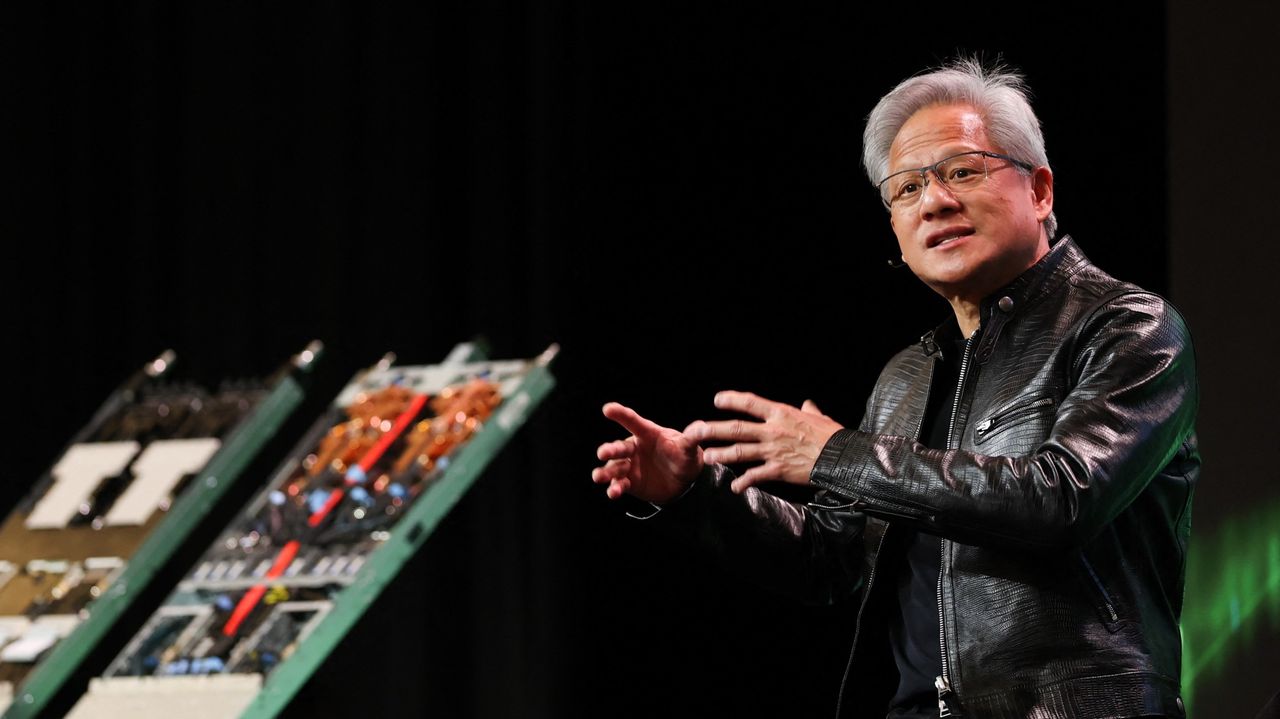
Nvidia founder and CEO Jensen Huang speaks about the Vera Rubin AI platform during a question and answer session with reporters at the annual Consumer Electronics Show (CES) in Las Vegas, Nevada, on January 6, 2026.

NVIDIA is currently the world's most valuable company, and its wealth has largely been carried to the bank on the shoulders of AI datacenters powered by its GPUs. Refusing to slow down, NVIDIA unveiled a new Rubin supercomputing platform at CES 2026 consisting of six different chips, including a Vera CPU and a Rubin GPU.

The Rubin platform as a whole, as NVIDIA explains it, is ushering in a new "industrial" era of AI compute where costs are lower, and output is higher. Indeed, NVIDIA says the Rubin platform can offer 10x lower inference token costs while requiring 4x fewer GPUs when training mix-of-experts (MoE) models; that's compared to the current Blackwell generation of hardware found in so many cutting-edge datacenters around the world.

Here come the screeching brakes, heard loudest by those who couldn't care less about AI.

A look at the six new chips that go into NVIDIA's Rubin AI supercomputer platform. (Image credit: NVIDIA)

Last year ended in a dire situation for PC makers and consumers, and it's continuing today — memory is being gobbled up by AI firms at an alarming rate, leaving only some scraps for the rest of us. It's nigh impossible to build a new PC without dropping an enormous sum on RAM, and leading manufacturers are also starting to feel the squeeze.

The same shortages have already begun to show up in the SSD hardware space, as NAND — the type of flash memory that's used in SSDs — was starting to feel a similar squeeze.

Now, as the Vera Rubin server systems arrive, it's being projected that storage is the next sector of hardware that's about to dry up. That's due to Vera Rubin's new memory design that significantly speeds up data processing.

Vera Rubin is projected by Citi to eat up "1,152TB of additional SSD NAND" per server system in order to properly support the new NVIDIA Inference Context Memory Storage (ICMS) operations. If those estimations are even close to the truth, we're about to be in for (another) bad time.

👉 Related: Conspiracy theory or apt prediction? — The AI-fueled hardware shortage will kill local PCs, paving the way for subscription-based cloud computing

Consumer SSDs could get a lot more expensive in 2026 and 2027 as AI demand intensifies. (Image credit: Ben Wilson | Windows Central)

If you can wrap your head around a projected 30,000 Vera Rubin shipments in 2026 and another 100,000 shipments in 2027, the result falls out to about 34.6 million TB of NAND in 2026 and 115.2 million TB of NAND in 2027 for NVIDIA's new servers alone.

In 2026, those 34.6 million TB represent approximately 2.8% of the expected global NAND demand. In 2027, the 115.2 million TB represents 9.3% of global NAND demand. That's a big jump, and Citi says "the global NAND supply shortage is expected to intensify further." This dilemma will undoubtedly trickle down into consumer SSDs, igniting the fuel that sends prices into space.

Experts have predicted for months that NAND would represent the next big hardware shortage, and it seems those predictions weren't too far-fetched. Is this the next step on our way to subscription-based cloud computing?

(via WCCFTech)

Realistic prediction or baseless rumors? What do you think about Citi's projection involving hundreds of millions of TB of NAND capacity going into NVIDIA's new Rubin platform? Let us know in the comments section below!

Follow Windows Central on Google News to keep our latest news, insights, and features at the top of your feeds!

Sign up to read this article
Read news from 100’s of titles, curated specifically for you.
Already a member? Sign in here
Related Stories
Top stories on inkl right now
One subscription that gives you access to news from hundreds of sites
Already a member? Sign in here
Our Picks
Fourteen days free
Download the app
One app. One membership.
100+ trusted global sources.