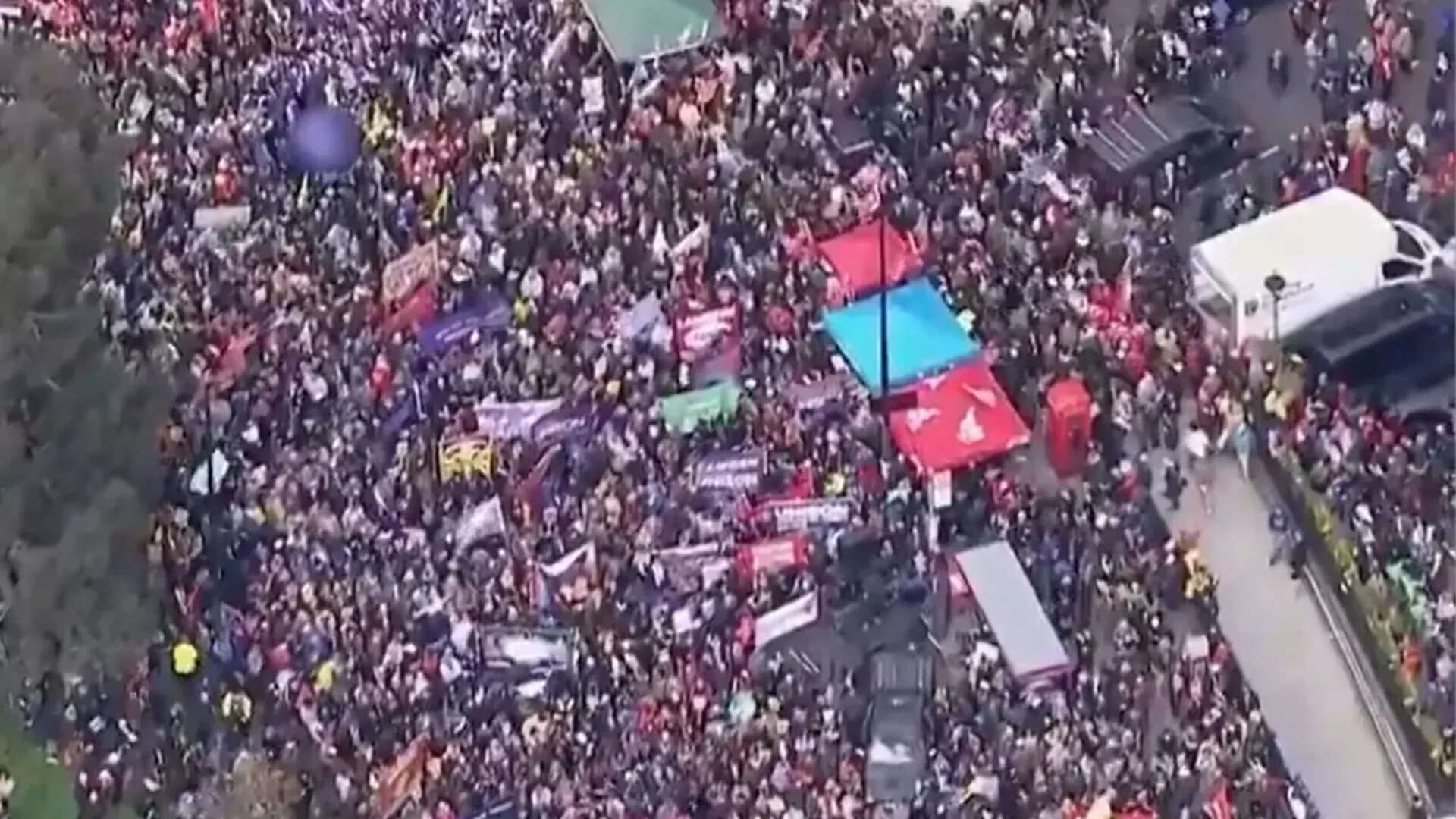
Thousands of people marched through the streets of London on Saturday in a massive demonstration against far-right politics.
Organisers of the Together Alliance, backed by nearly 500 groups including trade unions, anti-racism organisations and Muslim representative bodies, said the march was the largest ever of its kind in British history.
Crowds of all ages converged on Whitehall near the Houses of Parliament, many waving banners calling for unity and inclusion.
Organised show of unity
The rally featured speeches, cultural performances at Trafalgar Square, and a video address from Mayor Sadiq Khan.
Co-organiser Kevin Courtney told participants the turnout would “give confidence to carry on,” while fellow organiser Sabby Dhalu said the scale of mobilisation had “intimidated the far right.”
The march was framed as a stand against what organisers called the “politics of division,” highlighting concerns about racism, Islamophobia, and the increasing mainstream visibility of far-right ideologies.
Organisers claimed as many as 500,000 people joined the march, though the Metropolitan Police offered a more conservative estimate of around 50,000, citing the difficulty of counting such a widespread crowd.
Huge crowds of up to 500,000 march in London to protest against the Far Right. pic.twitter.com/CRYjnArAZK— BladeoftheSun (@BladeoftheS) March 28, 2026
Parallel protests and arrests
A separate pro-Palestine march briefly joined the route before merging with the main rally in Whitehall.
Police reported 25 arrests during the demonstrations, including 18 linked to support for a proscribed organisation and others for public order offences.
The march follows a large right-wing rally in London last September, led by Tommy Robinson, which saw incidents of violent disorder.
Saturday’s event, by contrast, remained largely peaceful, with only a small number of counter-protesters present.
Participants emphasised that the march was a necessary demonstration against far-right rhetoric and a call for action both on the streets and at the ballot box, with specific mentions of figures such as Nigel Farage.