
Get all your news in one place.
100's of premium titles.
One app.
Start reading
Euronews
Euronews
Nela Heidner

Spectacular find: 1,000-year-old Viking textile workshop unearthed

The Vikings were apparently not only a warlike people: In Søften, a small village in the Mid Jutland region north of Aarhus, archaeologists have uncovered the remains of an exceptionally large craft settlement. The complex dates from the 7th to 10th centuries and covers 100,000 square metres. In total, the archaeologists excavated 82 pit houses.

The area seems to have served as a specialised craft zone, with numerous workplaces operating in parallel. The large number of identical workshops suggests that division of labour, and possibly centralised control, played a role.

An aerial photograph shows the archaeological excavation site in Søften near Aarhus, Denmark. (An aerial photograph shows the archaeological excavation site in Søften near Aarhus, Denmark.)

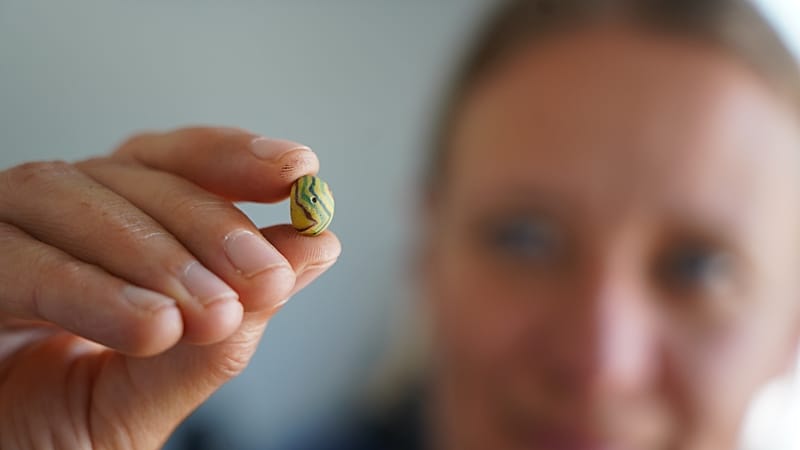
The excavations brought to light an enormous number of loom weights, spindle whorls and glass beads, indicating that textiles were produced there on a scale far exceeding the needs of the local population. The finds document a complete production chain, from processing the fibres to the finished fabric.

Loom weights and spindle whorls were found during the excavations in Denmark. (Loom weights and spindle whorls were found during the excavations in Denmark.)

The researchers also found Arabic coins from the Middle East, as well as mintings from what is now France and Germany. These artefacts show that the inhabitants of Søften were part of far-reaching trade networks that extended as far as Asia.

The site was strategically well placed near the then trading centre of Aros. Its location made it easy to channel the goods produced into trade and export them.

In the researchers' view, the finds prove that the Vikings had a highly developed economy. Historian Kasper H. Andersen from the Moesgaard Museum stressed: 'It shows us that the Viking Age was not just an uncivilised, barbaric and backward era, as is often assumed.'

It is not yet clear when the artefacts, probably including those to be displayed at the Moesgaard Museum, will be available for public viewing. The analysis of the finds is still ongoing and could take several months to several years.

This text was translated with the help of artificial intelligence. Report a problem : [feedback-articles-en@euronews.com].

Sign up to read this article
Read news from 100's of titles, curated specifically for you.
Already a member? Sign in here
Related Stories
Top stories on inkl right now
One subscription that gives you access to news from hundreds of sites
Already a member? Sign in here
Our Picks
Fourteen days free
Download the app
One app. One membership.
100+ trusted global sources.