“Megaconstellations” of vast numbers of satellites could threaten space-based astronomy, scientists have warned.
In recent years, companies such as Elon Musk’s SpaceX have launched thousands of new satellites, to offer internet connections to those who might not otherwise be able to get online. In the years to come, companies hope to send many more: FCC filings suggest that companies want to launch half a million satellites by the end of the next decade.

Those satellites are often visible to the naked eye but are even more visible to astronomers. They rely on detailed and precise images of distant space to better understand our universe.
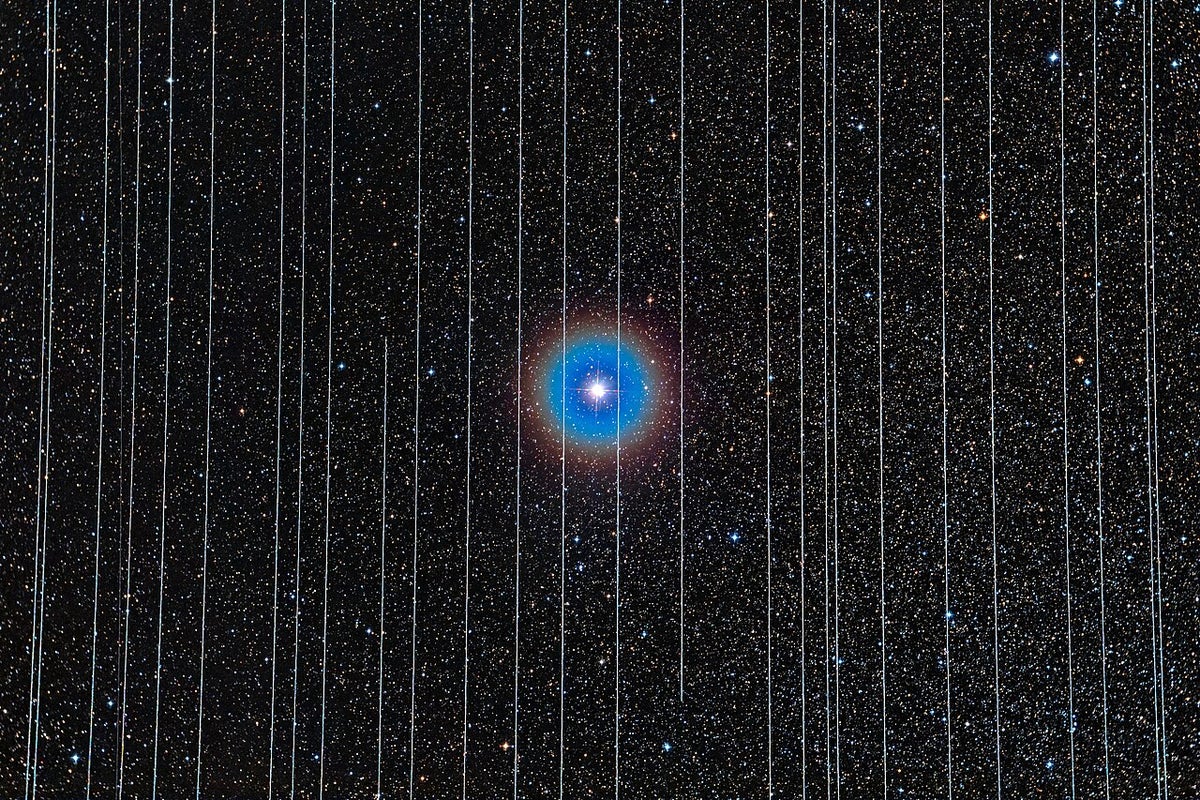
Already, many of those images from both ground- and space-based satellites are smeared with light as the satellites cross across the equipment. But that could become a vastly more pronounced problem as the number of satellites dramatically increases.
When those vast constellations are completed, they could contaminate a third of images from Nasa’s Hubble Space Telescope, according to the new study. Some will be even more dramatically affected: the SPHEREx (Spectro-Photometer for the History of the Universe, Epoch of Reionization and Ices Explorer), ARRAKIHS (Analysis of Resolved Remnants of Accreted galaxies as a Key Instrument for Halo Surveys) and Xuntian space telescopes will have some 96 per cent of their images polluted by light from the satellite megaconstellations, the scientists warn.
Last year, the International Astronomical Union Centre for the Protection of the Dark and Quiet Sky published a series of recommendations for the operators of such satellites, with the aim of protecting our view of space. They included a host of changes, including asking manufacturers to limit how reflective the satellites are and to try and avoid the flares that result when they change their orientation.
The scientists behind the new study also make a range of new suggestions, including finding an upper limit for the orbit of the megaconstellations so that space telescopes can fly above them and avoid interference, as well as better data on where both active and derelict spacecraft are in space so that telescopes can steer clear of them.
The work is reported in a new paper, ‘Satellite megaconstellations will threaten space-based astronomy’, published in Nature.