Get all your news in one place.
100’s of premium titles.
One app.
Start reading
The Independent UK
The Independent UK
Maroosha Muzaffar

South Korea’s birthrate rises again – thanks to ‘echo boomers’

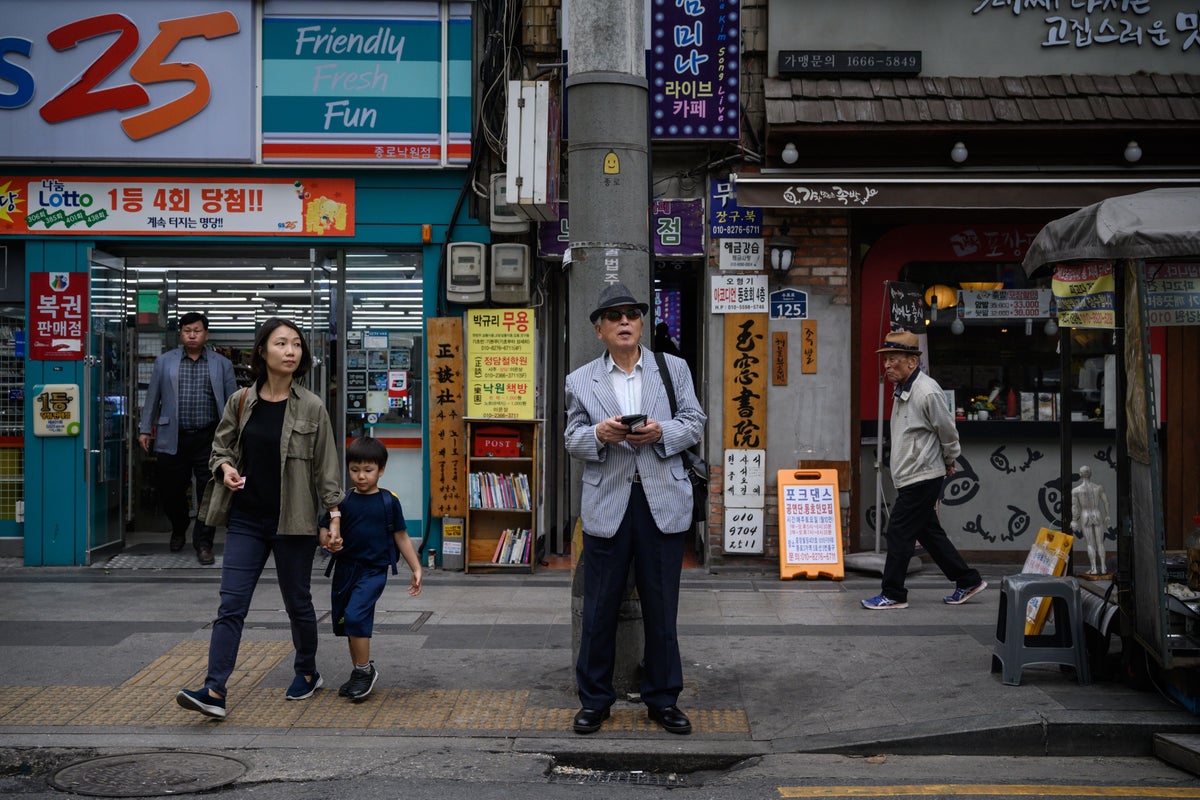
File. A man holding a mobile phone stands on a street as a woman and child cross a road in Seoul on 20 September 2019 - (AFP via Getty)

South Korea has recorded the biggest rise in births in nearly two decades, offering a rare moment of relief in a country long seen as facing a demographic crisis.

Last year, 254,500 babies were born, up 6.8 per cent from the previous year and the largest annual increase since 2007, according to provisional figures released by the ministry of data and statistics on Wednesday.

The total fertility rate, a measure of how many children a woman is expected to have in her lifetime, rose from 0.75 to 0.80, returning to the 0.8 range for the first time in four years.

Births have now increased for two consecutive years after nearly a decade of steady decline.

Demographers say the rebound is largely driven by the so-called “echo boomers” or the “echo boom generation” – people born between 1991 and 1995 during a temporary rise in births – who are now in their early 30s, the peak age for childbearing.

The term “echo boom” describes a demographic cohort made up primarily of the children of baby boomers.

Marriages have also rebounded following pandemic-era delays, with births within two years of marriage rising sharply.

Government incentives, including cash support, housing subsidies and expanded parental leave, may also be contributing, though officials say it is difficult to measure their exact impact.

The average age of mothers rose to 33.8 last year and over a third of births were to women aged 35 or older.

“I waited until my life felt more settled before having children, so I ended up pregnant in my late 30s, but I definitely feel like there are more people around me who want to have children. And for us, it happened naturally,” Lee Soo Min, who is expecting her second child after six years of marriage, told Korea JoongAng Daily.

“I can take a total of six years of parental leave, and my husband has already used one year. The system has improved compared to before, so the burden of parenting feels lighter.”

Despite this recent improvement, South Korea’s fertility rate remains the lowest among OECD nations and far below the 2.1 mark deemed imperative to maintain a stable population without immigration.

And deaths continue to outnumber births, meaning the population is still shrinking overall.

Experts caution that the current rise may be temporary as generations born after the mid-1990s begin reaching childbearing age in the coming years.

The final confirmed figures are expected later this year.

File. A mother carries her baby at a pregnancy and maternity exhibition in Seoul (Getty)

While many credit the recent rise in births to the large size of the “echo boom” generation, research suggests the explanation is overstated.

A study by the Korea Institute for Health and Social Affairs found that the rebound in births in 2024 was driven much more by changes in behaviour than by simple demographics. In other words, it was not mainly because there were more women of childbearing age but because a higher proportion of women in their 30s chose to have children.

The data supported this: of the 10,924 additional births among women in their 30s in 2024, only 3.2 per cent were due to an increase in the number of women in that age group.

A striking 96.8 per cent of the rise came from higher birth rates, meaning more women within that group decided to give birth. This, experts said, marked a shift after eight straight years of declining births, with 2024 becoming the first year in nearly a decade to show an increase.

The study noted another reason for the rise in births: a mindset shift that experts described as the “zero or two” mentality, meaning couples choosing either to remain child-free or go straight for two rather than stopping at one. In other words, families that do opt into parenthood may be committing more fully.

The study found that second births accounted for a larger share of the overall increase than first births, something not seen in previous analyses.

“There has never been a period in which the births of second children played such a large role in overall birth numbers,” the researchers said earlier this month.

Second-child births declined steeply over the past eight years, dropping from about 166,000 in 2015 to 74,000 in 2023, before inching up to 76,000 in 2024.

“When I received cash benefits, such as a voucher worth 2 million won [$1,380] from the government after my first child, I felt as if the burden of having a second child wouldn’t be as heavy as I had expected,” a woman surnamed Kim, who gave birth to her second child last December, was quoted as saying by Korea JoongAng Daily.

“It was hard to get my first child into a day care centre, but once I became pregnant with my second child, my first child received priority for admission, which made enrolment easier.”

The study suggested that changing attitudes towards parenthood helped drive the rise in births.

In a survey of 1,003 women who gave birth in 2024, the desire to bear children was found to be the most important factor in their decision, followed closely by their spouse’s willingness and concerns about age.

“Compared to the past, the fear of career breaks has clearly decreased, and I see more people around me choosing marriage or childbirth,” Han, another expecting mother, said.

Sign up to read this article
Read news from 100’s of titles, curated specifically for you.
Already a member? Sign in here
Related Stories
Top stories on inkl right now
Our Picks
Fourteen days free
Download the app
One app. One membership.
100+ trusted global sources.