Get all your news in one place.
100’s of premium titles.
One app.
Start reading
Radio France Internationale
Lifestyle
Isabelle Martinetti

South African photographer Jo Ractliffe captures imprints of violence

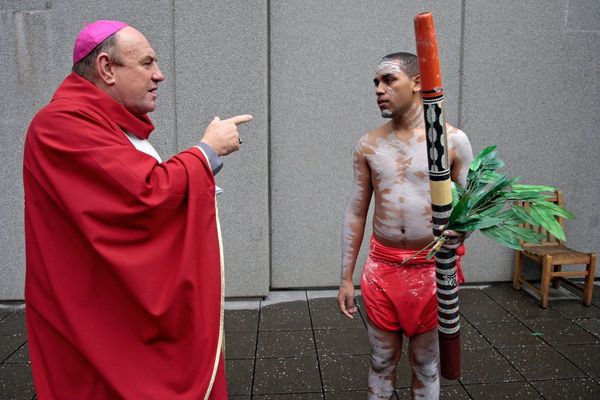
Boys at the shaft, Pomfret Asbestos Mine, 2013, from "The Borderlands" series by South Africa photographer Jo Ractliffe. © Jo Ractliffe / Courtesy Stevenson, Cape Town, Johannesburg, Amsterdam, 2026

Paris – South African photographer Jo Ractliffe's black-and-white images reveal the residues left by apartheid, regional conflict, population displacement and the aftermath of violence. RFI met her in Paris, where a new exhibition draws together work from the past four decades.

The exhibition Out of Place, now showing at the Jeu de Paume, traces moments in time captured by Ractliffe between 1982 and 2026.
Bringing together photographs taken in South Africa and Angola – several of which are being shown in France for the first time – it explores places marked by history and trauma.

Throughout her work, Ractliffe says she asks a recurring question: "How do you photograph the mood of a place?"

RFI met her on the sidelines of the show.

South African photographer Jo Ractliffe at the Jeu de Paume on 29 January, 2026. © RFI/I. Martinetti

RFI: What is your exhibition Out of Place about?

Jo Ractliffe: The work really looks at places that have histories of violence and my interest in this work is how the land of these places, the landscapes of these places, show the residues of historical violence... whether it's a donkey that was shot on the side of the road, whether it's a small moment or a large institutionalised aspect of violence.

But it's not 'place' in the sense of "I'm going to make a documentary" or "I'm going to make a project about Paris". Often these places are on the edge of things – the borders, like The Borderlands title. So that was the title of Out of Place, because often these places are places that are off the radar.

Often I'm working with material which is not always visible. The traces, the residues, are either not visible or very hard to understand. It's like trying to understand a story in a language that you don't have. So often in these places with signs, I don't know their meaning. I have to work in a slow, accumulative way, building up moment by moment the meaning of these places.

Donkey, Pomfret, 2011, from "The Borderlands" series. © Jo Ractliffe. Courtesy Stevenson, Cape Town, Johannesburg, Amsterdam, 2026

RFI: Your photos were taken in South Africa and Angola, but it seems the places you photographed could be somewhere else, in another country…

JR: Well, yes and no. Because on one level there are signs that make these specific, you know... whether it's the quality of light, whether it's the quality of the landscape. But yes, they don't have these hugely distinguishing features.

I have a friend who is a Mexican art historian, and she first came upon my work with the book of Angola As Terras do Fim do Mundo [The Lands at the End of the World]. And she started looking at the images, and she thought, "this looks so familiar". It almost, to her, felt like Mexico.

Then she thought, "is it because of the land?... No, it's not the same, these are not the trees of Mexico, these are not what things, what forests look like in Mexico." Then she realised what she was looking at was something very similar. It was the way violence is hidden in the landscape... It's a landscape that is made up of violence. She recognised a quality, a mood, an atmosphere that was very similar to the atmosphere in Mexico.

Port Nolloth, 2023, from the "Landscaping" series. © Jo Ractliffe. Courtesy Stevenson, Cape Town, Johannesburg, Amsterdam, 2026

RFI: What do you mean by 'violence'?

JR: Maybe violence is too much of a specific word. There's something more than what is apparent. There's something below the surface and it's not necessarily violent, but it might be loss. It might be something that is broken.

I mean, when I look at that Cuban [military] base in Angola, it reminds me of some of the photographs that I've seen of Gaza... I thought, "oh, these broken buildings in the sand".

Violence is an easy word because violence happens and the loss is one of the things that remains. It's like activities that come about from people's cruelty to other people. That's really what it is about. It's about people exerting power. And you know, I look at the world and I see what is happening now. There are bullies all over the world. We are living in these dictatorships. We don't really always see what is happening until a place no longer exists, like Gaza. They are going to destroy Gaza.

We don't have to have all the information about these pictures. These are not history pictures nor documentaries. And if somebody comes and says: "I look at this pile of rocks and it reminds me...", I think, "beautiful, perfect, that's what I want". I don't want people to think that they have to have a big history book.

Jo Ractliffe. Crossroads, 1986. © Jo Ractliffe. Courtesy Stevenson, Cape Town, Johannesburg, Amsterdam, 2026

RFI: What about animals? Especially dogs, which we see in many of your photo series.

JR: If you see more work, you'll see them more. I don't know what it is.

There was this one body of work called Nadir… The dogs kind of happened and I was interested in them. And it seemed to me that it was easier to work with dogs as a kind of carrier of meaning, as a kind of symbolic figure, than it was with people. I think the works are political, but people would be making a kind of a specific political [point]... Dogs in these images, if you look at the whole series of Nadir, they are both victims and perpetrators.

In many of these images, the dog, or the goat or the donkey, they sit there, but they have a strong presence. Some of them are looking back at you, or some of them are looking at the scene, like that goat. And in the beginning it used to happen by accident. But then I used to think they are my interlocutors. It's like the person, like the narrator of the story. They are the holders of the narrative... They hold the secret of these places.


The exhibition Out of Place is at the Jeu de Paume in Paris until 24 May 2026.

Sign up to read this article
Read news from 100’s of titles, curated specifically for you.
Already a member? Sign in here
Related Stories
Top stories on inkl right now
One subscription that gives you access to news from hundreds of sites
Already a member? Sign in here
Our Picks
Fourteen days free
Download the app
One app. One membership.
100+ trusted global sources.