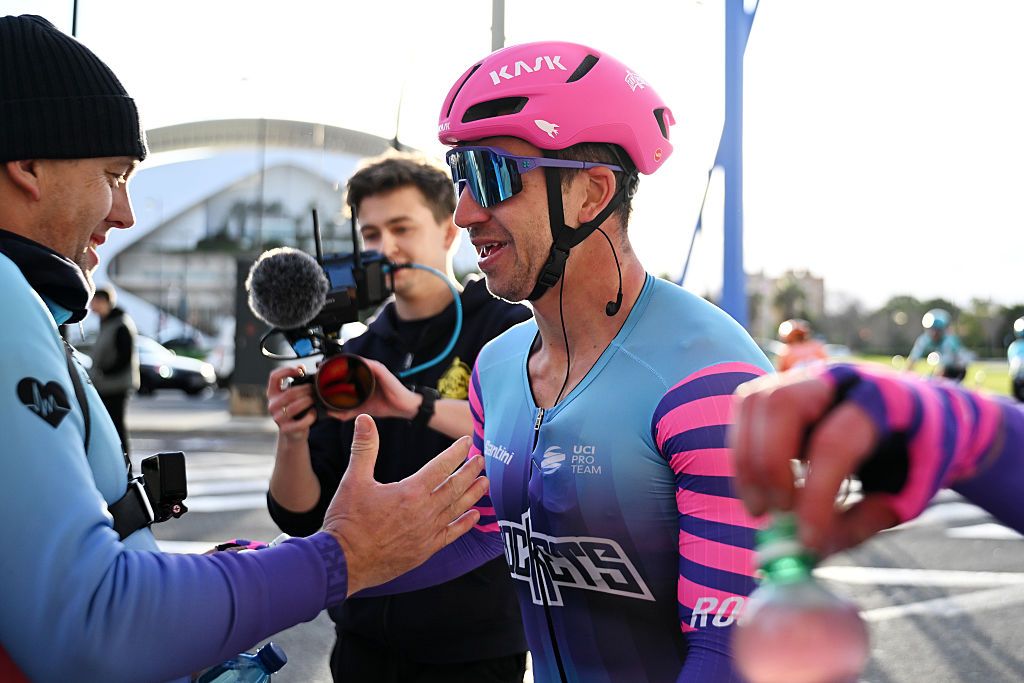
A few months ago, it felt almost certain that we'd see Unibet Rose Rockets, a professional cycling team born from a YouTube channel, line up for their first Tour de France in 2026.
They'd changed their nationality to French, ranked among the top 30 UCI teams, and signed not one but three former Tour stage winners. It looked like the final wildcard invitation was in their hands.
This morning, however, it was announced that that would not be the case. The possibility had started to become clear over the week, when the Rockets missed out on wildcards to other ASO races like Paris-Nice, the Tour Auvergne-Rhône-Alpes and Liège-Bastogne-Liège.
After months of excitement, by last night the chances were looking slim, and the French press were reporting that Spanish team Caja Rural-Seguros RGA would get the final wildcard spot instead. This morning's news confirmed that.
Of course, an invite to the Tour is super special for Caja Rural, too – maybe even more, given they've been around since 2000, whilst Unibet only burst onto the scene in 2023. Caja Rural sports director José Miguel Fernández called the invitation "an honor and a thrill that is difficult to describe" and pledged that the team will "prepare for the Tour with the utmost respect and with great attention to every detail".
It's also not difficult to see why ASO wanted to invite a Spanish team to their Barcelona Grand Départ, particularly after the now-resolved concerns that emerged after the Vuelta that the Barcelona start was at risk.
I'm sure that Caja Rural will dutifully go in every break possible, and do whatever they can to add some intrigue to the boring transition stages, which is what ASO thinks the wildcard teams are there for. They have strong riders, and they will deliver on that role. And I really don't want to rain on their parade, or say they aren't deserving of going to the Tour – they absolutely are, and I'm genuinely pleased for them.
But – and of course there is a but – is this really what cycling needs in 2026? I'm not so sure.
Unibet Rose Rockets' modus operandi is all about doing something different, and connecting with fans, sponsors and the media in a unique way. As team founder Bas Tietema told Joe Laverick in a special feature about building new teams from scratch, they have the biggest communications department of any professional team, and their aim to create narratives, take riders behind the scenes, and connect with their fans.
For them, success and ROI doesn't come from wins, it comes from a positive image, personality and reputation. This is a concept that many sports are now leaning towards, with great success – but not so much in cycling. It's something the sport needs to do to keep up, and Unibet are pioneering it. It's not hard to see how they would be good for the Tour.
It's also not as if the team would be coming to the race without ambitions, or just to make YouTube videos. They have six-time Tour stage winner Dylan Groenewegen, 2023 stage victor Wout Poels and Frenchman Victor Lafay on their books for 2026 (signings that, unfortunately, were probably sweetened by the likelihood of a Tour invite), so this is a team that could genuinely expect to take top 10s, if not even top fives and stage wins.
As a result, maybe they wouldn't be relied upon to go in as many doomed breakaways, but is that really what matters these days? Instead, the Rockets would absolutely bring more eyes and attention to the race – their story alone is one that fans love, and their media strategy is exciting and engaging. I personally was already excited about the prospect of the YouTube behind the-scenes from the Tour.
To the average fan, that kind of content is a hundred times more interesting than watching a rider go in the breakaway for the 15th day in a row. It's 2026, the sport is changing, the media landscape is changing, how people want to consume the Tour de France is changing. The Rockets represent what, to my eyes, cycling teams should now be doing, whilst other teams just stick to the way things have always been done, and watch fans and sponsors fall away.

So why did ASO go for the traditional option? Well, that I really don't know. Christian Prudhomme seems to think they were trying to game the system by registering as a French team. "They don't claim any French identity at all, they have more Dutch riders," he told AFP, though he did also praise their recruitment for 2026, and said they would "look at all of that for the years to come".
Or maybe ASO were just trying to do something nice for a long-standing Spanish team. But that loses a little bit of weight when you remember that invitations weren't afforded to Uno-X for the Copenhagen start, not Euskadi-Euskatel for the big kick-off in the Basque Country. ASO aren't usually sentimental about this kind of thing, so I'm not entirely sure that's the reason behind this.
Whatever the reasoning behind this move, I'm convinced it was the wrong one. As a sport, we need to be looking towards the future, finding new ways to reach new audiences and connect with younger fans. This isn't just a want, it's a necessity, if cycling wants to keep up with the global sporting world and changing economic landscape.
Hopefully, ASO keeps to their word and considers the Rockets in years to come, because a rejection of modernity or doing things differently would be a huge, huge mistake. Cycling is built on tradition, and the Tour de France is the most iconic, historic race of all, but that doesn't mean we should be stuck in the past. The future is here, and teams like Unibet Rose Rockets are already in it – it's time for the rest of the cycling world to step forward with them.