
Get all your news in one place.
100's of premium titles.
One app.
Start reading
Digital Camera World
Hillary K. Grigonis

Sony’s first-ever DSLR had a wild feature that started focusing without pressing any buttons

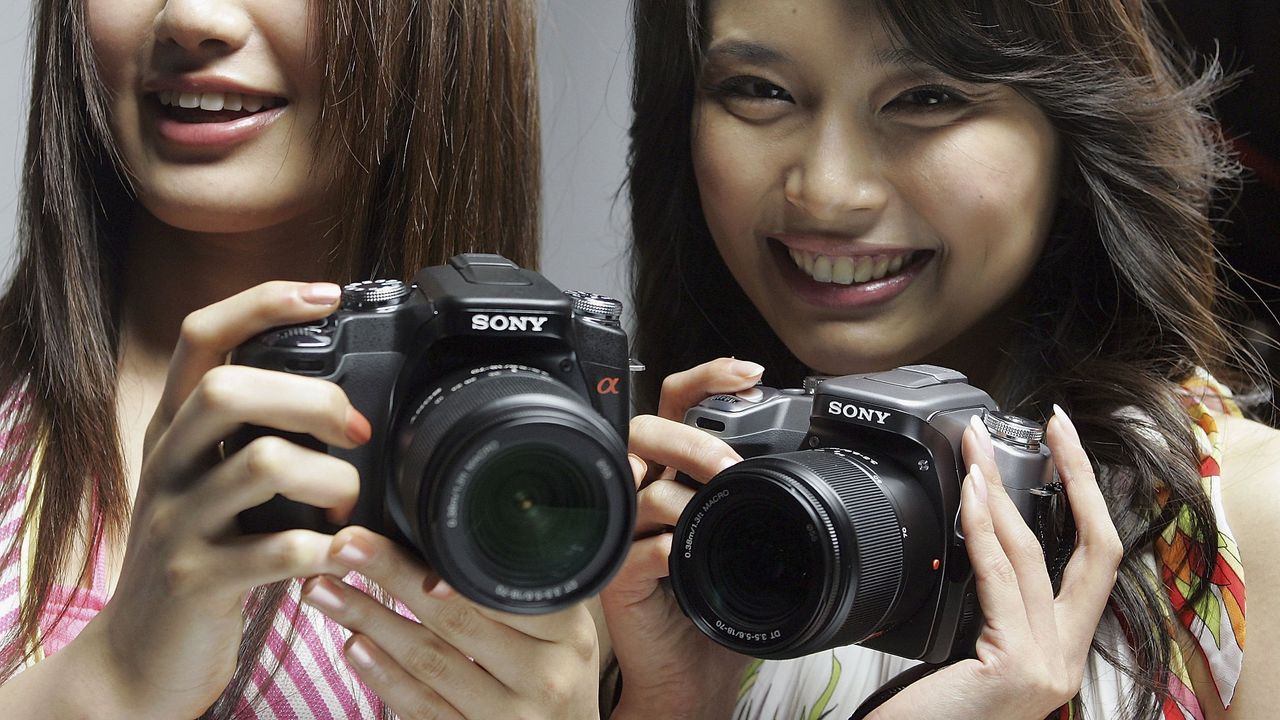
TOKYO, JAPAN - JUNE 6: Models show off Sony's digital single-lens reflex (DSLF) camera Alpha "DSLR-A100" during a press conference on June 6, 2006 in Tokyo, Japan. This is Sony's first DSLF 10.2-megapixel with a 21 lens camera which will be released on July 21, 2006. (Photo by Junko Kimura/Getty Images).

The Sony Alpha name has officially been around for more than two decades. On June 5, 2006, Sony announced its first DSLR, the Sony Alpha A100. Twenty years later, Sony’s interchangeable lens cameras still carry the Alpha name, but the imaging giant’s latest models are a far cry from Sony’s first.

The Sony Alpha A100’s 10.2MP APS-C DSLR, which shot at just 2.49fps, shows just how far imaging technology has come in the last twenty years – after all, Sony’s most recent announcement, the A7R VI shoots 66.8MP images at 30 fps.

But, the A100 did have a feature that Sony’s modern E-Mount cameras do not. The Sony Alpha A100 had a feature called “eye-start autofocus” – while the name sounds a little like Sony’s modern eye detection autofocus, the older tech had an entirely different purpose.

Photojournalists take photos of the Sony Alpha A100 at a launch event in 2006 (Image credit: Junko Kimura/Getty Images)

Eye-start autofocus used a sensor placed near the DSLR's optical viewfinder. Whenever this sensor detected something within about an inch of the camera, the DSLR would start autofocusing. That meant the camera would start focusing as soon as photographers pulled it up to their face, starting to focus before photographers even pressed any buttons on the camera.

The feature could help boost the camera’s autofocusing speed by starting the focus before the photographer pressed the shutter release halfway. But the eye-start autofocus never made it out of the A-mount DLSRs and into the E-Mount. A likely culprit? The eye sensor drained a lot of power, reducing the battery life. Other objects coming within an inch of the back of the camera, like a camera strap or having the camera bounce around a neck, would also trigger the camera to begin focusing.

The feature also illustrates how Sony Alpha cameras got their start, despite being a little late to the DSLR game: from Konica Minolta. Some Minolta film SLRs had eye-start autofocus in the 1990s.

(Image credit: Sony)

The Sony Alpha A100 arrived in part from Sony’s purchase of the Konica Minolta camera division, and along with the eye-start AF, the Minolta heritage also brought in-body stabilization. While the stabilization is common in the mirrorless era, the feature wasn’t as easy to find at the time.

The A100’s stabilization was rated to somewhere between 2 and 3.5 stops – another key example of how far Sony has come, as cameras like the A7R VI have stabilization systems rated up to eight stops.

Other features that speak to the DSLR’s early 2000s age? The native ISO topped out at ISO 1600, and low-light autofocus was only rated to +1 EV.

While Sony celebrated 80 years in May, the Sony Alpha series has just passed its 20th anniversary. Happy 20th birthday, Sony Alpha series!

You may also like...

Take a look at the best Sony cameras, or the best Sony E-Mount lenses.

Sign up to read this article
Read news from 100's of titles, curated specifically for you.
Already a member? Sign in here
Related Stories
Top stories on inkl right now
One subscription that gives you access to news from hundreds of sites
Already a member? Sign in here
Our Picks
Fourteen days free
Download the app
One app. One membership.
100+ trusted global sources.