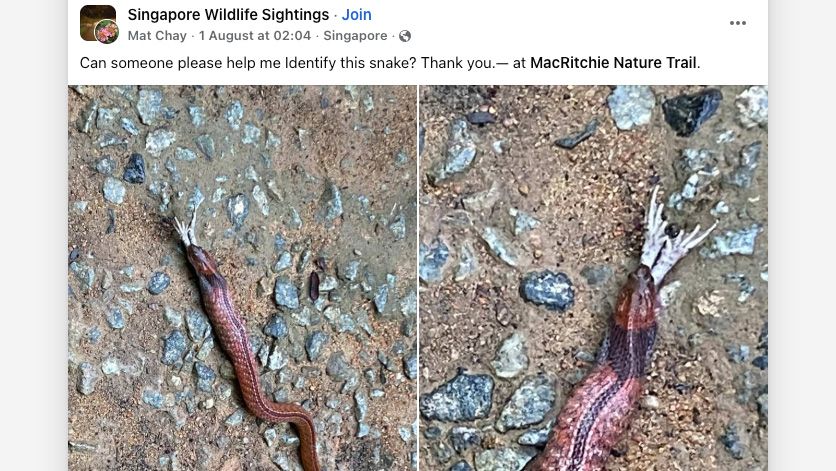
An image of a very uncommon and venomous snake appeared on Facebook on August 01, photographed at Singapore’s MacRitchie Reservoir. But would-be photographers or reptile enthusiasts are being warned not to approach or disturb the potentially dangerous species.
Judging by the Facebook comments, there seems to be some confusion as to whether the snake is poisonous or venomous and just how much of a danger it poses to humans. However, this has been cleared up by experts.

According to the Straits Times, the National Parks Board confirmed that the elusive reptile is both poisonous and venomous. The former refers to animals that secrete toxins when touched or ingested, while the latter requires toxins to be injected into the body via a bite.
The same news outlet quoted Dr Alex Figueroa of the Lee Kong Chian Natural History Museum, who stated: “The species is known to be venomous, so any handling should be left to experts”.
Judging by the photographs from Mat Chay, a fairly wide-angle lens was used – probably belonging to a camera phone. This would likely require getting closer to the reptile than is advised.
That’s why dedicated wildlife photographers rely on telephoto lenses and supertelephoto lenses, as well as the best trail cameras, allowing them to photograph subjects from a safe distance.
But as is often the case with wildlife photography, keeping a safe distance isn’t just about human safety. Some commenters on Facebook have noted that the reptile appears to have been in the process of ingesting a frog, which is a common form of prey for the species.
One concerned commenter stated: “Disturb the snake at this point and it will spit the carcass out then slither away hungry. Hope nobody denied it its meal.”
Thankfully, that’s what groups like Singapore Wildlife Sightings are for. Posts like Mat’s offer valuable insight into the country's biodiversity, while inviting others to offer advice that will hopefully keep humans (and snakes) sss-afe and sss-sound.
You might also like...
Want to be a better wildlife photographer? Check out my 10 tips for wildlife photography. Plus, photographer chases owl around field and refuses to stop. This is why we need to talk more about wildlife photography ethics! And finally, here are the best cameras for wildlife.