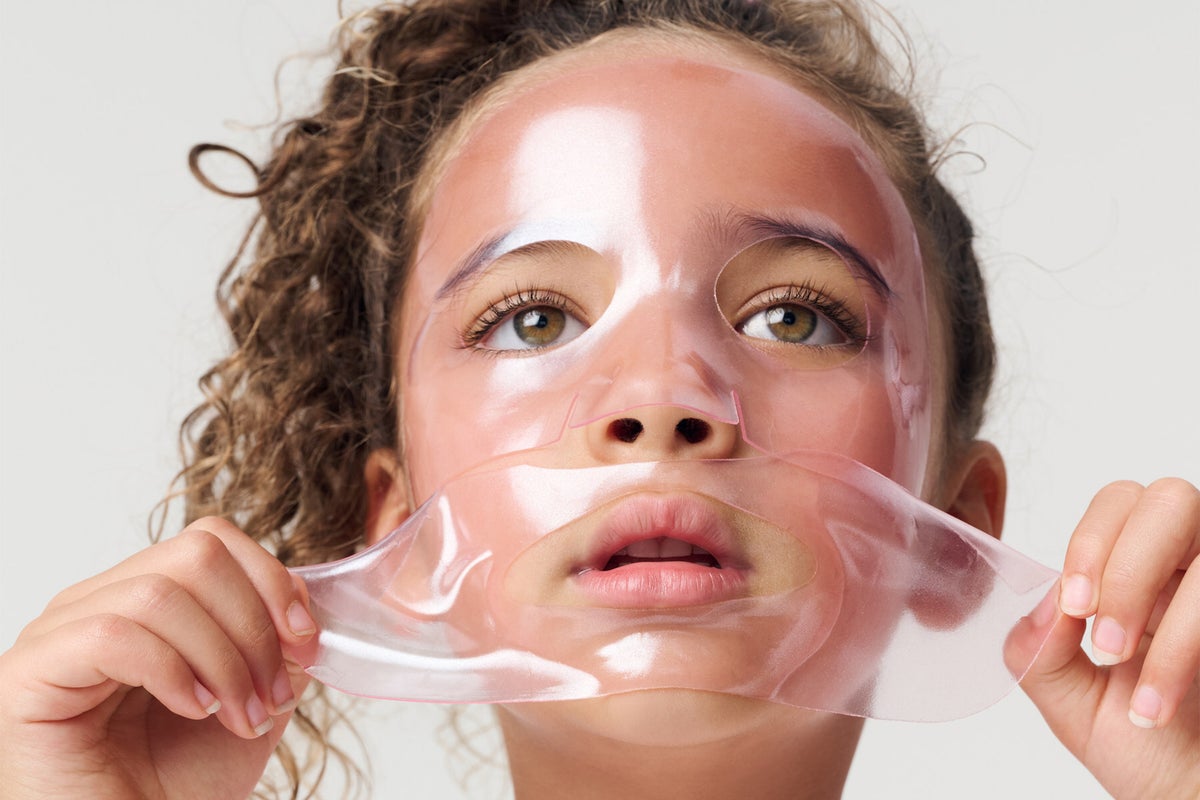
Pretty Little Liars star Shay Mitchell’s new skincare range for kids as young as four years old includes £6 hydrogel masks in two versions – “hydrating” with Vitamin B12 and “after-sun” with aloe vera.
The latter is described on her brand Rini’s website as “a green shimmery, two-piece jelly mask designed to fit growing faces (ages 4+)… to help skin recover from sun, environmental, and post-play stress”. There is also the Everyday Facial Sheet Mask with vitamin E in cute panda, puppy, and unicorn designs (£5).
Since she lauched her Korean-made brand on Instagram at the weekend, Mitchell, 38, who also has a popular luggage brand Béis, has received fierce criticism from people on social media who are outraged that she’s encouraging young children barely out of nappies to focus on their appearance, calling it “dystopian” and “depressing”, and accusing the brand of blurring the lines between care and consumerism.
Rini’s mission, however, sounds very different: It’s to “nurture health habits” and “spark confidence” in a world “where skincare meets play”.
The brand was inspired by Mitchell’s two mini-me children, Atlas, six, and Rome, three, wanting “to do what mummy does” with face masks, as well as “their curiosity, and all the little moments” that made her realise “how early it starts”.
“Rini isn’t about beauty, it’s about self-care,” Mitchell continued in a caption on her Instagram. “[It’s] About teaching our kids that taking care of themselves can be fun, gentle, and safe.”

Using face masks might seem like harmless fun, but it’s one step away from your child turning into a full-blown “Sephora kid” – which has become shorthand for children who use high-end beauty products. The current trend of young children, tweens, and teens obsessed with skincare is in full swing among my children’s primary school friends in west London – even in the reception class of five-year-olds.
Beauty-themed birthdays have become so regular on my children’s party circuit that I squirm every time I hear the ping of the class WhatsApp in case it’s yet another one. Presents can only be Labubus, or, far worse, the dreaded Sephora gift voucher. I was even bamboozled into allowing my daughter Liberty, seven, to have her last birthday party at Claire’s, a big mistake in which she and her friends had a makeover and walked the runway, while carrying horrid handbags around the store that had been opened an hour early for the event. Luckily, it wasn’t a big party, so there weren’t too many children there being “groomed” into being little adults, which saved me a fortune on beauty and accessory goodie bags.

It was my own fault for agreeing to it, and something I will never again repeat. I’m sticking to old-fashioned fun. A noisy, large-scale soft play, a chaotic swimming pool trip or a jaunt to the local stables. Anything is better than these increasingly popular makeover parties, which have become a conveyor belt of mini-me sleepover spa parties. A mum recently organised one with a mobile beautician and sent us all photos of the girls, including my daughter Lola, nine, in matchy-matchy pink towelling robes, while having pedicures with face masks on. Liberty even once asked me if we could buy her friend Charlotte Tilbury’s makeup.
I’m putting my foot down before it’s too late. Childhood should be about make-believe, not make-up. I’ve banned my kids from watching any more GRWM (Get Ready with Me) videos, which included one starring Kylie Jenner and her seven-year-old daughter Stormi in their first mother-daughter makeup tutorial in July. It is depressing that children as young as seven are now sharing their multi-step skincare routines. There is something deeply wrong when girls are focusing on anti–ageing before reaching puberty, on TikTok, Instagram, and YouTube.
When I was four, I was playing with teddies, not face masks. By seven or eight, I was into Blue Peter, not beauty products, and even at age 10, I was not getting my nails painted as a treat with my mum at the nail salon. I was climbing trees in Richmond Park and playing Monopoly.
Beauty-themed birthdays have become so regular on my Gen Alpha party circuit that I squirm every time I hear the ping of the class WhatsApp in case it’s yet another one
Children aged four do not need to worry about wrinkles – and sit around with a panda face mask on, when their time is better spent reading and doing creative play. Yet Rini joins a growing trend of skincare lines for Gen Alpha (those under-15), including Evereden, Pour Tous, Sincerely Yours, and Bubble. And of course it’s big business. It feeds into a beauty-industrial complex that has been stalking women’s insecurities for years. Millions are made by peddling products, services and images that promise to boost our self-worth. Starting girls young on these apparent self-care routines guarantees a lifetime supply of customers craving unattainable beauty standards, which will ultimately boost the bottom line for corporations and manufacturers.
But a backlash is gently building. California introduced a bill to prohibit the sale of over-the-counter anti-ageing products with ingredients like retinol and alpha hydroxy acids to minors under 18, amid concerns that children as young as eight are using these products, marketed for adult skin, despite risks like irritation, rashes, and long-term damage.
But it’s the damage it is doing to young minds that is really concerning. Gen Alpha’s early exposure to social media means they are under pressure to present a perfect, curated image of themselves online. The need to achieve flawless skin, as seen in filtered or airbrushed social media images, can have profound psychological effects on self-esteem when girls don't meet these idealised standards. A Dove report found that one in two girls aged 10-14 say they feel pressure to look perfect online and one in three girls in this age group feel they are not beautiful enough to post a picture without editing. In the Dove Self-Esteem project report, 90 per cent of girls now say they follow at least one social media account that makes them feel less beautiful.
Many report that they learned these expectations directly from beauty brands and influencers marketing “perfect skin”, which creates the perfect beauty doom loop for our children to purchase expensive and unnecessary products (or beg their parents to buy them).

A belief has been created among under-15s that normal features are “problems” that need fixing. Skin texture needs treatment, dark circles are unacceptable; the new trend for “glass skin” is the expected standard.
Dr Emma Wedgeworth, a consultant dermatologist and member of the British Cosmetic Dermatology Group, tells me that while there is nothing in the Rini facemasks that would likely damage a child’s skin barrier, it’s not adding to their skin health in any way, either. “Face masks are completely unnecessary for a four-year-old, and it’s worrying that brands are targeting this age group,” she says. It’s opening the door to a whole skincare routine for children at a time that is, she says, “completely inappropriate”.
“As adults, we need to be making the decisions for our children’s skin,” she continues. “Our skin health isn’t role play.”

She strongly advises against putting any unnecessary ingredients on children’s skin. “Children’s skin has a very sensitive immune system, which is still developing and regulating. They are also more likely to absorb ingredients than adults due to a larger surface area and volume ratio. By introducing unnecessary ingredients, there is concern that you could sensitise the skin, leading to later allergies and reactive skin.”
Mitchell might sell her kids-friendly skincare range in the name of self-care, but I believe real care is giving them a childhood free from Gen Alpha beauty products. Our children have got the rest of their lives to feel insecure about their looks – and spending all their hard-earned cash on retinol creams and injectable peptide treatments.
We need to give them – and their skin – a break.