
Get all your news in one place.
100’s of premium titles.
One app.
Start reading
Space
Space
Science
Anthony Wood

See the 'Seven Sisters' of the Pleiades swim in the light of a waxing moon at sunset tonight

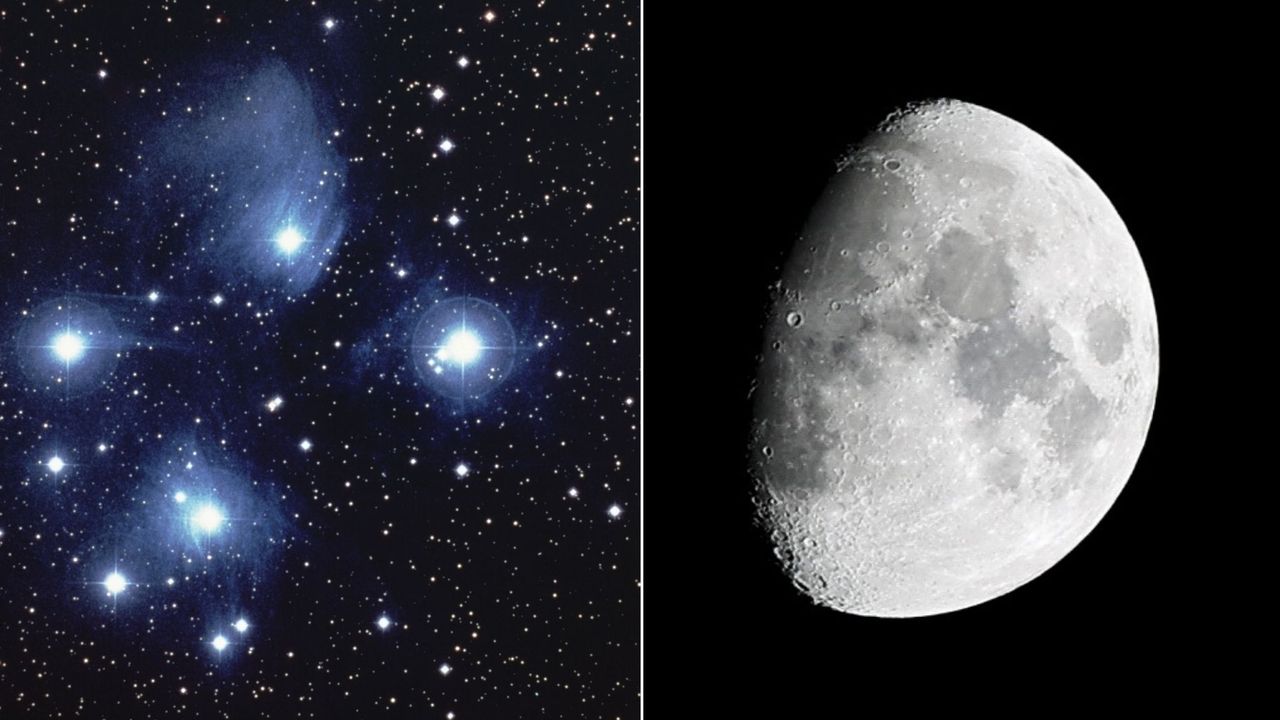
A silvery waxing moon is shown to the right of a two-panel image with most of its right side illuminated by sunlight against a black sky, leaving only a small crescent wreathed in impenetrable shadow. Dark lunar seas and craters can be seen marking the lunar surface. A collection of blue-white stars are pictured to the left, surrounded by a diffuse blue glow against the dimmer starfield beyond, which is threaded with wispy clouds.

Look high above the southeastern horizon in the hours following sunset on Jan. 27 to see the waxing gibbous moon shine alongside the Pleiades open star cluster in the constellation Taurus.

At sunset, the 76%-lit moon will dominate the winter sky, with the Pleiades positioned less than 5 degrees to the right of the moon. Located about 440 light-years from Earth, the light we see from the Pleiades tonight began its journey in the late 1500s, long before the invention of the telescope! The soft glow cast by the roughly 1,000-strong stellar hive will become more apparent as dusk fades to night, though the reflected light of the waxing moon will make viewing it with the naked eye a greater challenge than on previous nights.

Both the moon and Pleiades will be close enough to share the field of view of a pair of 10X50 binoculars, which will help reveal the handful of dazzling blue-white stars from which the cluster gets its "Seven Sisters" moniker — Asterope, Alcyone, Celaeno, Electra, Merope, Maia and Taygete.

Celestron NexStar 4SE
(Image credit: Amazon)

The Celestron NexStar 4SE is ideal for beginners wanting quality, reliable and quick views of the night sky. It's sturdily built, quick to set up and automatically locates night sky targets and provides crisp, clear views of them. For a more in-depth look at our Celestron NexStar 4SE review

A telescope with an aperture of 6 inches will bring dozens more, fainter stars of the ancient cluster into view. It will also allow you to explore a host of dramatically shadowed impact sites — such as the Clavius and Tycho craters — scarring the southern lunar surface close to the line separating night from day, known as the terminator.

Over the course of the night, the moon will appear to drift away from the Pleiades, before finally setting shortly after 3 a.m. local time on Jan. 28. Remember to use a trusted website like Time and Date to discover the exact times that the moon will rise and fall from your location.

The Pleiades star cluster (Image credit: Photo by: Alan Dyer/VWPics/Universal Images Group via Getty Images)

Want to see the clue-white stars of the Pleiades and the craters of the moon up close? Then be sure to read our roundups of the best telescopes and binoculars for exploring the night sky. Astrophotographers may also want to read our guide to photographing the moon, along with our picks of the best lenses for immortalizing the post-sunset realm.

Editor's Note: If you capture the moon shining with the Pleiades and want to share your astrophotography with Space.com's readers, then please send your photo(s), comments, and your name and location to spacephotos@space.com.

Sign up to read this article
Read news from 100’s of titles, curated specifically for you.
Already a member? Sign in here
Related Stories
Top stories on inkl right now
One subscription that gives you access to news from hundreds of sites
Already a member? Sign in here
Our Picks
Fourteen days free
Download the app
One app. One membership.
100+ trusted global sources.