
Get all your news in one place.
100’s of premium titles.
One app.
Start reading
Space
Space
Science
Anthony Wood

See a slender crescent moon shine with Saturn in the western sky tonight

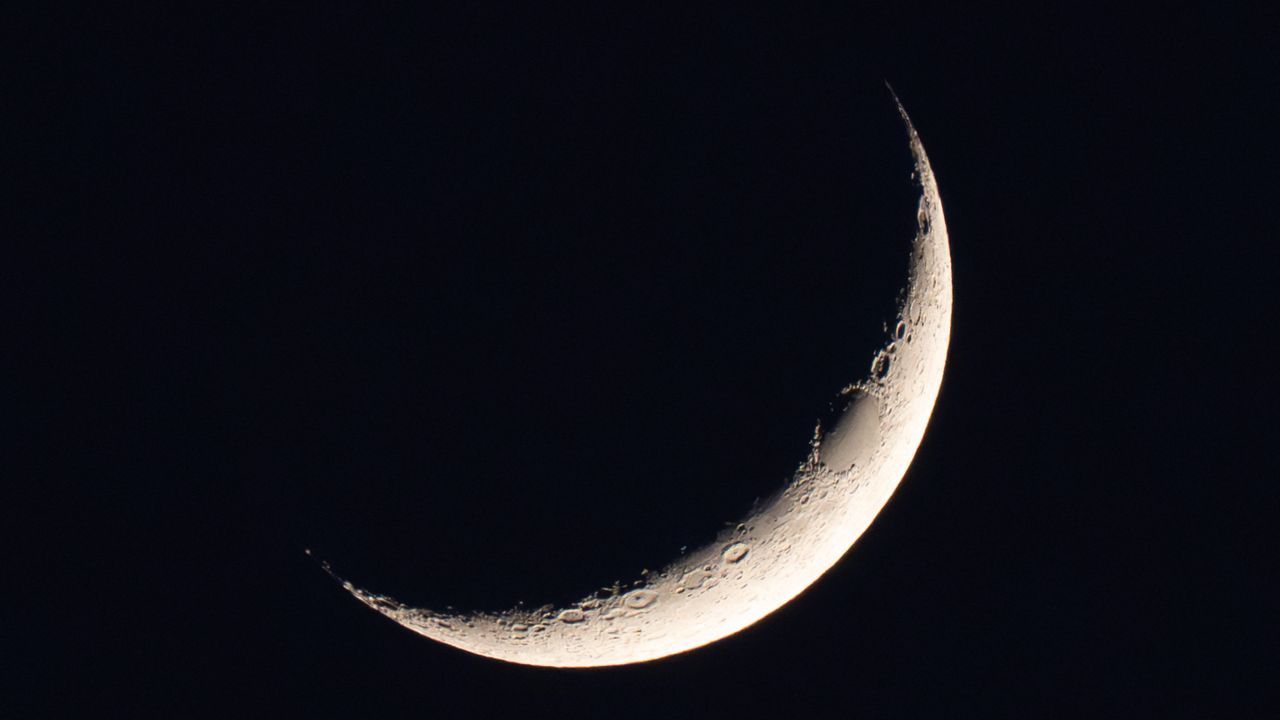
A photo of a thin waxing crescent moon shining in a black night sky. A dark oval is visible on the upper section of its sickle-like profile. Elsewhere, large craters can be seen pockmarking the illuminated wedge of the lunar disk.

Look toward the southwestern horizon at sunset on Jan. 22 to witness the slender crescent moon cozy up to the gas giant Saturn beneath the stars of the constellation Pisces.

The moon's 22%-lit disk will appear roughly 30 degrees above the horizon — roughly the width of three clenched fists held at arm's length. Saturn will appear as a steady, bright star-like object less than 7 degrees to the moon's upper left.

Both Saturn and the moon's delicate, sickle profile will make for a gorgeous naked eye stargazing target and photo opportunity, with the four bright stars of the Great Square of Pegasus asterism forming a diamond to the pair's upper right.

A small telescope will enhance the view of the moon, revealing the dark basalt plains of Mare Crisium (the Sea of Crisis) and Mare Fecunditatis (the Sea of Fertility). These lunar features formed billions of years ago, when molten lava filled ancient impact basins and solidified in the extreme space environment.

Point the same telescope toward Saturn to catch the thin profile of its famous ring system dividing the gas giant's cloudy disk. The rings are currently tilted almost edge-on as seen from Earth. Saturn's largest moons Titan, Dione, Rhea and Tethys will also be visible as bright specs of light extending to one side of the gas giant's disk.

The thin crescent moon will shine near Saturn and Neptune on Jan. 22. (Image credit: Starry Night/Chris Vaughan)
Celestron NexStar 8SE
(Image credit: Amazon)

We reckon the Celestron NexStar 8SE is the best motorized telescope out there as it's great for astrophotography, deep-space observing and it offers stunning detailed imagery. It is a little pricey but for what you get, it's good value. For a more detailed look, you can check out our Celestron NexStar 8SE review.

Neptune also lurks nearby on the night of Jan. 22. The distant ice giant — about 17 times farther from the sun than Earth — sits less than 2 degrees above Saturn, though you'll need a telescope with an aperture of at least 8-inches (200 millimeters) to resolve the tiny blue dot of its disk. For scale, the tip of your little finger held at arm's length accounts for roughly 1 degree of sky.

The moon and Saturn will set around four and a half hours after the sun on Jan. 22. By the following night, the upturned lunar crescent will have leapt past Saturn to appear above it in the evening sky, noticeably thicker ahead of its first quarter phase on Jan. 25, when its right half will be bathed in direct sunlight as its left lies in shadow.

Want to capture beautiful photos of the waxing moon? Then why not read our guide to photographing the lunar surface, or peruse our picks of the best cameras and lenses for astrophotography if you're looking to upgrade your gear in preparation for the 2026 skywatching season. Our roundups of the best telescopes for viewing Saturn and Jupiter can also help you as the gas giants put on a spectacular show to dominate the night sky in January.

Editor's Note: If you take a picture of the moon with Saturn and want to share your astrophotography with Space.com's readers, then please send your photo(s), comments, and your name and location to spacephotos@space.com.

Sign up to read this article
Read news from 100’s of titles, curated specifically for you.
Already a member? Sign in here
Related Stories
Top stories on inkl right now
One subscription that gives you access to news from hundreds of sites
Already a member? Sign in here
Our Picks
Fourteen days free
Download the app
One app. One membership.
100+ trusted global sources.