Aging research : The body relies on immune cells to remove cells that have become old or dysfunctional. New research from Stanford Medicine suggests that this cleanup process becomes less effective with age, allowing senescent neutrophils to accumulate and contribute to inflammation.
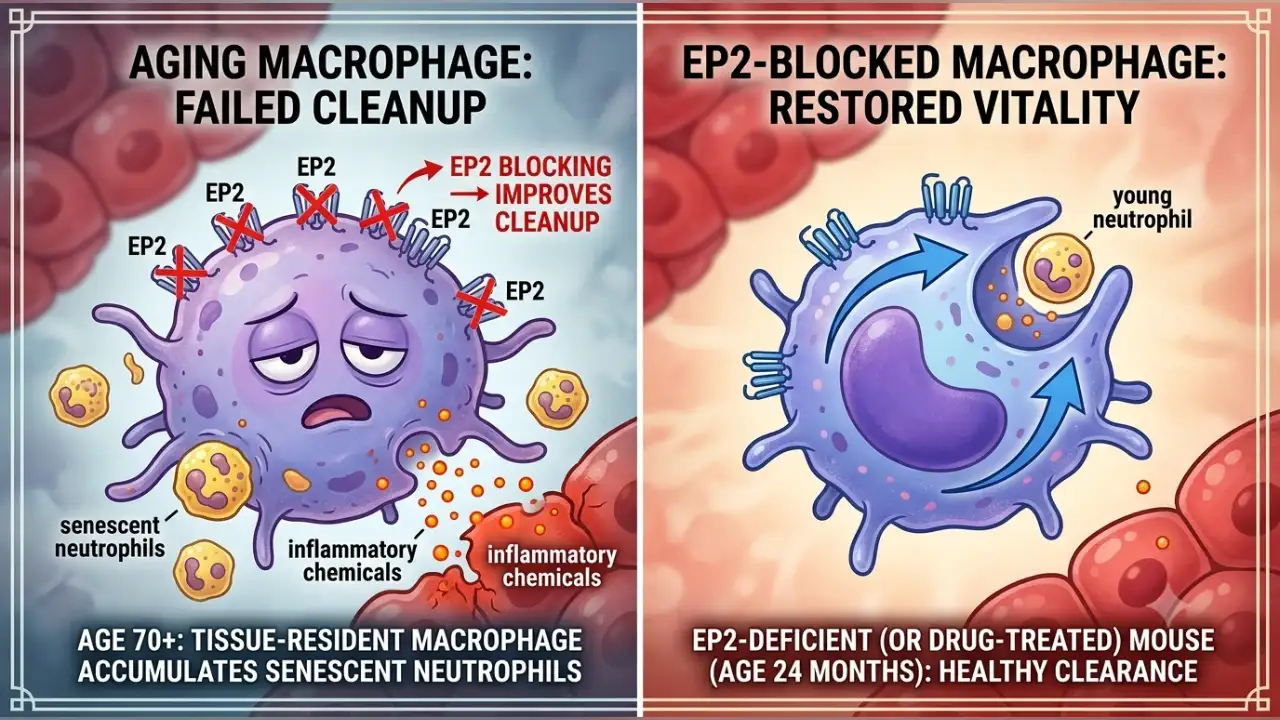
The study, conducted in mice and human cells, found that tissue-resident macrophages become less effective at removing neutrophils as they age. Blocking a receptor called EP2 on these macrophages helped older mice retain characteristics seen in younger animals.
The effects of disabling EP2 in tissue-resident macrophages were seen in the brain, heart, skeletal muscle, liver, spleen, bone marrow, kidney and colon.
The study was published in Science. Katrin Andreasson, MD, Edward F. and Irene Thiel Pimley Professor in Neurology and Neurological Sciences, was the senior author, while Jessy Tan, PhD, an instructor in neurology, was the lead author.
Aging leaves more neutrophils in a dysfunctional state
Neutrophils are the most abundant type of white blood cell and act as first responders to bacterial, viral and fungal threats. Produced in the bone marrow, they enter the bloodstream and patrol for these threats.
They can release toxic substances and self-destruct, forming web-like traps around microbes. Neutrophils typically survive for about 12 hours and can live for up to 24 hours.
About 90% of circulating neutrophils eventually reach the liver, spleen or bone marrow, where other immune cells remove them.
With age, many neutrophils that do not encounter pathogens quickly enter senescence. In this dysfunctional state, they can release harmful chemicals that damage nearby cells and promote inflammation. Neutrophil numbers also increase with age, along with the number that become senescent.
Tissue-resident macrophages lose their cleanup ability
Macrophages remove dead and dysfunctional cells, fight pathogens, coordinate immune responses and release growth factors.
Tissue-resident macrophages are long-lived immune cells that settle into organs during fetal development and remain there throughout life. They specialize according to the organs where they reside and are responsible for engulfing senescent cells, particularly neutrophils.
Roughly 100 billion neutrophils are produced each day and need to be cleared.
Earlier research from Andreasson's group, published in Nature in 2021, found that tissue-resident macrophages become increasingly vulnerable to inflammation with age and can contribute to inflammation themselves. Their energy metabolism also deteriorates with age. As Andreasson explained, “Once that starts, there's a steady decline in a macrophage's performance,” as per ScienceDaily.
PGE2 and EP2 disrupt neutrophil clearance
The researchers focused on prostaglandin E2, or PGE2, a hormone involved in inflammation and pain in mice and humans.
PGE2 is one of five types of prostaglandins and can affect cells through different receptors. EP2 strongly promotes inflammation, and tissue-resident macrophages contain high levels of the receptor.
PGE2 production rises with infection, injury and toxic substances, including compounds produced as the body ages. Earlier work showed that PGE2 levels increase substantially over time, while tissue-resident macrophages develop higher concentrations of EP2 with age.
The researchers found that repeated stimulation of EP2 by increasing PGE2 levels weakens macrophages’ ability to engulf neutrophils. Senescent neutrophils can then accumulate in the bloodstream and tissues.
The findings suggest that EP2 is critical to the decline in macrophage function. When tissue-resident macrophages lack EP2, or when the receptor is blocked by a drug, this decline does not occur.
Removing EP2 helped older mice retain youthful characteristics
Researchers engineered mice whose EP2 gene could be deleted at a chosen time specifically in tissue-resident macrophages.
Removing EP2 restored the macrophages’ ability to dispose of neutrophils and reversed the disruption caused by PGE2.
The researchers compared young normal mice that were 6 to 8 months old with old normal mice that were 23 to 25 months old. They also studied older mice whose EP2 gene had been deleted at 4 to 6 months.
In normal older mice, 71 blood proteins changed significantly. Of those, 59 remained at youthful levels in older mice whose macrophages lacked EP2.
Many of those proteins came from the liver, which is rich in tissue-resident macrophages and is a major contributor to age-related changes in blood chemistry.
Normal old mice accumulated senescent neutrophils in the liver, spleen and bone marrow, with smaller increases throughout other organs. Older mice without EP2 had organ neutrophil levels closer to those seen in young mice.
The mice without EP2 appeared younger, leaner and more physically fit. They had less visceral fat and more muscle, while their performance on several organ-function tests matched that of young mice.
EP2 removal improved inflammation, strength and memory
Removing EP2 reduced inflammation in the blood, liver, colon, heart, kidney and hippocampus.
Older mice without EP2 performed like young mice on tests of speed, balance and forelimb grip strength.
Their memory was also stronger. They were nearly as effective as young mice at navigating a maze and recognizing objects, and performed better than mice of the same age that still had EP2.
Researchers want to target EP2 specifically
There is no approved drug that selectively shuts down EP2.
NSAIDs such as aspirin reduce PGE2 production and can reduce pain, fever, swelling and redness. However, they also affect other prostaglandins that have important roles.
PGE2 itself can also have beneficial effects through receptors other than EP2.
The researchers therefore want to target EP2 specifically rather than broadly suppress PGE2.
In another experiment, otherwise normal 22-month-old mice received an experimental EP2 inhibitor for two months. The treatment brought total neutrophil and senescent neutrophil levels closer to youthful levels.
In cell cultures, aging reduced macrophages’ ability to engulf and digest worn-out neutrophils. Blocking EP2 significantly restored that ability.
Human liver cells showed similar changes
The researchers examined a large database containing cell information from young, old and diseased human livers.
Older livers showed increased neutrophil accumulation, greater neutrophil senescence, declining tissue-resident macrophage function and elevated EP2 activity.
These changes were more pronounced in diseased livers.
Andreasson said this was the first time these changes had been observed in human cells, as per ScienceDaily.
The findings suggest that improving the body’s ability to remove senescent neutrophils could eventually have therapeutic benefits.
The researchers need to develop a safe drug that blocks EP2 without interfering with earlier processes such as PGE2 production.