
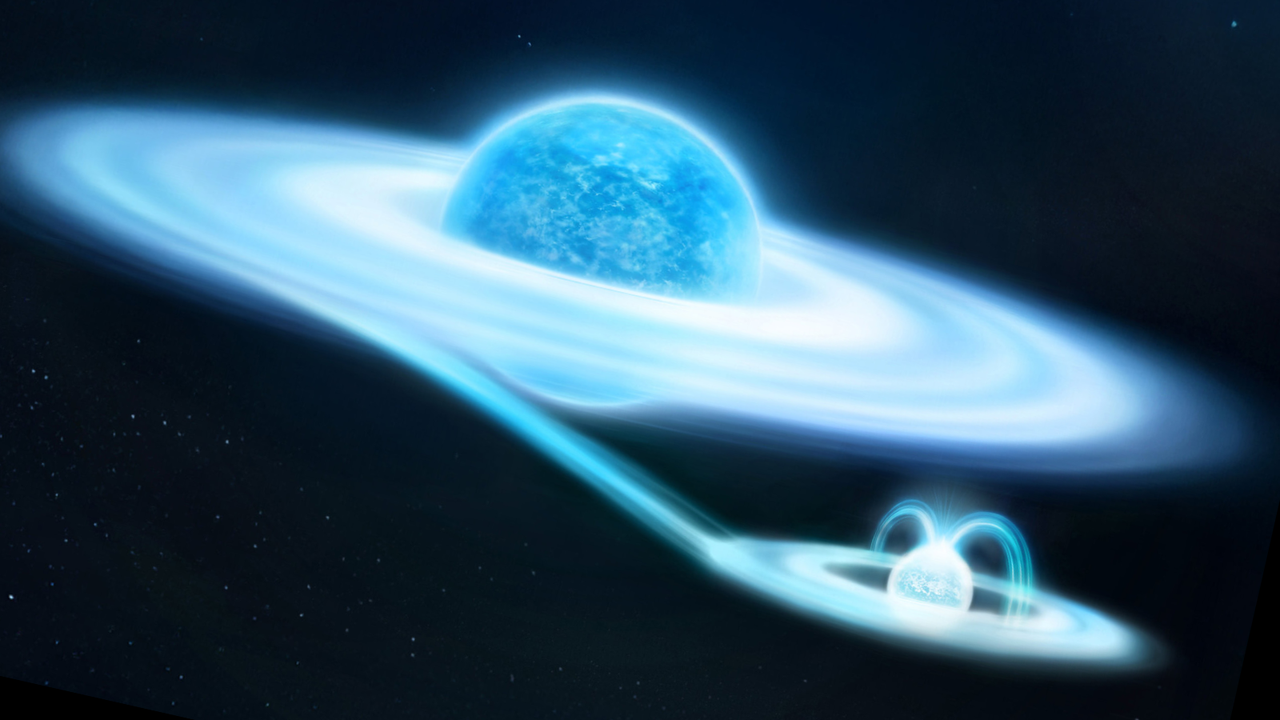
Astronomers have used the XRISM (X-Ray Imaging and Spectroscopy Mission) X-ray spacecraft to discover that a star is being slowly devoured by an elusive stellar companion, solving a mystery that has baffled scientists for over a century.
The star in question is named gamma-Cas, located around 550 light-years away and visible with the unaided eye over Europe on clear nights as the peak of a distinctive "W" in the constellation Cassiopeia. The star gamma-Cas, which is 19 times the size of the sun and up to 65,000 times brighter than our star, first became a puzzle in 1866 when it was found to possess a bright hydrogen "fingerprint" unlike other stars such as the sun.