When she meets people who are visiting the Rio Grande Valley for the first time, Mollie Wallace—a 31-year-old occupational therapist in McAllen—usually asks whether they’ve gone to the Santa Ana National Wildlife Refuge yet.
The refuge is a point of pride for Wallace, who was raised in the Valley. She’s come there through multiple phases of her life, calling the 2,000-plus acres of riparian forest and thornscrub on the southern edge of Alamo a formative place for her and generations of local kids.

“I’ve grown older through here, and it’s a fun reference for anyone who’s from the Valley,” she told the Texas Observer on an early September morning, walking toward the refuge’s observation tower. “I love showing it to people who say, ‘There’s nothing to do in the Valley,’ or ‘We don’t have any green spaces.’”
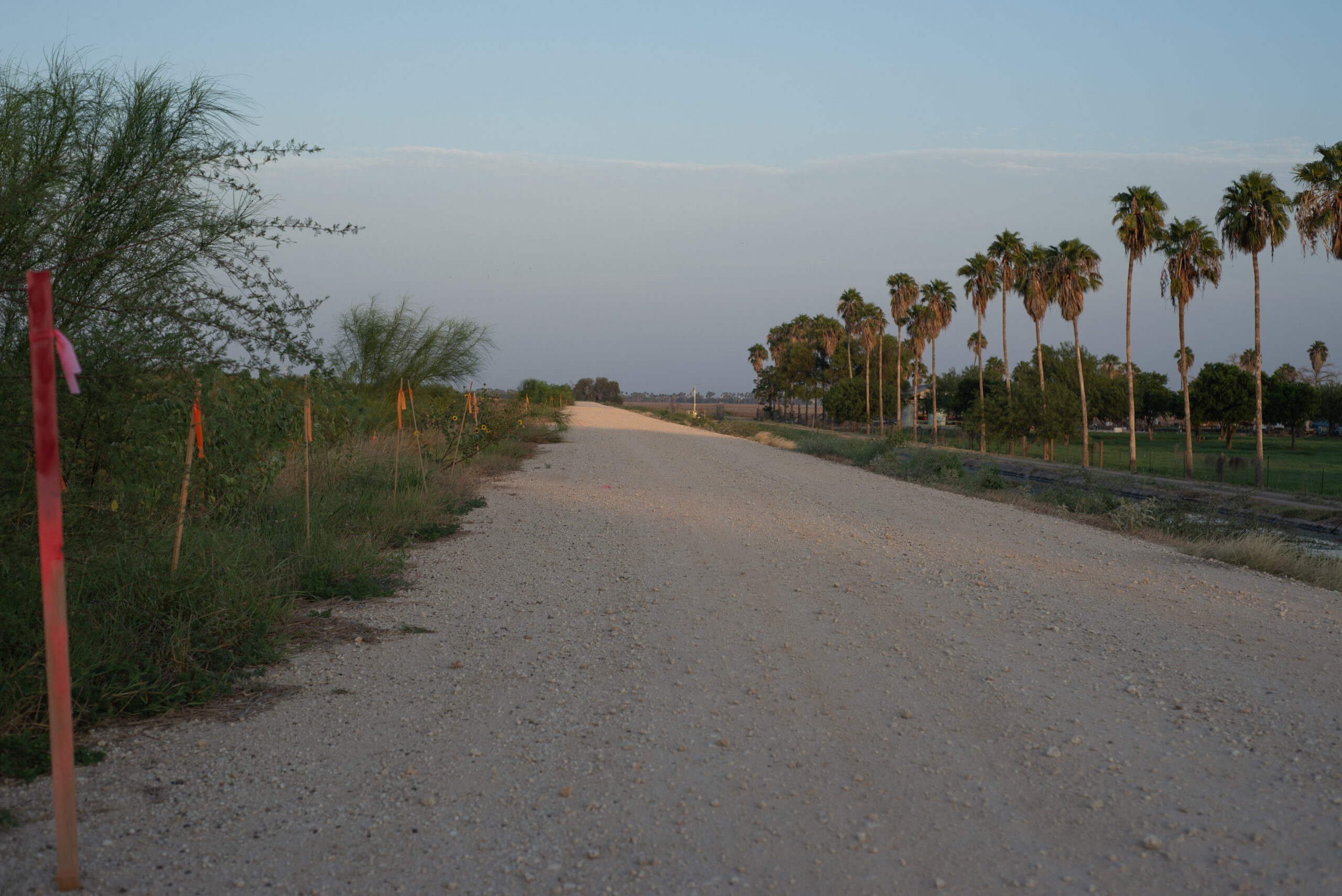
It’s the first time Wallace has visited since surveyors thrust thin wooden stakes, some painted orange, others pink, into the earth along the levee road from east to west, marking where sections of 30-foot-tall steel bollards atop concrete wall will create a physical barrier miles from the Rio Grande, Texas’ border with Mexico. At some point in the future, Santa Ana’s visitors will see the wall before they get to the refuge’s trailheads, which will then only be accessible through a locked gate. Though the wall will not run through the heart of the refuge, it will trap much of it beyond steel.
The construction—which started in June this year and paused in mid-July because of a lawsuit from the Hidalgo County Irrigation District—is nearly a decade in the making. President Donald Trump’s first administration quietly prepared to build a wall through Santa Ana in 2017, which was condemned by Valley’s congressional leadership, local residents, and beyond. The plan then was for an 18-foot-tall wall to go through the refuge, essentially destroying its function as a wildlife corridor.
Saving the refuge from wall construction became a coalescing issue in the Rio Grande Valley and across the state. During one protest in August 2017, hundreds of people formed a human chain along the levee road. By the end of that year, CBP was intent on Santa Ana being the start of a 60-mile stretch of new barrier.
Then, thanks to an effort led by U.S. House Representative Henry Cuellar, language was added to 2018 appropriations legislation shielding Santa Ana—called the “crown jewel” of a federal refuge system belonging to the U.S. Fish and Wildlife Service that runs along the Rio Grande—from wall construction. The following year, additional Valley sites were added to this exemption list. Despite a brief scare when Trump declared a national emergency to shift Defense Department funds into wall building, Santa Ana survived that administration unscathed.
That state of affairs lasted until this past summer, when Congress passed the so-called One Big Beautiful Bill. As the nation’s attention fixated on the healthcare implications, the act pumped an unprecedented $46.6 billion into border barrier construction, drawing little outcry at the time. This bill—what’s called a reconciliation measure that doesn’t pass through the typical appropriations process—did not reiterate the protections for Santa Ana and other sites including the La Lomita chapel and National Butterfly Center, creating a green light for Trump to ignore the will of Congress as expressed in at least six prior funding measures.
Contractors erected two short sections of wall in June and July on the western edge of Santa Ana, using what appear to be older bollards. Those bollards, weathered likely from years in storage, end a dozen or so yards from the black-painted bollards built during the first Trump administration. That section of older wall is the same that Trump spoke in front of, and signed, in 2021, in what was his first public appearance after the January 6 insurrection and former President Joe Biden’s election. CBP did not respond to the Observer’s emailed questions on when the bollards were made.
Cuellar, a Laredo Democrat, is now trying to get the Rio Grande Valley sites exempted again through the next bill outlining the Homeland Security budget, he told the Observer in a phone call. This time, he said, neither appropriations nor reconciliation money could be used for border fencing through Santa Ana, La Lomita, or the other sites. He’s hopeful that Congress can get the bill passed before the end of the year.
“They’re trying to beat the clock, in my opinion,” Cuellar said, referring to the GOP. “And the more time the local folks can give us through lawsuits or whatever way to delay it—so we can at least get into December and hopefully have a shot at trying to pass the appropriation bill with this appropriate language—that will pretty much stop them [in] their tracks.”
Santa Ana is not in Cuellar’s current district but rather in Republican Congresswoman Monica De La Cruz’s, which stretches north all the way to Seguin.
“The border construction pause is up to the courts,” her office told the Observer in a statement. “Congresswoman De La Cruz has supported exemptions specifically for the Santa Ana National Wildlife Refuge, and she continues to consult closely with community leaders regarding ongoing construction plans.”
During the Biden administration, De La Cruz voted for the government funding bill for fiscal year 2024 that included the Rio Grande Valley site exemptions. She also voted for the One Big Beautiful Bill, which did not include these protections. (Her electoral opponent, Bobby Pulido, told the Observer in his first public comment on the Santa Ana wall in late July: “I haven’t said anything about it, but I obviously oppose it.”
The last protest over Santa Ana to get any news coverage was in February, as attention to wall building has instead concentrated at Big Bend, where U.S. Customs and Border Protection (CBP) is clearing portions of the West Texas national park for patrol roads and vehicle barriers. Nearby residents sued the federal government last week to prevent further construction, following months of bipartisan befuddlement over the Trump administration’s border wall plans.
Wallace remembers the greater level of public resistance nearly a decade ago, when she was a student at the University of Texas Rio Grande Valley.
“It just kind of felt like what we did mattered,” Wallace said while reminiscing about those protests, which she attended. “I don’t speak for everyone, but I definitely feel like everything I do is like a drop in the bucket. I feel very powerless. But it’s not a good excuse to not show up.”
From atop the refuge’s observation tower, the new wall can be seen. Once the fence is finished, it will make an imposing scar through the north side of this 360-degree view that today shows what this region looked like long before it was called the Rio Grande Valley, filled with hardy, drought-tolerant trees, thorny plants, and tropical flowers.
“I think it represents us so well,” Wallace said of Santa Ana. “So to put a wall through it is just metaphorically and physically and literally such a stab to our entire home.”
Spencer Construction and Royal Concrete, the contractors building the wall through Santa Ana, stopped working in July after the Hidalgo County Irrigation District No. 2 filed a lawsuit against them, alleging that they were building on irrigation district property; had put debris in the irrigation district’s canal, which abuts the levee; and were trespassing. The canal supplies water from the Rio Grande to several thousand acres of farms and homes, including being the sole provider of water for Pharr, San Juan, and Alamo, according to the lawsuit.
Two weeks later, in August, the Department of Justice (DOJ) moved the lawsuit into a federal court and requested the case be dismissed, arguing that state trespassing laws did not apply. Federal District Judge Arthur Jones, in McAllen, has yet to rule on the case but has ordered construction paused until October 15.
Scott Nicol, an art professor at South Texas College, has spent years advocating against the government building border wall anywhere in the Rio Grande Valley.
“The Trump administration goes on and on and on and on and on about how there were all these huge number of crossings during the Biden administration,” Nicol said while walking around the Santa Ana fence sections in early September. “That’s after Trump had already built hundreds and hundreds of miles of border walls. You had this huge spike in crossings, but the walls are there, so what the hell did those walls do?”
Nicol was active in a coalition whose pressure helped push the site exemptions during the first Trump administration. About 12 miles west of Santa Ana, the historic La Lomita chapel will reportedly see the wall run south off of the levee—atop which almost all border fencing in Hidalgo County runs, part of a compromise approach stretching back to the W. Bush administration—and toward the river to accommodate the aged house of worship. Another few miles upriver, the National Butterfly Center, which the levee bisects, presently shows no signs of construction. However, there are placemarker buoys in the bend of the Rio Grande that creates the southern border of the center’s land, signaling that large, orange “waterborne barrier system”—sometimes known by critics as razor buoys—will soon arrive. Significant stretches of Hidalgo County already host finished wall.
“I think it was a lot easier to get people concerned when it was coming, and there was a chance of stopping it,” Nicol said. “I think it becomes difficult, very difficult now, because it’s like, ‘Well, shit, it’s already happened.’”
That’s the fight at hand in Big Bend: trying to stop the bulldozers before a sense of inevitability kicks in. In August, crews and heavy machinery arrived to start constructing what CBP now says are going to be patrol roads and vehicle barriers. But earlier this year, Big Bend was also set to get the same steel bollards making their way through Santa Ana. Bipartisan resistance from Texas congressional and legislative officials, and even Texas Governor Greg Abbott, made CBP change plans. Though CBP assured the public it was not yet constructing its planned vehicle barriers or patrol roads in the area, a New York Times investigation using satellite imagery found that it was.
CBP can legally tear through Big Bend and Santa Ana, protected public lands, in part thanks to the Trump administration’s waiving environmental laws to accelerate barrier construction along the southern border. That legal mechanism was created in 2005 by the Real ID Act, allowing the Department of Homeland Security secretary to waive dozens of environmental laws to “ensure expeditious construction of the barriers and roads” that make up the southern border.
On September 14, the Hidalgo County drainage district named the United States as a defendant in its lawsuit against Spencer Construction and Royal Concrete, the wall builders. It’s seeking a permanent injunction, hoping to stop wall construction in the area completely.
“The harm Plaintiff will suffer is irreparable because damage to irrigation infrastructure, interference with public water management operations, and unauthorized alteration of Plaintiff’s Property cannot be adequately compensated solely through monetary damages,” the filing reads. “Furthermore, the potential disruption or loss of water service to Plaintiff’s customers also cannot be fully compensated by damages. Plaintiff’s customers [sic] loss of water would be catastrophic and cannot be remedied.”
During the early, muggy mornings of September, a month ahead of when wall construction might resume, birders, hikers, and bikers continued passing through this once-protected wildlife corridor. No one on the levee road paid much attention to the thin wooden stakes, some of which were already broken or taken out of the ground and thrown yards away from their points of origin.
The levee road is supposedly closed, according to the refuge. Maps for visitors now highlight the road in red to signify this. But people, Border Patrol agents and Alamo Police officers included, quietly pedaled down the caliche and into the trails on their bikes as dawn faded, using the road as if it was not a construction site. Because, for now, it’s not.