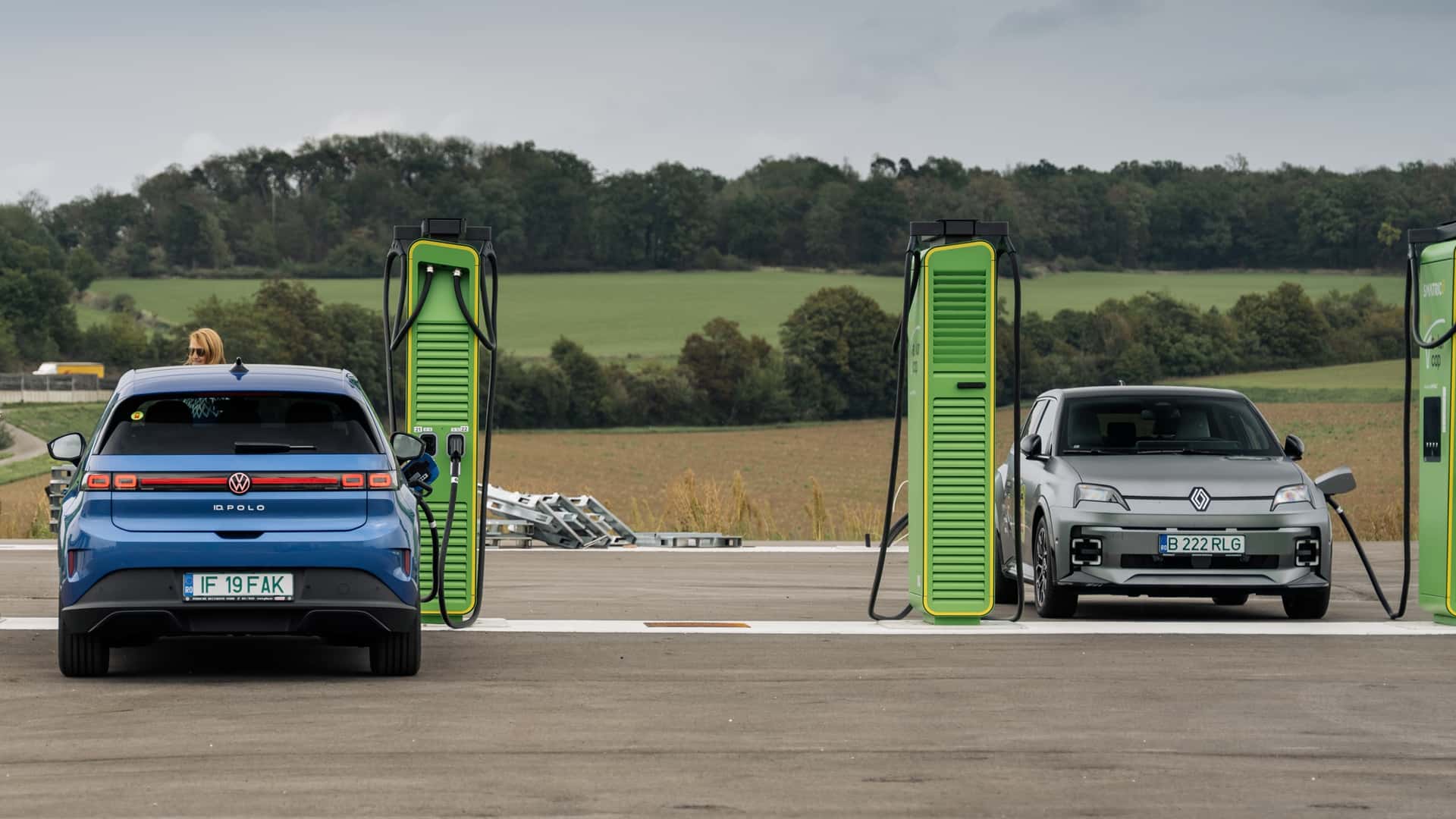
- The ID. Polo used 5.5% less energy per kilometer than the Renault 5 on a highway-heavy European road trip.
- With equal 52-kWh usable batteries, calculated range was 188 miles for the Polo versus 178 for the Renault.
- The Polo spent 25 fewer minutes charging, although different charging windows prevent a direct speed comparison.
Give two very similar electric hatchbacks the same amount of electricity, and you would expect them to perform about the same on a road trip. The Volkswagen ID. Polo and Renault 5 E-Tech proved predictably similar in many ways during the Eurocharge by Schaeffler EV road trip, but one proved to be the better road-trip machine.

Both have 52 kilowatt-hours of usable battery capacity. On the third day of Eurocharge, the Polo stretched that energy further. But the bigger surprise came at the charging stops, and that deserves a closer look.
The day started with the cars leaving Tata, Hungary, for Turracher Höhe, Austria, on a route with around 80% highway driving and 20% mountain passes. Temperatures ranged from 6 to 20 degrees Celsius (43–68 degrees Fahrenheit) under overcast skies, with occasional rain mostly in the latter part of the day on Austrian mountain switchbacks.
The Renault 5 is a pretty efficient EV, but the VW ID. Polo showed that it could stretch its electrons even further. The R5 averaged 18.2 kWh/100 km (3.41 miles/kWh), while the Polo achieved 17.2 kWh/100 km (3.61 miles/kWh). That means it is around 5.5% more efficient and the better of the two for long drives.
Applied to their usable battery capacities, those figures produce calculated ranges of 302 km (188 miles) for the Polo and 286 km (178 miles) for the Renault. These are estimates based on observed consumption, rather than distances established by running either from full to flat.
Now that may not be a huge difference, and the Polo stood out for its extra range and quicker charging. Both cars started full, stopped three times, and finished with substantial reserves: 44% for the Polo and 36% for the Renault.
However, the Volkswagen logged 77 minutes of charging, compared with the Renault’s 102 minutes. That 25-minute difference, which excludes overnight charging at the hotel, is pretty significant. And 17 of those 25 minutes came from just one charging stop.
The Polo charged from 28% to 100% in 43 minutes, while the Renault needed 60 minutes to go from 23% to 100%. Different starting percentages and charging conditions mean this wasn’t a controlled charging-speed comparison, but the key point still remains: the Polo used less energy and recorded shorter charging sessions, although both crews chose to fill their batteries at lunch and arrived with plenty remaining.
Gallery: VW ID. Polo and Renault 5 E-Tech in Eurocharge
The two EVs have similar peak DC fast-charging power figures: 105 kW for the ID. Polo and 100 kW for the Renault 5 E-Tech. However, their official charging times suggest the Volkswagen has the better charging curve. It officially needs around 24 minutes to go from 10% to 80%, while Renault quotes 30 minutes from 15% to 80%.
My Renault 5 review found plenty to like beyond the numbers, and it’s still one of my favorite EVs ever. But what this comparison shows is that equal battery capacity doesn’t mean equal range or the same charging time. Whether those extra minutes matter depends partly on how quickly you eat, but the Polo comes closer to a gas-car-like road trip experience.