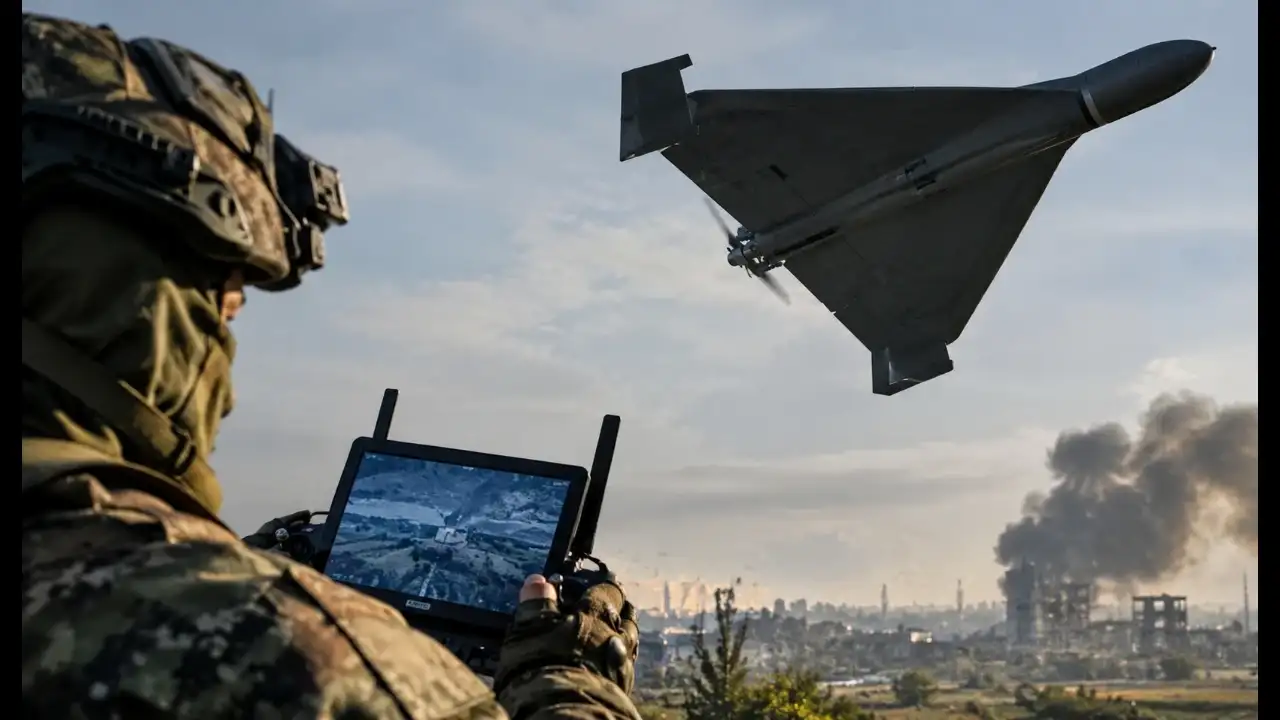
The sound of a Russian drone approaching a Ukrainian city once came with a little more time. The older Shahed-type aircraft were slow, usually cruising at around 180 km/h. That gave air-defense teams a longer window to find them, follow their route and try to bring them down.
The newer Geran drones are changing that calculation.

Russia has moved from propeller-driven versions to aircraft fitted with jet engines, with some variants reaching speeds of 500 km/h or more. The fastest in the group, the S8000 Banderol, is reported to reach about 650 km/h. The difference is not just a matter of speed on a specification sheet. It means a target can cover the same distance in far less time, leaving defenders with fewer opportunities to act.
The immediate consequence of these upgrades is a sharp decline in interception rates. When mobile fire groups were tracking 180 km/h propeller drones with spotlights and machine guns, interception rates frequently topped 90 percent. Against the jet-powered variants, that success rate has plummeted to roughly 60 percent. Target acquisition relies heavily on manual aim and tracer fire, which simply cannot track a dark, radar-absorbing airframe moving at 180 meters per second.
For Vasyl, a 26-year-old member of one of Ukraine’s mobile air-defence groups, the change is easy to see during a mission. He uses the call sign Racoon and operates a shoulder-fired ground-to-air missile. Recently, he watched a Russian jet-powered Shahed moving toward his position. The drone was flying too high for his team to engage it.
“Before, Shaheds used to fly lower — one or 1.5 kilometres above ground and we could work on them,” Vasyl said. The newer drones can fly at four, five or even seven kilometres, he said. At those heights, a weapon carried by a small mobile team may simply not have the reach needed to bring the aircraft down.
Why altitude has become such a problem for Ukraine
The earlier Shahed threat was difficult enough because Russia could launch the drones in large numbers. But their slower speed and lower flight paths gave Ukrainian defenders more time to detect and engage them. Mobile teams could move into position and use relatively short-range weapons against some of the incoming aircraft.
The jet-powered versions have altered that calculation. Their engines allow them to travel much faster, while their higher flight paths put them beyond the practical reach of some of the weapons used by mobile crews. A defender can therefore see the target without necessarily being able to attack it.
Air defence is not a single weapon or system that covers every threat in the same way. Ukraine uses several layers, with different systems designed to deal with aircraft at different speeds, heights and ranges. When a drone moves outside the envelope of one system, another layer has to take over.
The new drones leave defenders with only seconds
Altitude is only part of the problem. The speed of the jet-powered Shaheds is changing the amount of time Ukrainian crews have to react. Vasyl said his three-person mobile team can have only seconds to respond to one of the newer drones. Earlier propeller-powered Shaheds could sometimes give defenders minutes to prepare. That difference becomes critical when a drone is approaching a city or another protected area.
Russian manufacturing has overhauled its drone fleet, swapping slow propellers for Chinese-manufactured turbojet engines. The resulting munitions travel at three times the speed of their predecessors. At 600 kilometers per hour, ground-level acoustic detection is physically useless. By the time a spotter hears the jet turbine, the munition has already passed their position. Sirens now sound mere moments before impact. The shift is not a simple propulsion upgrade; it is a fundamental recalculation of the aerial battlefield designed to overwhelm detection grids through sheer velocity.
The transition began as an experiment with the Geran-3, a jet-powered analogue that topped out at 370 km/h. It served as a proof of concept before Russian engineers moved to mass production of far more capable systems at facilities like the Alabuga Special Economic Zone.
Strapping a jet engine to a lightweight drone chassis creates immense structural stress. To keep the airframes from tearing apart under high-speed aerodynamic loads, the new assembly lines abandoned the older, lighter honeycomb structures. Wreckage recovered from Ukrainian cities reveals reinforced composite bodies layering fiberglass over woven carbon fiber.
Internally, the avionics have matured alongside the airframes. Early Geran models relied on basic commercial GPS that was easily scrambled by electronic warfare. The new variants employ complex mesh-network radio modems, anti-jamming satellite receivers like the Comet system, and AI-assisted optical guidance. They do not just fly blind to a fixed coordinate. They adjust mid-flight, communicating across swarms to evade jamming cones.
A few extra minutes can allow a crew to identify the target, move into a suitable position and prepare its weapon. A few seconds leaves little room for adjustment. The faster the aircraft moves, the smaller the window between detection and arrival.
The change has also affected when the crews are working. Russia previously relied heavily on nighttime drone attacks, but Vasyl said the newer drones have been appearing throughout the day. His team has been operating for long periods without the same opportunity for rest.
“It all takes its toll,” he said. The crews remain on duty while the attacks continue, and the lack of sleep becomes another part of the air-defence problem. The technology is changing, but so is the physical demand placed on the people expected to stop it.
Erasing the Line Between Drone and Missile
The current threat relies on a lineage of munitions that no longer fit the traditional definition of a suicide drone. The Geran-4 operates at altitudes up to 5,000 meters and reaches speeds of 500 km/h. Powered by heavy-duty Telefly TF-TJ2000A turbojets, it carries a 90-kilogram thermobaric or high-explosive warhead, nearly doubling the explosive payload of the original Shahed.
The Geran-5 takes this evolution further. Visually, it abandons the classic delta-wing shape entirely, adopting a 5.5-meter wingspan that closely resembles a traditional cruise missile. It utilizes a tracking computer built around a commercial Raspberry Pi microcomputer and cruises at 600 km/h with a 1,000-kilometer range. Ukrainian intelligence estimates that Russian facilities are now producing a combined 3,000 Geran-4 and Geran-5 units per month. They are effectively manufacturing cruise missiles at the cost and scale of loitering munitions.
The Kinetic Geometry of the S8000 Banderol
The peak of this new development cycle is the S8000 Banderol. Categorized by defense analysts outright as a missile-drone, it is built around a Chinese Swiwin SW800Pro-A95 jet engine and maxes out at 650 km/h.
The Banderol fundamentally alters the kinetic math of an urban strike. It carries a 150-kilogram warhead, but the explosive yield is only half the problem. Impacting a target at 650 km/h transfers a devastating amount of kinetic energy. While a standard propeller-driven Geran might destroy the roof of a house, a Banderol carries enough mass and velocity to collapse a multi-story apartment block.
It is also highly maneuverable. Launched from ground platforms or mid-air from Mi-28N helicopters, the Banderol is programmed to execute sharp, high-G turns on its terminal approach. This makes intercept calculations exceptionally difficult for automated ground defense systems. Russia has heavily deployed the Banderol across the southern front, routinely using it to bypass defense grids around Odesa.
Russia is using the drones on a much larger scale
The increase in jet-powered attacks is also striking because of the numbers involved. Ukrainian Prime Minister Sergii Koretskyi said Russia launched 2,100 jet-powered attack drones and 136 missiles at Ukraine during the first three weeks of September.
Those attacks killed 288 people, including four children, according to the figures he gave. In August, he said Russia launched more than 2,800 of the drones. Moscow denies targeting civilians, despite the civilian deaths and damage caused by its attacks on Ukrainian cities.
The numbers create a difficult calculation for Ukrainian air-defence planners. A single incoming aircraft is one problem. Hundreds or thousands of drones arriving over a short period create another.
Defenders must decide how to use weapons that vary greatly in cost, range and capability. Using a sophisticated missile against a relatively inexpensive drone can be difficult to sustain when attacks come repeatedly. But allowing the drone through can put homes, infrastructure and businesses at risk.
The attacks are reaching deeper into everyday life
The effect is being felt well beyond military positions. Reuters reported that the recent attacks have disrupted businesses, government operations and ordinary life in Kyiv and other Ukrainian cities on a scale that has become increasingly difficult to absorb.
Russia has also targeted infrastructure connected to Ukraine’s economy. Black Sea grain ports, railways, steel facilities, warehouses and logistics sites have been affected by the wider campaign. Damage to those systems can create problems that continue long after an individual drone strike has ended.
That makes air defence important for more than protecting a particular building. Ukraine depends on functioning transport networks, industrial facilities and commercial sites to keep supplies moving and the economy operating during the war.
The attacks also come as Ukraine continues striking targets inside Russia. Ukrainian forces have attacked oil and fuel infrastructure as well as facilities linked to weapons production. The conflict has therefore developed into a wider contest in which both sides are trying to disrupt the other’s ability to sustain military operations.
Ukraine is looking beyond traditional air-defence missiles
The changing threat is pushing Ukraine to look for other ways to stop the drones. Ukrainian forces have reported successful combat uses of drone interceptors against jet-powered Russian drones.
A drone interceptor is essentially another unmanned aircraft used for defence. Instead of relying only on a missile launched from the ground, Ukraine can use an interceptor to pursue an incoming drone and destroy it in the air. Such systems could provide another option against targets that are too fast, too numerous or too costly to handle with conventional missiles alone.
The approach is still developing. Testing a system in combat is different from producing enough of it to protect a large country facing repeated attacks. Ukraine also has to consider the cost of building, deploying and maintaining these interceptors while continuing to fund its existing air-defence systems.
Money is already a major constraint. President Volodymyr Zelenskiy has announced a $27 billion defence funding shortfall for this year. Kyiv is seeking additional support from international partners as the war continues and the demands on its military increase.
Fedir Venislavskyi, a lawmaker from Zelenskiy’s ruling party and a member of parliament’s security committee, said Ukraine expected to address the jet-powered drone threat in the short term. He also acknowledged that weapons procurement depends on the money available.