
Get all your news in one place.
100’s of premium titles.
One app.
Start reading
Tom’s Hardware
Tom’s Hardware
Technology
Mark Tyson

Russia has reportedly improved the range of its jam-proof optical drones to over 40 miles — purported Chinese-Russian collaborative production imagery reveals dramatically increased tethered drone range

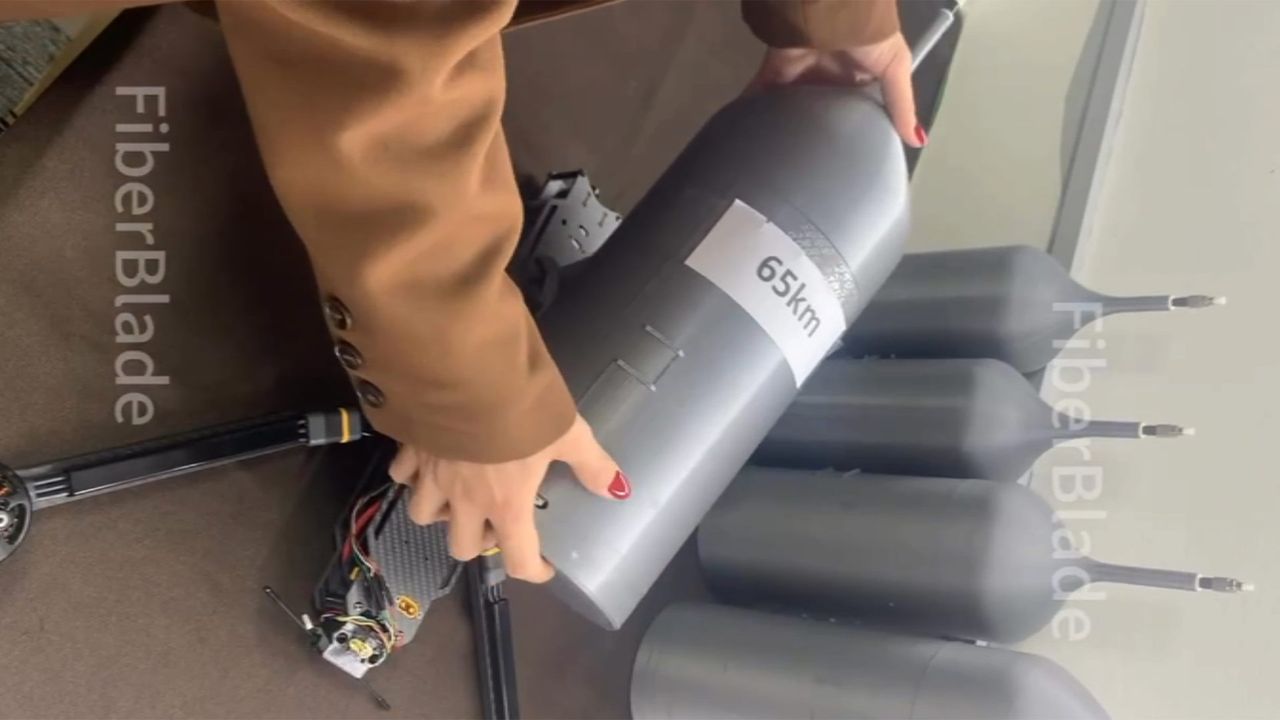
Optical fiber spools for FPV drones.

Videos and images purportedly showing spools carrying as much as 65km (~40.4 miles) of optical fiber have been shared on Russian social media channels. Previously, we reported on Ukraine-based prototypes being tested at up to 50km (~31 miles). Tethered FPV drones are hardened against electronic warfare and allow for deep, precise strikes into enemy territory. Obviously, having a longer reach (without other compromises) is an advantage.

The images and videos embedded above were shared by a widely followed Open Source Intelligence (OSINT) account on X. GrandpaRoy2’s tweet is followed up by his Telegram source links (an app widely used in Russia). One of the videos appears to have originally been shared by the official PGI Technology account on that social media platform.

PGI Technology?

Based on our searches and review of prior reports, PGI Technology is a joint Chinese-Russian technology venture specializing in the development and manufacture of reinforced optical fiber spools for the military.

Some of the shared imagery shows that PGI makes a wide range of spools with “1, 2, 3, 4, 5, 10, 15, 20, 25, 30, 35, 40, 45, 50, 55, 60km Internal and External Unwinding.” The factory seems to have a lot of stock prepared to supply Russia’s drone assault strategy.

Refinements such as Kevlar, improved windings, new adhesives, and more are touted by PGI Technology in its posts.

(Image credit: Various Russian Telegram accounts)

Wired > wireless

Optical fiber-tethered drones have become one of the prominent threats in the Russia-Ukraine war. In civilian life, wireless connectivity is often preferred or deemed necessary. But in war, with advanced electronic warfare (EW) effectively blocking the skies to swarms of deadly drones, simple, reliable tethering wins.

With the emergence of optical fiber-tethered drones as the asymmetric remote weapon of choice, range has always been an issue. Optical fiber enables fiber-optic-guided drones using FPV (first-person view) controls for precise, smart targeting. However, designers have to ask how long a spool of fiber a drone can carry without reducing a drone’s deadly payload too much, and without the risk of tangling.

We previously reported on Ukraine’s unique approach to defending against physically tethered threats from the sky with its equally physical rotating barbed-wire tangling-and-snapping system.

Follow Tom's Hardware on Google News, or add us as a preferred source, to get our latest news, analysis, & reviews in your feeds.

Sign up to read this article
Read news from 100’s of titles, curated specifically for you.
Already a member? Sign in here
Related Stories
Top stories on inkl right now
One subscription that gives you access to news from hundreds of sites
Already a member? Sign in here
Our Picks
Fourteen days free
Download the app
One app. One membership.
100+ trusted global sources.