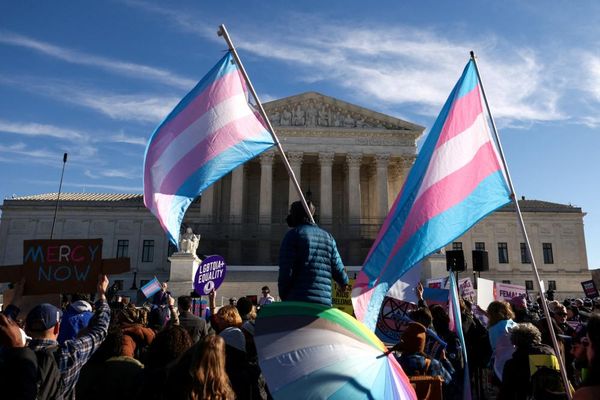
As a philanthropy that believes in following the data, the Rockefeller Foundation has long supported surveys to help us understand how people feel about world events. But as an American, I stopped short when I saw the results of our latest survey. The poll of 35,000 respondents in 34 countries asked people to rank which country poses the biggest threat—Russia, China, or the United States. The U.S. was the number one pick in half of the countries. In fact, one in three people around the world see the United States as a threat—more than China.
Let those numbers sink in for a moment. One-third of the world now fears a country that for most of its existence has thought of itself—with evidence on our side—as the last best hope on earth. When I ran the U.S. Agency for International Development, I recall driving into villages in remote parts of Western Africa, India or Indonesia. Walking into a schoolhouse in the middle of nowhere, I’d see John F. Kennedy’s portrait hanging above a blackboard. People around the planet admired the United States and those like Kennedy because we willfully established our domestic and foreign policy as a means to universal human dignity.
Today’s data show that we are losing that standing. The task ahead of us is to reestablish American foreign policy grounded in our values, but in a way that reflects that the world has changed. The old ways in which we built our moral authority—traditional, donor-driven aid programs—are no longer sufficient. Recommitting to universal human dignity through more modern, politically sustainable investments will make us safer and more secure.
People around the world have long understood that the United States was founded on the principle of universal human dignity—life, liberty, and the pursuit of happiness. The Declaration of Independence and the Constitution wove the idea of universal human dignity into the country’s identity. Abraham Lincoln put the civil war in global terms when he called our experiment a hope for the planet. Emerging victorious from World War II, the United States built a set of institutions, most notably, the UN, to enshrine dignity as the defining aspiration of the free world. Throughout the Cold War, even as we made serious military missteps, we had something the Soviet Union never had: the hearts and minds of people who shared the dream that America represented. This is why the imagery of America as the “shining city on a hill”—an ideal that others aspire to—has such enduring power. Nearly every president and presidential aspirant since Reagan has invoked it, with Trump as a notable exception.
America was the superpower militarily and morally—which made it the safest it’s ever been. The so-called “Pax Americana” was sustained not just by our military power, but by the invisible bond we built with people around the world who instinctively connected with our commitment to human dignity. Ou comments were more than words: We put our money where our mouth was, from rebuilding Europe through the Marshall Plan to development aid during the Cold War to lifesaving disease-prevention efforts like GAVI and PEPFAR. These efforts helped vulnerable people and bolstered our global negotiating position on everything from nuclear weapons to the dominance of the dollar to trade agreements. The only time in history NATO has invoked Article 5 was to defend the U.S., not any other country. We’ve had allies back us every time we went to war, except for the current one. Historians have shown how America’s unique brand of leadership has simultaneously promoted the collective global good and our own national interests.
By contrast, in recent years, America has too often chosen to lead by fear rather than by example. For example, we have spent $38 billion on a war of choice that has killed 18 U.S. service members and thousands of civilians, created an ongoing global energy crisis, and squandered what moral authority we had left. That’s the same amount—$38 billion—that America cut from its global foreign assistance budget between 2024 and 2025. We’ve effectively taken $38 billion from poor and sick people around the world who rely on U.S. help, and spent it on an unpopular, seemingly endless war that’s raising prices for Americans and around the world.
Now, we’re seeing the consequences. The Rockefeller Foundation has supported analysis that shows 9.4 million vulnerable people will die between now and 2030 because we’re pulling back on food security support during famines and fighting diseases for kids. Boston University researchers estimate that more than 700,000 people have already died because these programs have been dismantled. At the refugee camp in Kakuma in Kenya near the Somali border, 150,000 people abruptly stopped receiving the food they needed to survive after the U.S. halted its funding to the World Food Programme. Poll respondents seeing America as a threat is no surprise.
Americans understand that leadership through fear, rather than respect, is not in our national-security interests: A June 2026 poll showed that 72% of Americans believe foreign aid makes us more secure. But they agree it needs to work better: 81%—including 80% of Trump supporters—would prefer reforming foreign aid and strengthening safeguards rather than eliminating it. That means we cannot just rebuild the institutions created after World War II, but take a new, modern approach, one that prioritizes underlying issues, like electricity access, uses new technology like A.I. chatbots, and leverages different actors than just the traditional rich countries.
First, energy investments can produce gains on many humanitarian. For example, through Mission 300, The Rockefeller Foundation and its partners have reached almost 100 million people in Africa with electricity access. Access to power allows girls to go to school at night, helps hospitals health clinics run better diagnostics, and lets small women-run businesses grow their revenue. Mission 300 is not a traditional aid program; it’s an investment program. And for every dollar we invest, $15 of new investment runs alongside it. The need to transition to investment, rather than aid, is why global electrification efforts are increasingly focused on ensuring electricity access leads to jobs and economic growth—creating a virtuous cycle that benefits both recipient and donor.
Second, new technology, including AI, can help communities compete in the modern economy if used responsibly. The Gates Foundation found a 16% jump in diagnostic accuracy at Penda Health clinics in Nairobi after giving clinicians an AI “second opinion” tool. AI and data analytics also have tremendous potential to detect famine outbreaks before they happen, something humanitarian organizations have long hoped for.
And finally, the new approach to leverage strengths of many different sectors. Today, recipient countries themselves are taking more ownership. For instance, the “Accra Reset” is an ambitious effort, led by African countries, to transition away from aid toward country-driven investments in their health systems. We also need the expertise and resources of the private sector, the credibility and reach of the public sector, and the first-mover advantage of philanthropies. Technology companies and civil society need to be at the table, too, figuring out how to shape AI in a way that benefits everyone. And philanthropy can provide meaningful risk capital.
The data is clear: Americans want to do more. They want their country to stand for universal human dignity, not purely for reasons of compassion but also because they understand the longstanding link between our moral authority and our safety, security, and prosperity. They just want to do it better. Ideas are ready to do just that—America can lead on this again.
The opinions expressed in Fortune.com commentary pieces are solely the views of their authors and do not necessarily reflect the opinions and beliefs of Fortune.