Get all your news in one place.
100's of premium titles.
One app.
Start reading
The Conversation
The Conversation
James Pikul, Associate Professor of Mechanical Engineering, University of Wisconsin-Madison

Robots run out of energy long before they run out of work to do − feeding them could change that

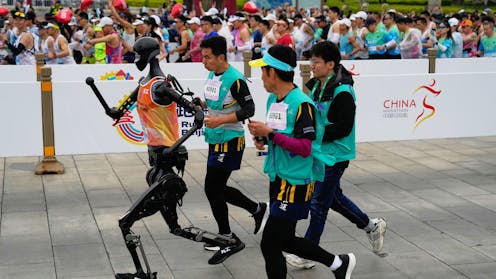
Robots can run, but they can't go the distance. AP Photo/Ng Han Guan

Earlier this year, a robot completed a half-marathon in Beijing in just under 2 hours and 40 minutes. That’s slower than the human winner, who clocked in at just over an hour – but it’s still a remarkable feat. Many recreational runners would be proud of that time. The robot kept its pace for more than 13 miles (21 kilometers).

But it didn’t do so on a single charge. Along the way, the robot had to stop and have its batteries swapped three times. That detail, while easy to overlook, speaks volumes about a deeper challenge in robotics: energy.

Sign up to read this article
Read news from 100's of titles, curated specifically for you.
Already a member? Sign in here
Related Stories
Top stories on inkl right now
One subscription that gives you access to news from hundreds of sites
Already a member? Sign in here
Our Picks
Fourteen days free
Download the app
One app. One membership.
100+ trusted global sources.