Get all your news in one place.
100's of premium titles.
One app.
Start reading
International Business Times UK
Maybelyn B. Paden

Robert F. Kennedy Jr. Says That Artificial Intelligence Can Help 'To Free Us From Medical Tyranny'

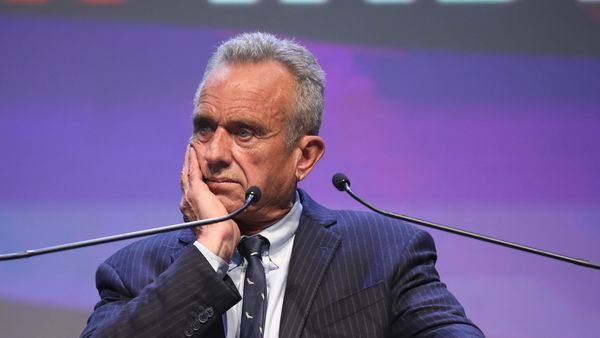
US Health Secretary Robert F. Kennedy Jr. said 29 September that AI could offer a 'better informed' second opinion than doctors and help Americans escape 'medical tyranny' (Credit: United States Department of Health and Human Services, Public domain, via Wikimedia Commons)

US Health Secretary Robert F. Kennedy Jr. told a Washington conference on 29 September that artificial intelligence could provide a 'better informed' second opinion than any doctor and help Americans escape what he called 'medical tyranny'.

His remarks, delivered during a fireside chat with Vice President JD Vance, framed AI as a challenge to public health experts rather than simply a clinical tool.

RFK Jr's AI Claims Put Doctors in the Crosshairs

The comments came at the Make America Healthy Again Summit, held at the Waldorf Astoria in Washington, DC. The event brought together administration officials, healthcare executives, technology companies and wellness figures for discussions on healthcare, food policy, cancer detection and artificial intelligence.

Kennedy has repeatedly questioned the authority of medical experts, particularly over the government's response to Covid-19 and vaccination. At the summit, he argued that AI would allow individuals to examine medical advice for themselves instead of accepting guidance from public officials.

'One of the things that is going to change is that we're never ever again going to be able to be dominated by public officials who tell us, "Trust the experts,"' Kennedy said, according to a transcript of his remarks.

He then offered examples involving masks, social distancing and vaccines. 'If somebody tells you, "Masks work, trust the experts," AI may tell you otherwise,' Kennedy said. 'If somebody tells you, "Social distancing works, trust the experts," AI may correct that.'

He also claimed OpenAI chief executive Sam Altman had told him that it would be 'malpractice' for a doctor to diagnose a patient or issue a prescription without first consulting AI. That account has not been independently confirmed in the material available for this article.

The distinction is important. AI systems can process large volumes of information, but Kennedy's remarks blurred the line between helping a clinician search records and replacing professional judgement.

A chatbot can summarise a file. It cannot examine a patient, observe a physical symptom or take responsibility for a treatment decision.

Medical AI Is Already in Use, but Trust Is Not Automatic

There is a real technology story beneath Kennedy's sweeping claim. Medical professionals already use AI tools for research, documentation, transcription and clinical information retrieval.

OpenEvidence, one such platform, says it is free for verified US healthcare professionals and provides answers grounded in medical literature, including material from The New England Journal of Medicine and JAMA.

It was reported in May that nearly two-thirds of US physicians were actively using OpenEvidence, based on figures provided by the company. That figure describes use of one platform, not proof that AI has surpassed doctors or that patients should rely on chatbots without medical supervision.

The technology's limitations are not hypothetical. AI systems can produce confident but incorrect answers, omit relevant context or reflect the assumptions embedded in their training data. Even tools designed to support healthcare workers require checking, correction and accountability.

A Political Pitch Wrapped in Tech Optimism

Kennedy's language carries a clear political charge. He did not present AI merely as an assistant for doctors. He presented it as a way for Americans to dispute public health institutions and official advice.

The summit's setting highlighted that framing. The programme included sessions on AI and healthcare and the 'AI health stack', while the event's sponsors included technology firms and companies with business interests before government agencies.

The summit's organisers said the MAHA Center did not coordinate with any government entity over its planning or sponsorship.

Kennedy and other officials were invited speakers, rather than planners, yet the gathering placed government power beside commercial health and technology interests. Vance even joked that he had expected a summit about 'weight loss and acid, not AI'.

Kennedy's argument is likely to find an audience among those who believe medicine has become too distant, expensive or institutional. Patients often struggle to obtain their records, secure appointments or receive clear explanations in a rushed consultation. Better digital access could help address some of those problems.

The Risk of Confusing Answers With Expertise

An accessible tool is not automatically a reliable authority. The risk is not that people ask AI questions. It is that they mistake a fluent answer for a medically sound one, especially when the answer confirms what they already want to believe.

Kennedy urges Americans to question experts, yet places significant weight on systems built by private companies whose workings are not always visible. Medical advice becomes a contest between institutions, chatbots and personal conviction. Somewhere in the middle sits the patient, still waiting for an answer.

Sign up to read this article
Read news from 100's of titles, curated specifically for you.
Already a member? Sign in here
Related Stories
Top stories on inkl right now
One subscription that gives you access to news from hundreds of sites
Already a member? Sign in here
Our Picks
Fourteen days free
Download the app
One app. One membership.
100+ trusted global sources.