Get all your news in one place.
100's of premium titles.
One app.
Start reading
The Conversation
The Conversation
Christina Warinner, Associate Professor of Anthropology, Harvard University

Reconstructing ancient bacterial genomes can revive previously unknown molecules – offering a potential source for new antibiotics

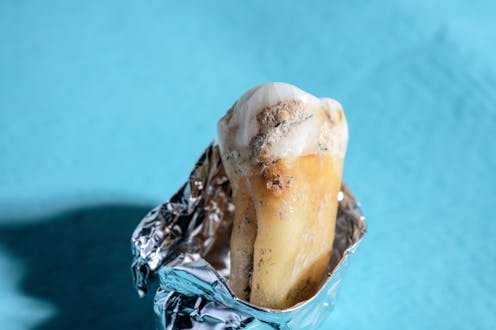
Ancient DNA preserved in the tooth tartar of human fossils encodes microbial metabolites that could be the next antibiotic. Werner/Siemens Foundation

Microorganisms – in particular bacteria – are skillful chemists that can produce an impressive diversity of chemical compounds known as natural products. These metabolites provide the microbes major evolutionary advantages, such as allowing them to interact with one another or their environment and helping defend against different threats. Because of the diverse functions bacterial natural products have, many have been used as medical treatments such as antibiotics and anti-cancer drugs.

The microbial species alive today represent only a tiny fraction of the vast diversity of microbes that have inhabited Earth over the past 3 billion years. Exploring this microbial past presents exciting opportunities to recover some of their lost chemistry.

Sign up to read this article
Read news from 100's of titles, curated specifically for you.
Already a member? Sign in here
Related Stories
Top stories on inkl right now
One subscription that gives you access to news from hundreds of sites
Already a member? Sign in here
Our Picks
Fourteen days free
Download the app
One app. One membership.
100+ trusted global sources.