Get all your news in one place.
100’s of premium titles.
One app.
Start reading
Fortune
Fortune
Eleanor Pringle

Recession and stagflation risks are rising due to Iran conflict, as economist warns it’s ‘getting harder to argue disruption will be temporary’

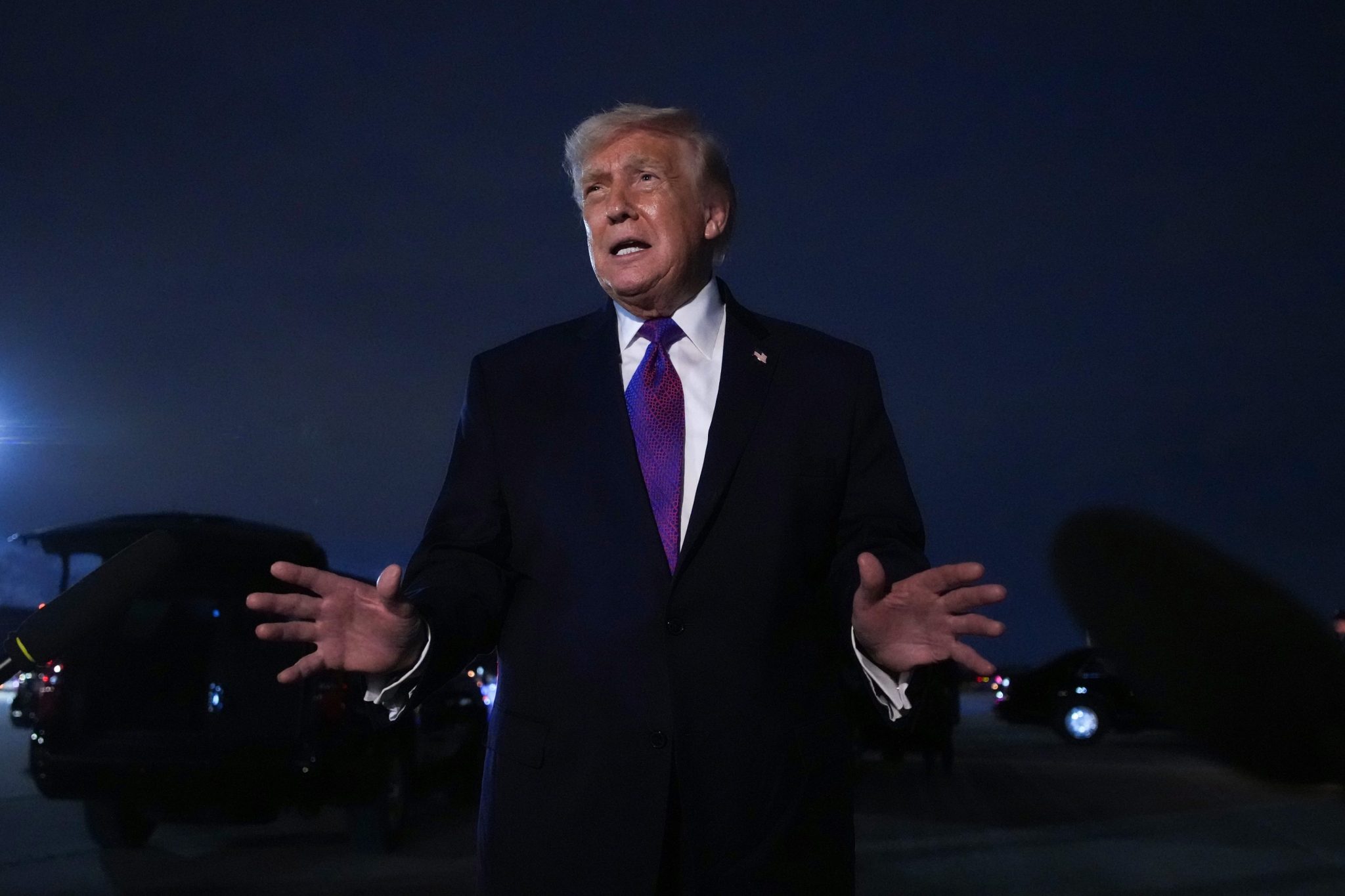
U.S. President Donald Trump speaks to the press after landing on Air Force One on March 11, 2026 at Joint Base Andrews, Maryland. (Credit: Andrew Harnik - Getty Image)

As oil prices once again topped $100 a barrel, the damn-the-torpedoes confidence Wall Street analysts have had since the U.S. and Israel undertook strikes in Iran took another knock. Economists have lived in hope that President Trump is unlikely to pursue the campaign beyond the end of the month, arguing the White House won’t want to see energy prices inflate in a mid-term year.

However, volatility across the tickers is making it harder for analysts to maintain a sense of calm. The unease relates to the worsening geopolitical situation: A string of attacks was launched this week on oil ships in the Persian Gulf, and assurances of military escorts from the U.S. Navy are yet to emerge. Likewise, attacks on the countries neighbouring Iran are continuing: Dubai has reported a number of drone attacks, while Kuwait’s airport has also been targeted.

“Investors are increasingly pricing in a more protracted conflict that causes extensive economic damage,” noted Deutsche Bank’s Jim Reid to clients this morning. The outlook of investors hasn’t been helped by the latest monthly report from the International Energy Agency (IEA), which wrote today that the war in the Middle East is “creating the largest supply disruption in the history of the global oil market. Iran has reportedly dismissed the notion of a ceasefire, while President Trump has maintained there is “practically nothing left” to target in Iran.

No concrete evidence of de-escalation in the region has been confirmed, Reid notes as a result: “That’s keeping oil prices elevated, and raising the risk of a broader stagflationary shock … with each passing day it gets harder to argue that the disruption to shipping and energy infrastructure will only prove temporary.”

Stagflation is the combination of high inflation (stemming from energy prices), higher unemployment (while the U-rate is 4.4% according to the latest report from the Bureau of Labor Statistics, jobs reports have continued to be weak), and stagnating economic growth (Q2 and Q3 GDP figures were relatively strong, but the estimations for Q525 have fallen to 1.4%).

The latest tip over $100 a barrel means “we’re also getting closer to the territory that’s historically led to bigger risk-off moves,” noted Reid. Economists don’t have to look far back for evidence of what that might look like: Russia’s invasion of Ukraine in 2022 pushed energy prices sky-high. We’re not there yet, and the global economy isn’t also battling inflation in the wake of a pandemic.

However, Reid adds: “Clearly, the longer that oil remains at these levels, expectations of a sustained shock will only grow.”

The bar for a recession

Analysts have also been drawing up projections for how deep the chaos would need to be to push the U.S. economy into a recession.

There’s some way to go, according to Oxford Economics’ chief global economist Ryan Sweet and director of global macro research Ben May, though not impossible. In the duo’s modelling, global oil prices would need to average $140 per barrel for two months to pose a recessionary risk. The U.S. would also have to face “significant tightening in financial market conditions, heightened supply-chain disruptions, and a continuing deterioration in the collective psyche”—potentially easy to imagine if the Middle East conflict dragged on longer than expected, and disruption in the Strait of Hormuz continued.

Sweet and May ran a simulation that assumes Brent crude oil hits $140pb for eight weeks, meaning natural gas prices rise in turn and negative spillover effects on global real GDP sit around 0.7% by the end of 2026. The results were mild contractions in the Eurozone, the U.K., and Japan, while the U.S. edged toward a “temporary standstill” with layoffs pushing up the unemployment rate.

“We also considered a less severe alternative where oil prices average around $100pb for two months, which would shave a few 10ths of a percentage point off global GDP growth via higher inflation, but recessions would be avoided,” the pair continued.

Indeed, Bank of America economist Aditya Bhave argued this week that Wall Street may already be misreading signals when it comes to the Middle East. Many investors have expected the Fed to freeze any base rate action until the inflationary impact of energy becomes clear in the data, though Bhave argued: “Policy risks play out when demand is strong enough for activity to withstand a supply shock,” such as in 2022. He added: “By contrast, we now have a soft labor market, moderately elevated inflation and more modest fiscal support. This sets us up for a more dovish Fed response if the oil shock is persistent.”

Sign up to read this article
Read news from 100’s of titles, curated specifically for you.
Already a member? Sign in here
Related Stories
Top stories on inkl right now
One subscription that gives you access to news from hundreds of sites
Already a member? Sign in here
Our Picks
Fourteen days free
Download the app
One app. One membership.
100+ trusted global sources.