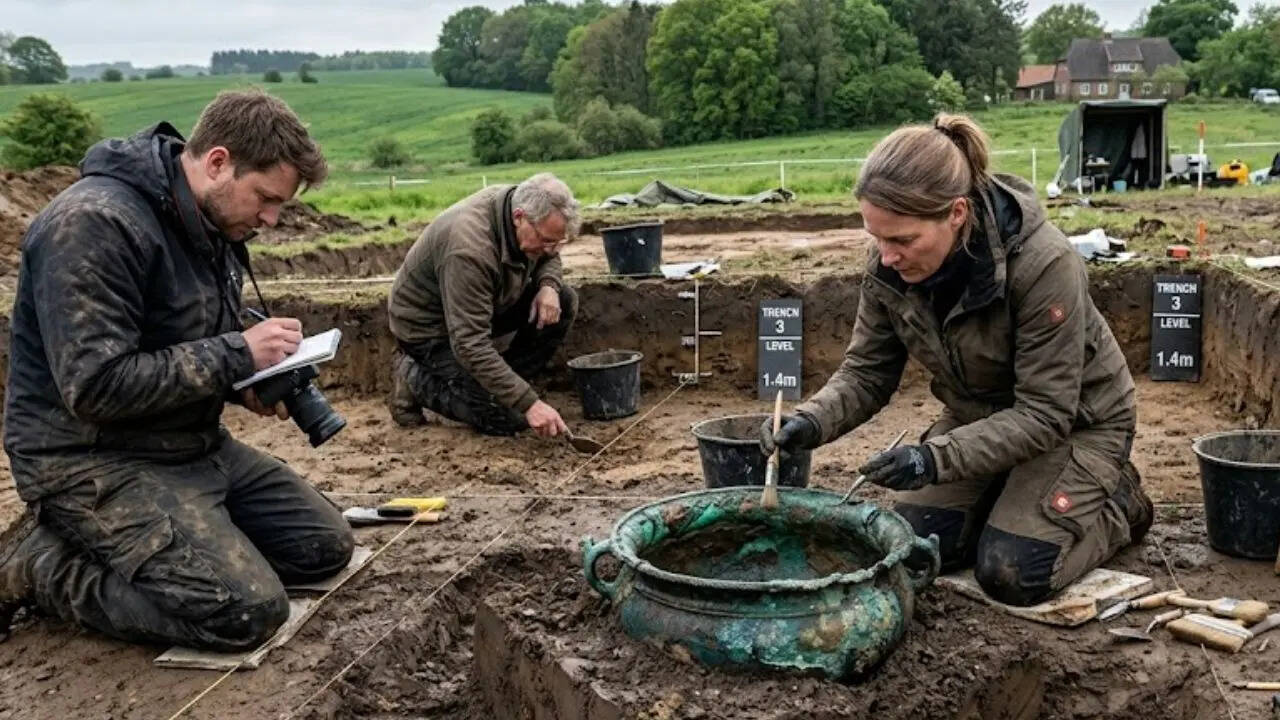
In Schaalby, northern Germany, archaeologists found rare bronze cauldrons dating from the 3rd to the 5th centuries AD. The cauldrons have been recovered through a collaboration between the Archaeological State Office of Schleswig-Holstein and Aarhus University. The cauldrons are called ‘Vestland cauldrons’ and provide important evidence of trade and cultural exchange in antiquity. Previously believed to have only been found in the Scandinavian and Rhine regions, cauldrons found in northern Germany represent an important challenge to how we think about the extent of Roman-period trade networks.
Researchers hope to use advanced technology, including ‘block lifting’ and computed tomography (CT) scanning, in order to preserve the cauldrons while also learning about any possible concealed contents that may be buried inside them. This work will enhance our understanding of the complexity of social hierarchies and the interconnectivity of economies during the Migration Period. These significant findings continue to reshape modern historical narratives regarding ancient European commerce, social structures, and cross-border interactions.