The Man Who Ran the Experiment
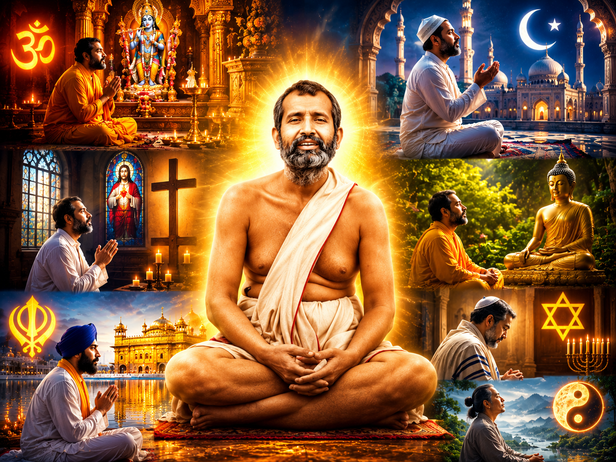
Between roughly 1861 and 1874, Ramakrishna Paramahamsa did something no theologian had proposed and no institution had sanctioned. He practiced, in sequence and with full commitment, the sadhana of traditions that were supposed to be mutually exclusive. He spent months in Tantric discipline under the teacher Bhairavi Brahmani. He sat in deep Vedanta practice with the Advaita monk Totapuri, who had to physically press his finger to Ramakrishna's forehead to help him cross into nirvikalpa samadhi. He turned toward Islam, wore a dhoti instead of his usual cloth, repeated the name of Allah, ate at a Muslim household, and reported that he saw a luminous figure he understood as the Prophet. He then turned to Christianity, meditated on an image of the Madonna and Child, and experienced a vision of Jesus that he described with the same matter-of-fact certainty he used for his visions of Kali.
He was not collecting religions. He was running an experiment with himself as the instrument.
What Made This Different From Tolerance
Tolerance is a political arrangement. It asks you to leave space for what you privately believe is wrong. What Ramakrishna did was categorically different. He did not tolerate Islam or Christianity from the outside. He entered each tradition's interior life, followed its prescribed method, and reported that the arrival point felt the same. The word he used, again and again, was the same Bengali phrase that translates roughly as: the same state, the same thing.
This is a falsifiable claim. If the states had differed, the experiment would have produced a different result. He said they did not. His disciple Swami Vivekananda, who went on to carry this argument to the West at the Parliament of the World's Religions in Chicago in 1893, understood that the weight of his teacher's position rested on this: Ramakrishna had not theorised unity. He had experienced it, repeatedly, across traditions whose surface structures share almost nothing.
The Advaita Vedanta framework that Totapuri brought to Ramakrishna insists that the individual self and Brahman are not separate. The devotional path to Kali that Ramakrishna had practiced since childhood insists on a personal God, a Mother, a relationship. These two positions are not easily reconciled at the level of philosophy. Ramakrishna held both without apparent contradiction, which either means he was confused or that the contradiction dissolves at a depth of experience that philosophy cannot reach from the outside.
Kali at the Centre
It would be wrong to present Ramakrishna as a man without a home tradition. Kali was his ground. He wept for her. He refused to eat when she didn't appear to him. He spoke to her image at the Dakshineswar temple the way a child speaks to a mother who is late coming home. His devotion was not abstract. It was a specific, embodied, sometimes anguished relationship with a deity who held a severed head and wore a garland of skulls.
The Dakshineswar Kali temple on the eastern bank of the Hooghly is where most of this happened. He lived there for decades as a priest. The same man who would later sit in Islamic prayer and Christian meditation spent his mornings dressing the Kali murti, arranging flowers, losing himself in states that the temple management occasionally mistook for madness.
This matters because it establishes that his pluralism did not come from detachment. He was not a man who had given up on the particular in favour of the general. He loved one deity with everything he had, and from that depth of particular love, he found he could enter other traditions without losing himself in them. The specific was the door, not the obstacle.
The Argument His Life Makes
Religious pluralism as a philosophical position is usually argued from the outside: all religions point to the same truth, therefore we should respect them all. This is a reasonable position and also a somewhat thin one, because it asks nothing of you except good manners. Ramakrishna's version asks everything. It says: go all the way in. Follow the sadhana completely. Do not dabble. And if you go all the way in, you will find that the destination does not carry the name of the path that brought you there.
This is an uncomfortable argument for every tradition that has a strong investment in its own exclusivity. It does not say your tradition is wrong. It says your tradition is sufficient, and so is the one you were taught to distrust. The sufficiency of the other path is the part that stings.
Vivekananda framed this in the language of Vedanta when he spoke at Chicago, and the framing was strategic. Vedanta gave him a philosophical vocabulary that Western audiences could engage with. But the source material was not a philosophy. It was a person in a temple in Bengal who cried for his goddess and then, without contradiction, bowed toward Mecca.
Why It Still Sits Uneasily
Ramakrishna's life is cited constantly in Indian public discourse as evidence that Hinduism is inherently pluralistic. This is a partial reading, and a self-serving one. His experiment did not prove that Hinduism contains all other religions. It proved that he, a human being following specific methods of spiritual discipline, arrived at a state he could not distinguish across traditions. The claim belongs to the experiential record of one man, not to the ownership of any institution.
The Ramakrishna Mission, which Vivekananda founded and which continues to run hospitals, schools, and centres across India and the world, has held this tension carefully. The Mission does not claim that all paths are Hindu. It claims, following its founder's teacher, that all sincere paths arrive. That is a smaller and more honest claim, and it is also the one that is hardest to weaponise.
What remains when you strip away the institutional framing is the image of a man at Dakshineswar, doing the work, going all the way in, and coming back each time with the same report. He did not write a treatise on religious pluralism. He left a life that functions as one.
The most radical arguments are rarely made in words. They are made in the accumulated record of what someone actually did, day after day, until the pattern becomes undeniable. Ramakrishna's sadhana across every tradition he entered is that kind of argument: not a position held, but a practice sustained, and the evidence is the man himself.