Get all your news in one place.
100's of premium titles.
One app.
Start reading
The Conversation
The Conversation
Christopher Gordon De Pree, Deputy Electromagnetic Spectrum Manager, National Radio Astronomy Observatory

Radio interference from satellites is threatening astronomy – a proposed zone for testing new technologies could head off the problem

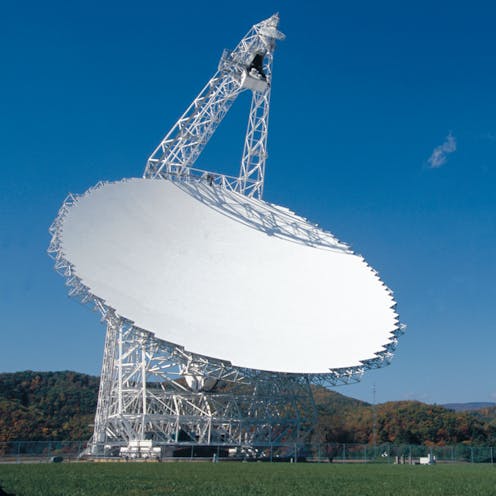
Radio observatories like the Green Bank Telescope are in radio quiet zones that protect them from interference. NRAO/AUI/NSF, CC BY

Visible light is just one part of the electromagnetic spectrum that astronomers use to study the universe. The James Webb Space Telescope was built to see infrared light, other space telescopes capture X-ray images, and observatories like the Green Bank Telescope, the Very Large Array, the Atacama Large Millimeter Array and dozens of other observatories around the world work at radio wavelengths.

Radio telescopes are facing a problem. All satellites, whatever their function, use radio waves to transmit information to the surface of the Earth. Just as light pollution can hide a starry night sky, radio transmissions can swamp out the radio waves astronomers use to learn about black holes, newly forming stars and the evolution of galaxies.
Sign up to read this article
Read news from 100's of titles, curated specifically for you.
Already a member? Sign in here
Related Stories
Top stories on inkl right now
One subscription that gives you access to news from hundreds of sites
Already a member? Sign in here
Our Picks
Fourteen days free
Download the app
One app. One membership.
100+ trusted global sources.