Get all your news in one place.
100's of premium titles.
One app.
Start reading
The Economic Times
The Economic Times
Trending Desk

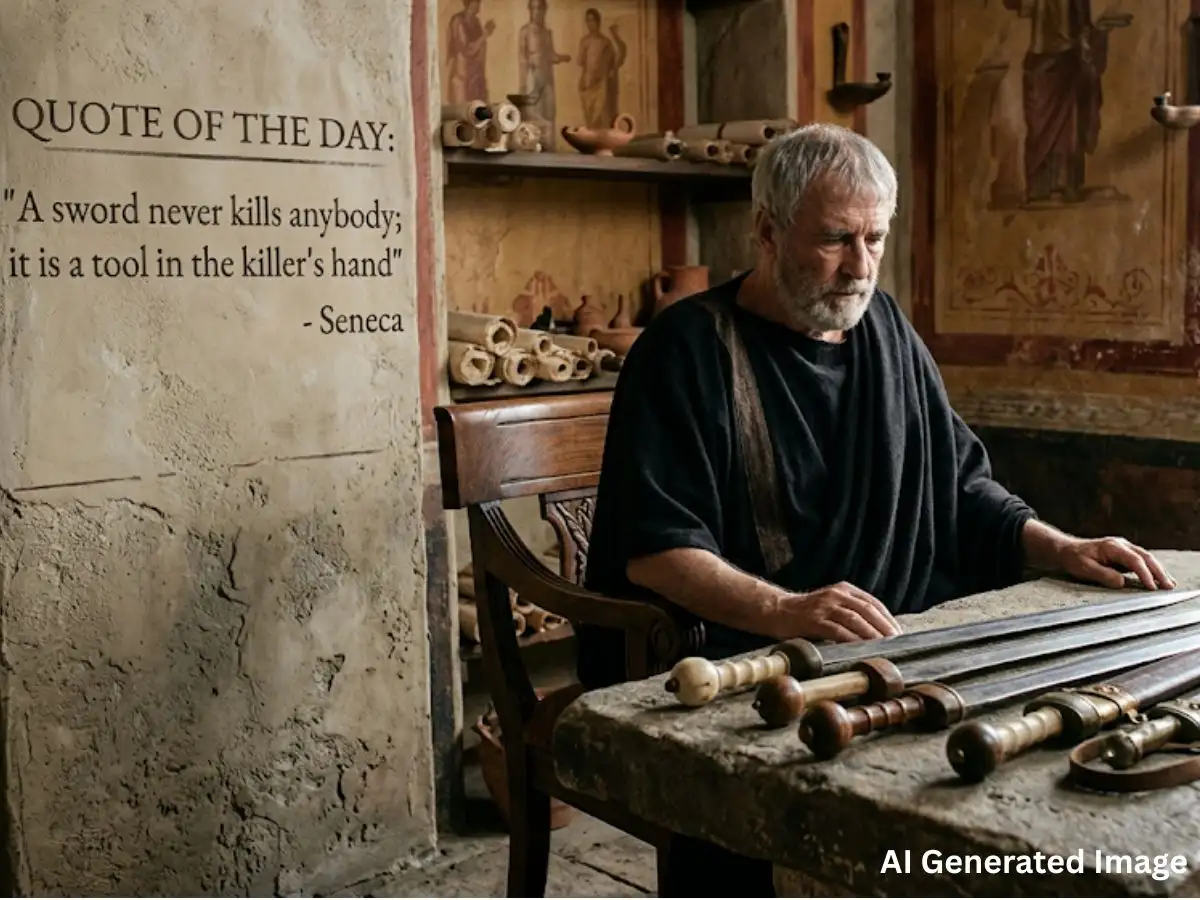
Quote of the Day by Seneca: “A sword never kills anybody; it is a tool in the killer’s hand,” and its lesson on responsibility

Quote of the Day by Seneca: “A sword never kills anybody; it is a tool in the killer’s hand” presents a powerful reflection on human responsibility. The thought shifts attention away from an object and toward the person who chooses how it is used. Rooted in Seneca’s Letter 87, the quote encourages readers to consider intention, choice and accountability rather than blaming the instrument alone.

Quote of the Day

The popular quote attributed to Roman Stoic philosopher Lucius Annaeus Seneca is: “A sword never kills anybody; it is a tool in the killer’s hand.”

The wording is widely circulated under Seneca’s name, but its origin is more nuanced. In Letter 87, section 30 of his Moral Letters to Lucilius , Seneca writes in Latin, “quemadmodum gladius neminem occidit: occidentis telum est.” A close translation is, “A sword by itself does not slay; it is merely the weapon used by the slayer.” The commonly quoted English version is therefore a later rendering rather than Seneca’s original wording.

The meaning behind “A sword never kills anybody”

At the heart of “A sword never kills anybody” is the distinction between an object and the person who uses it. A sword has no intention or independent purpose. It becomes an instrument through human action.

The idea places moral responsibility on the individual rather than allowing the instrument itself to become an easy explanation for what happened. The object may make an action possible, but the decision to use it remains connected to the person wielding it.

Why “it is a tool in the killer’s hand” matters

The phrase “it is a tool in the killer’s hand” sharpens that distinction. It directs attention to agency, suggesting that responsibility cannot simply be transferred to an object.

The broader lesson can apply beyond the literal image of a sword. Human beings routinely use tools, systems and technologies to accomplish things, but those instruments do not automatically determine the intentions behind their use. The ethical question therefore remains centred on human choices.

Seneca’s argument behind “A sword never kills anybody”

There is an important attribution detail behind the famous wording. Seneca was discussing arguments concerning wealth and the simple life in Letter 87. The sword comparison appears as part of an argument he attributes to “certain men”; it is not necessarily Seneca stating the modern quotation as his own independent maxim.

That distinction matters when presenting the quote. The popular version can accurately be described as a quote attributed to Seneca and as a later English rendering of a passage in his work.

What “a tool in the killer’s hand” teaches about responsibility

The enduring lesson is that responsibility follows choice. An instrument can be dangerous or useful, but the person deciding how it is used remains central to the moral question.

Seen this way, the quote is less about the sword itself and more about accountability. It asks readers to look beyond objects and circumstances and examine the decisions that lead to an action.

The life lesson behind Seneca’s quote

“A sword never kills anybody; it is a tool in the killer’s hand” remains striking because it challenges the tendency to separate actions from the people responsible for them. Its central lesson is one of accountability: circumstances and instruments may influence what happens, but human intention and choice remain essential parts of moral responsibility.

For readers today, the thought offers a broader Stoic-style reminder to examine what lies within human control: judgment, intention and action. The enduring value of the quote lies in directing attention back to those choices rather than allowing the instrument to become the whole explanation.

Sign up to read this article
Read news from 100's of titles, curated specifically for you.
Already a member? Sign in here
Related Stories
Top stories on inkl right now
Our Picks
Fourteen days free
Download the app
One app. One membership.
100+ trusted global sources.