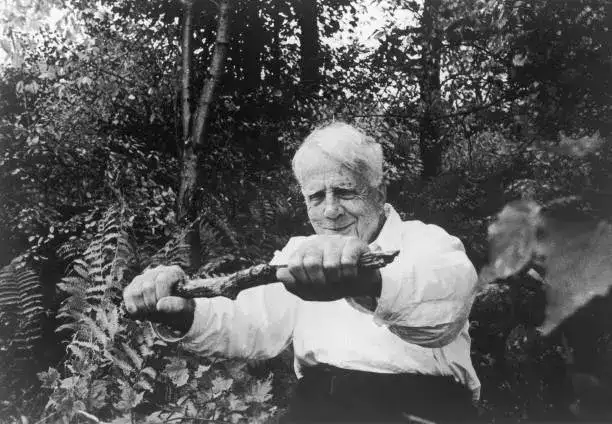
Quote of the day: For generations, Robert Frost has been celebrated as the quiet voice of rural America, a poet who transformed snowy woods, stone fences and lonely roads into reflections on human nature itself. Beneath his calm New England imagery, however, Frost often carried a sharp wit and subtle humor that cut straight into modern anxieties. His poetry explored exhaustion, isolation, ambition and emotional confusion long before those topics became part of everyday conversations about burnout and workplace stress. That blend of wisdom and irony explains why Frost’s observations continue to resonate decades after his death.
Among his most memorable remarks is a quote that humorously captures the strange relationship many people have with work, routine and mental fatigue in contemporary life.

Quote of the day today
“The brain is a wonderful organ; it starts working the moment you get up in the morning and does not stop until you get into the office.”The line remains one of Frost’s most widely shared quotes because of how effortlessly it combines humor with social commentary. On the surface, it sounds playful. But underneath the joke lies a surprisingly sharp observation about modern work culture.
Quote of the day meaning
Frost’s quote humorously suggests that people often begin the day energetic, imaginative and mentally active, only to feel drained or restricted once they enter structured workplace environments. The joke works because it reflects a familiar emotional reality for millions of workers.
The line is not necessarily an attack on work itself. Instead, it pokes fun at routines, office politics and systems that can suppress creativity or individuality. Frost implies that the human mind is naturally curious and alive, yet certain environments can dull that energy.
Even though Frost lived long before remote work, digital meetings and social media distractions, the quote feels surprisingly modern. Many employees today speak openly about burnout, emotional exhaustion and the pressure of constant productivity. The quote taps into that shared experience with wit rather than bitterness.
Its lasting popularity also comes from its relatability. Nearly everyone has experienced mornings filled with ideas and motivation, only to feel mentally exhausted once the workday fully begins. Frost’s humor transforms that frustration into something universal and oddly comforting.
The poet behind the humor
Robert Frost was never merely a sentimental poet of nature. Though famous for poems like “The Road Not Taken” and “Stopping by Woods on a Snowy Evening,” his writing frequently explored darker emotional territory beneath ordinary conversations and rural imagery.
Born in San Francisco in 1874, Frost endured repeated personal tragedies throughout his life. He lost his father at a young age, struggled financially for years and faced devastating losses within his own family. Several of his children died prematurely, while others battled serious mental health struggles.
Despite those hardships, Frost developed a literary voice that balanced seriousness with irony. His poems often sounded conversational, yet beneath their simplicity lay complex reflections on loneliness, fear and human resilience.
That same balance appears in this famous quote. Frost uses humor not simply to entertain, but to expose an uncomfortable truth about modern life: many people feel disconnected from joy and spontaneity once work routines take over.
Why the quote still resonates in modern workplaces
Frost’s observation feels especially relevant in an era defined by workplace stress and digital overload. Modern employees are expected to answer emails after hours, juggle multiple responsibilities and remain constantly available online.
As a result, discussions about mental exhaustion and “work-life balance” have become central to professional culture. Frost’s quote captures that emotional tension in one concise sentence.
The quote also reflects the growing debate around creativity in professional settings. Many workers feel their most imaginative ideas emerge outside formal structures, during walks, conversations, hobbies or quiet moments at home. Offices, meetings and rigid schedules can sometimes feel limiting rather than inspiring.
Ironically, Frost himself spent years struggling to gain recognition. Before achieving literary fame, he worked as a farmer and teacher while trying unsuccessfully to publish poetry. It was not until he moved to England in his late 30s that his writing finally gained serious attention.
That delayed success may explain why Frost understood frustration so well. He knew what it felt like to have ambition and imagination constrained by daily pressures and uncertainty.
Humor as social truth
One reason Frost’s quote survives across generations is that humor often communicates truth more effectively than lectures do. Rather than criticizing modern work culture directly, Frost turns it into a joke people instantly recognize.
The best humorous quotes tend to reveal hidden frustrations society quietly shares. Frost’s line does exactly that. It allows readers to laugh at their own routines while also questioning whether modern work habits leave enough space for creativity, curiosity and personal fulfillment.
The quote has also gained new relevance in discussions about remote work and office culture after the pandemic era. Many people discovered they felt more productive or emotionally healthier outside traditional office environments. Frost’s remark suddenly seemed less like a joke and more like a surprisingly accurate commentary.
A timeless reminder from Robert Frost
Though Robert Frost is remembered primarily as one of America’s greatest poets, his enduring appeal comes from his deep understanding of ordinary human emotions. He wrote about roads, snowstorms and fences, but underneath those images were questions about purpose, isolation and identity.
His famous quote about the brain and the office continues to endure because it captures a universal feeling with wit and honesty. It reminds readers that humor can sometimes expose uncomfortable truths more clearly than serious arguments ever could.
And perhaps that is why Frost’s words still spread so widely today: in one brief sentence, he managed to describe the modern working experience long before modern office culture even existed.