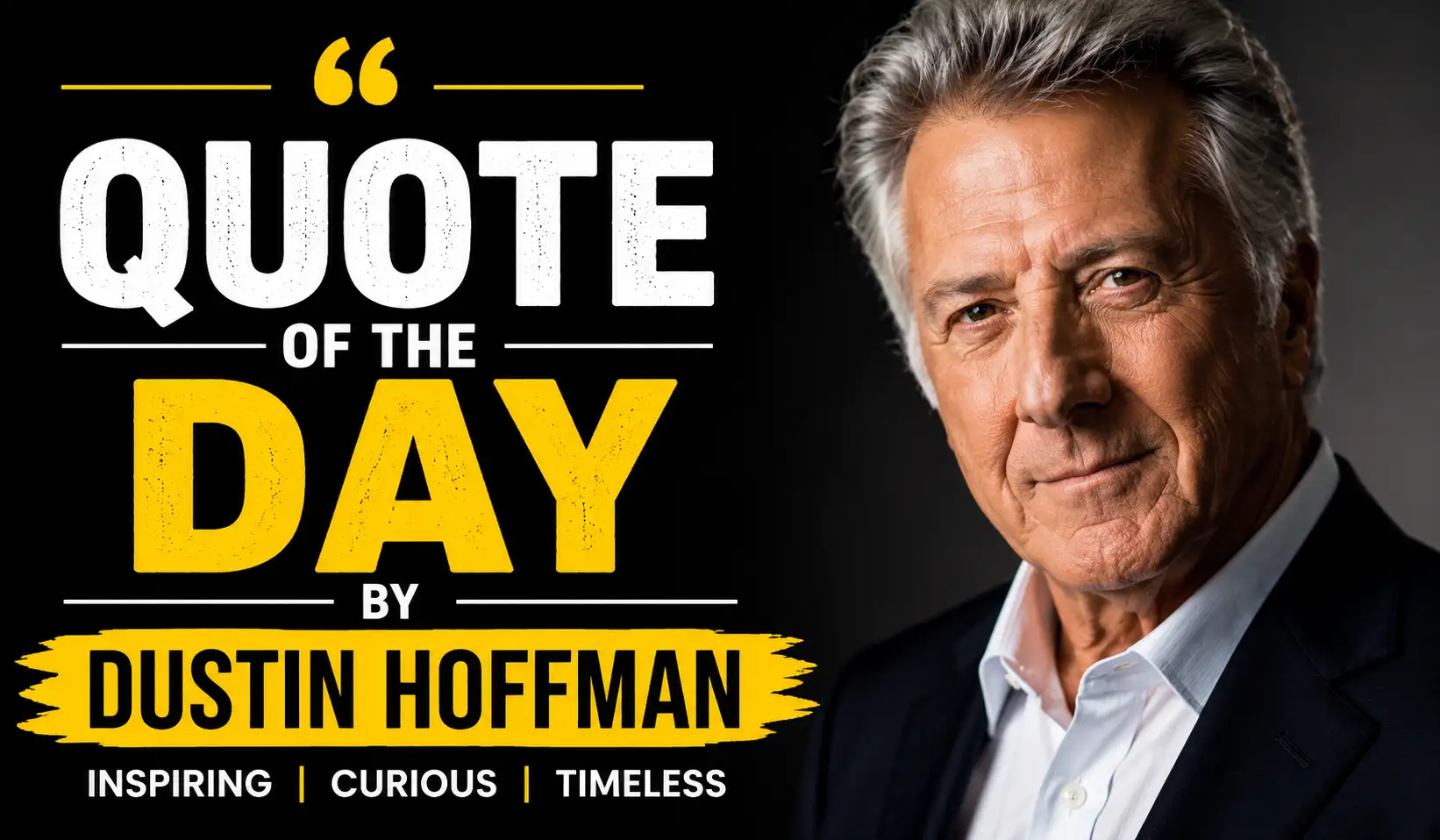
Quote of the Day by Dustin Hoffman is a reminder that personal growth never has a finish line. His words encourage us to stay curious, embrace change, and keep learning through every stage of life. In a world filled with distractions, this timeless message highlights why an open mind is one of our greatest strengths. As an Academy Award-winning American actor, Dustin Hoffman has inspired audiences through both his performances and his thoughtful outlook on life. This inspiring quote explores curiosity, resilience, mindfulness, and lifelong learning, showing how staying mentally engaged can lead to greater purpose, stronger character, and a more meaningful life.
Quote of the Day Today:
Quote of the Day by Dustin Hoffman: “There’s a rebirth that goes on with us continuously as human beings. I don’t understand how you can be alive and not be curious.”
— Dustin Hoffman
In this famous reflection, legendary American actor Dustin Hoffman offers a poignant commentary on the psychological difference between passive existence and active engagement. The core of Dustin Hoffman's quote lies in the concept of perpetual human evolution—the idea that every individual undergoes constant psychological, emotional, and intellectual transformation.
Meaning of Dustin Hoffman's quote about continuous rebirth
This Dustin Hoffman quote , widely shared through quote collections such as BrainyQuote, celebrates the idea that people are never finished growing. Every day presents new opportunities to rethink old beliefs, develop fresh perspectives, and become a better version of ourselves.
The phrase "rebirth" is not about starting life over completely. Instead, it symbolizes ongoing personal transformation. We evolve emotionally after heartbreak, intellectually after learning something new, and spiritually after overcoming life's obstacles.
The second part of the quote places curiosity at the center of human existence. Hoffman believes curiosity keeps the mind active and prevents people from becoming trapped by routine. Whether learning a new skill, meeting different people, or questioning long-held assumptions, curiosity becomes the engine of lifelong growth. His message reminds us that remaining mentally engaged helps us adapt to life's constant changes with resilience and optimism.
Why you should stay curious throughout life
Living in a fast-paced digital era presents constant sensory input, yet many people struggle with chronic boredom and disinterest. Embracing continuous rebirth offers a practical framework for breaking out of mental ruts and renewing daily motivation.
- Reframe Everyday Routine: Viewing personal identity as dynamic rather than fixed allows you to adopt new habits, learn new disciplines, and reinvent your professional trajectory at any stage of life.
- Cultivate Active Observation: Boredom often stems from surface-level interaction with your surroundings. Slowing down to observe details—whether in human behavior, nature, or work processes—reveals deeper layers of interest.
- Separate Apathy from Genuine Struggle: Recognizing that boredom is often a symptom of passive consumption empowers you to take agency over your attention span and redirect focus toward meaningful goals.
- Commit to Intellectual Curiosity: Approaching problems with a beginner's mindset ensures that routine challenges become opportunities for skill development rather than sources of monotony.
Early Life of Dustin Hoffman
Education and Academic Development
To formalize his craft, Hoffman joined the Pasadena Playhouse, where he trained alongside future acting icon Gene Hackman. Seeking deeper artistic rigor, he moved to New York City in 1958 to train at the prestigious Actors Studio under legendary acting teacher Lee Strasberg. During this period of academic and creative development, Hoffman worked odd jobs—including as a restaurant busboy, psychiatric attendant, and coat checker—while performing in off-Broadway productions and refining his immersive method acting approach.
Rise as an Oscar-Winning Actor
The GraduateThroughout the late 1960s and 1970s, Hoffman established himself as one of his generation's most versatile performers:
- Midnight Cowboy (1969): Portrayed the gritty, impoverished Enrico "Ratso" Rizzo, earning critical acclaim and a second Oscar nomination.
- All the President's Men (1976): Starred alongside Robert Redford as investigative journalist Carl Bernstein, detailing the uncovering of the Watergate scandal.
- Kramer vs. Kramer (1979): Delivered an emotionally grounded performance as Ted Kramer during a painful marital dissolution, winning his first Academy Award for Best Actor.
- Tootsie (1982): Played Michael Dorsey, an uncompromising actor who disguises himself as a woman to secure work, showcasing remarkable comedic and dramatic range.
- Rain Man (1988): Portrayed Raymond Babbitt, an autistic savant, winning his second Academy Award for Best Actor and setting a benchmark for research-driven character portrayal.
Fame, Recognition, and Personal Philosophy
Hoffman’s reputation as a perfectionist stems from his belief that art demands total commitment. By immersing himself in diverse roles—from historical figures to complex anti-heroes—he demonstrated that human character is endlessly multifaceted. His philosophy suggests that as long as one remains committed to uncovering truth in human behavior, neither artistic exhaustion nor personal boredom can take root.
Legacy and Lasting Influence
His enduring influence extends beyond cinematic history into modern discussions on mental agility, career longevity, and personal growth. In an era where short attention spans and algorithmic content consumption often foster passive indifference, Hoffman’s perspective serves as a reminder that engagement with the world is an active choice.
Life lessons from Dustin Hoffman's famous quote
1. Never Stop Growing as a PersonDustin Hoffman's quote reminds us that personal growth is a lifelong journey. Every experience, whether joyful or painful, has the power to change us. We are constantly learning, adapting, and becoming wiser through life's everyday moments. Instead of fearing change, we should welcome it because growth often begins outside our comfort zone.
2. Curiosity Keeps Your Mind Alive
One of the most powerful messages in Dustin Hoffman's quote is the importance of curiosity. Asking questions, exploring new ideas, and learning something new each day keeps the mind active and engaged. Curiosity helps us understand the world more deeply and prevents us from becoming stuck in routine or outdated thinking.
3. Every Day Is a Chance for a New Beginning
The idea of continuous rebirth teaches that no one is permanently defined by yesterday. Every sunrise offers another opportunity to improve, forgive ourselves, and make better choices. Even after failure or disappointment, we have the ability to begin again with greater wisdom and experience.
4. Embrace Change Instead of Resisting It
Life never stays the same, and Dustin Hoffman's words encourage us to see change as a natural part of being human. New experiences help us discover strengths we never knew we had. Instead of holding on to the past, embracing change allows us to adapt, grow, and move forward with confidence.
5. Lifelong Learning Creates a Meaningful Life
Education does not end after school or college. Every conversation, experience, and challenge teaches something valuable. Lifelong learners remain open-minded, adaptable, and eager to improve themselves. They understand that knowledge is built over a lifetime rather than gained all at once.
6. Emotional Growth Is Just as Important as Intellectual Growth
True growth is not measured only by what we know but also by how we respond to life. Developing patience, empathy, kindness, and self-awareness makes us emotionally stronger. Dustin Hoffman's quote encourages us to become better human beings by learning from both success and hardship.
7. Stay Open to New Perspectives
Curiosity encourages us to listen instead of assuming we already know everything. Every person has different experiences and insights that can teach us something valuable. Keeping an open mind helps us become more compassionate, respectful, and understanding of others.