
Get all your news in one place.
100's of premium titles.
One app.
Start reading
The Conversation
The Conversation
Alex Krasnok, Assistant Professor of Electrical & Computer Engineering, Florida International University

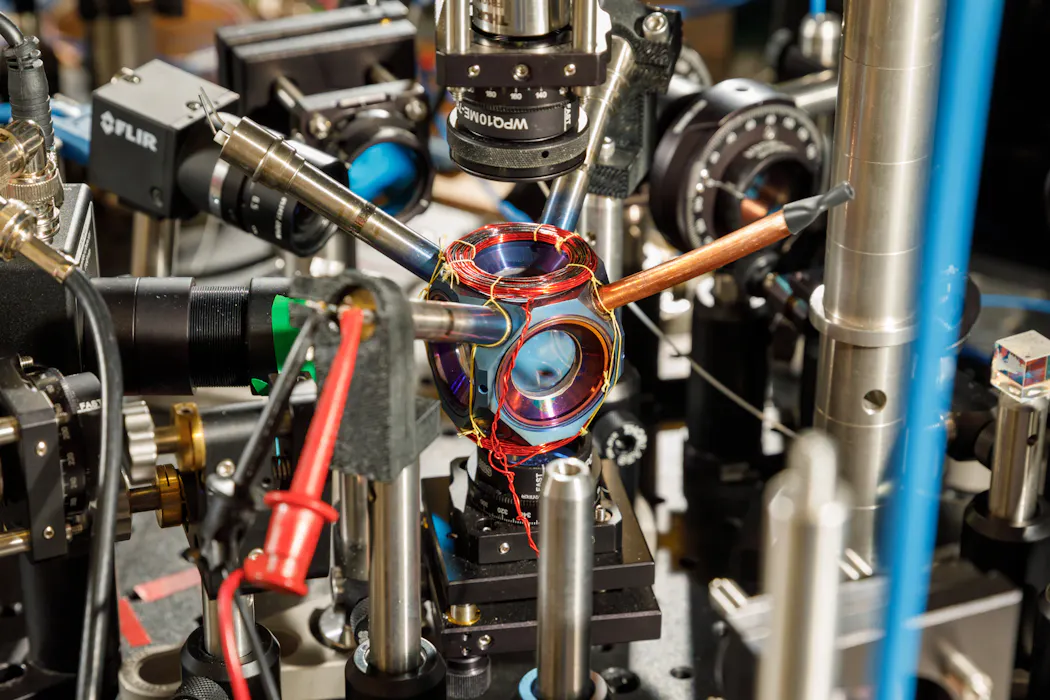
Quantum sensors use atoms, electrons and light as ultra-steady rulers – detecting faint motion, magnetism and gravity for navigation, medicine and science

This device measures acceleration and rotation by shining lasers into small clouds of rubidium atoms. Sandia National Laboratories

Quantum computers get a lot of attention, even though they are not ready for prime time, but quantum sensors are already doing useful work. These sensors measure fields, forces and motion so small that ordinary background noise can drown them out. Some sensors are already in daily use, while others are moving from research labs into flight tests, hospitals and field instruments.

For example, a human brain produces magnetic signals in the femtotesla-to-picotesla range – billions of times weaker than a refrigerator magnet – far weaker than the magnetic noise in an ordinary room. That is why brain scanners that measure these signals need ultrasensitive detectors and strong magnetic shielding. In some hospitals, these detectors use quantum technology to help map brain activity before epilepsy surgery, without touching the brain.

Sign up to read this article
Read news from 100's of titles, curated specifically for you.
Already a member? Sign in here
Related Stories
Top stories on inkl right now
One subscription that gives you access to news from hundreds of sites
Already a member? Sign in here
Our Picks
Fourteen days free
Download the app
One app. One membership.
100+ trusted global sources.







