Monday, February 9 marks the 24th anniversary of Princess Margaret's death, and although the stories of her vivacious (and sometimes controversial) personality live on, the bulk of her incredible jewelry collection no longer belongs to her family. Margaret's two children, Sarah Chatto and David Linley, auctioned off many of their mother's belongings after her 2002 death. Although their primary reason for selling was to pay off a £3 million inheritance tax bill, it's a decision that is said to have caused their late dad a considerable amount of pain.
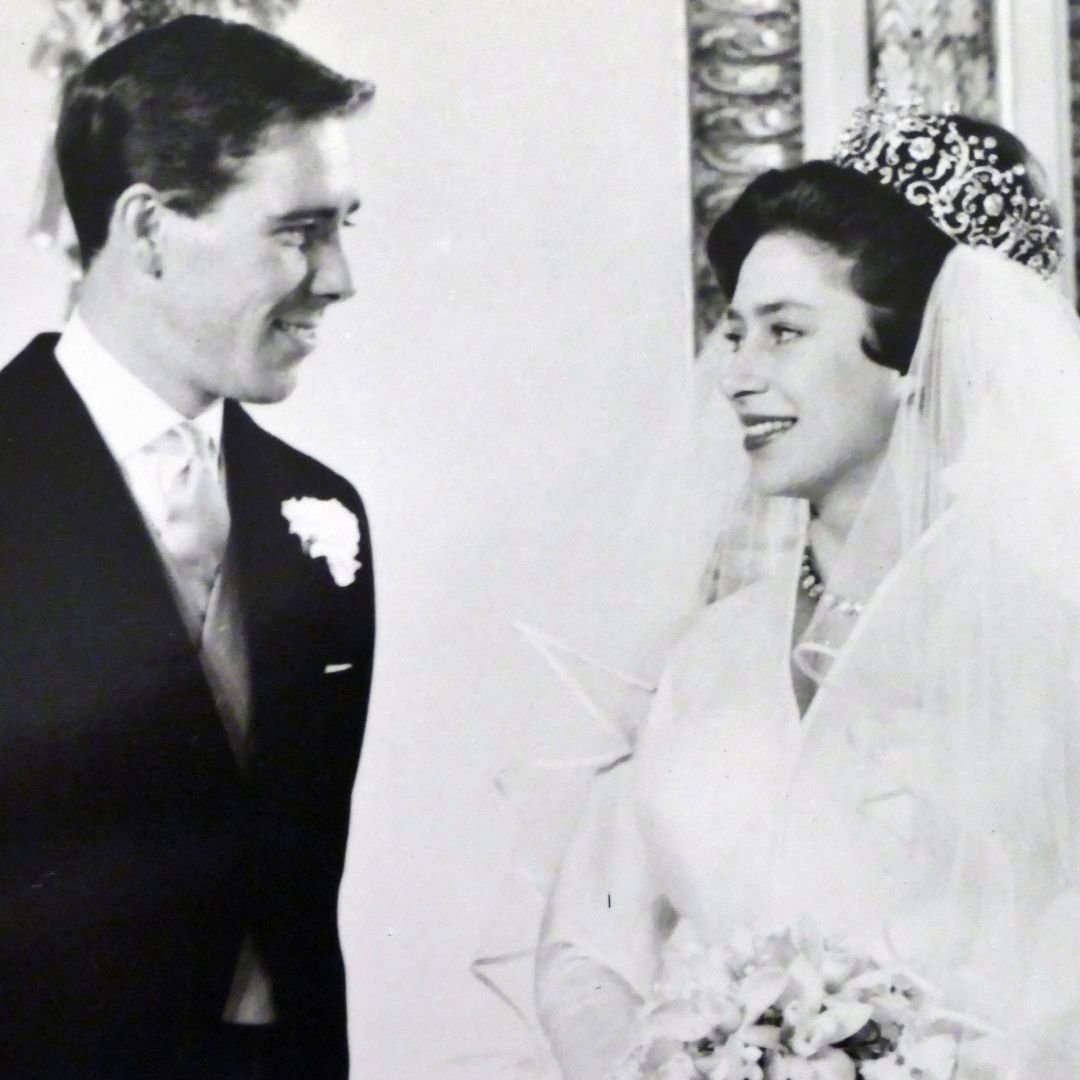
Antony Armstrong-Jones and Princess Margaret divorced in 1978, but his kids' decision to sell off their mother's wedding tiara and other sentimental objects was "heartbreaking" for the famed photographer, according to a 2023 documentary, Secrets of the The Royals.
"David Linley and his sister Sarah broke their father Lord Snowdon’s heart" when they sold 800 of the late princess's belongings at a 2006 auction, the documentary claimed (via the Daily Mail). This included the stunning Poltimore Tiara, which Margaret wore on her wedding day to Armstrong-Jones in 1960. Her husband later photographed her wearing the massive diamond tiara while lounging in the bath, with the photo becoming perhaps the most iconic image of the late princess.


"This Christies' auction was heartbreaking for Lord Snowdon…in fact, he wrote to his children asking them to stop it," Viscountess Hinchingbrooke said in the Channel 5 documentary. The Poltimore Tiara sold for £900,000 ($1.2 million), with the auction as a whole bringing in £14 million ($19 million).
Armstrong-Jones died in 2017, and in 2019, his son opened up about the decision to sell Princess Margaret's belongings. David admitted to the Telegraph he has "a lot of clutter" and that "getting rid of anything is not my natural habitat." However, the earl and his sister eventually came to the conclusion that they should hold an auction.
“You can start a museum with their name on it. I couldn’t," he said. "There were many, many reasons, mostly financial, that persuaded us that that was the correct route because, you know, when people die, taxes need to be paid."