
Imagine capturing an image so detailed you can count individual trees in a forest from 400 miles above Earth. Picture identifying objects smaller than a car while travelling at 17,000 miles per hour through the vacuum of space. This remarkable capability defines modern space-based observation, where cutting-edge satellite camera technology, as seen at https://dragonflyaerospace.com/satellite-cameras/, transforms how humanity monitors our planet.
Fifty years ago, the first Earth observation satellites captured grainy images that barely revealed continental outlines. Today's space-based observation systems detect changes as subtle as crop stress in agricultural fields, illegal fishing vessels hiding in vast oceans, and infrastructure damage from natural disasters. The evolution from those early experiments to today's sophisticated platforms represents one of technology's most dramatic transformations.
What makes this progression even more fascinating? The precision required for space-based observation exceeds almost any other imaging challenge humans have attempted. Every component must work flawlessly in conditions that would destroy ordinary cameras within minutes.
How Earth Observation Technology Evolved Over Decades
The journey toward modern Earth observation technology began modestly. Early satellites carried simple film cameras that ejected physical capsules back to Earth for processing. Astronauts literally caught these capsules mid-air, then developed the film in darkrooms. The process took days, and image quality remained poor by contemporary standards.
How does Earth observation work from space? Digital sensors changed everything. Charge-coupled devices (CCDs) converted light into electronic signals that could be transmitted instantly to ground stations. Resolution improved dramatically as manufacturing techniques produced sensors with millions of individual pixels. Space-based observation suddenly delivered images revealing objects measured in meters rather than kilometres.
Multispectral imaging added another dimension to Earth observation technology. Cameras capturing multiple wavelengths simultaneously—visible light, infrared, ultraviolet—revealed information invisible to human eyes. Healthy vegetation reflects infrared light differently than stressed plants, enabling agricultural monitoring from orbit. Urban heat islands show up clearly in thermal imagery, helping city planners reduce energy consumption.
According to NASA's Earth observation research, modern sensors can detect over a dozen different wavelength bands. This spectral richness allows scientists to distinguish between similar-looking features based on their unique spectral signatures. A satellite camera equipped with these capabilities becomes a powerful analytical tool rather than just a photography system.
Why Precision Matters in Space Observation
Precision in space-based observation involves far more than sharp focus. Consider what happens when a satellite orbits Earth: the spacecraft moves at tremendous velocity while the planet rotates beneath it. The atmosphere refracts light, temperatures swing between extreme hot and cold, and cosmic radiation bombards delicate electronics continuously.
Maintaining image stability under these conditions demands extraordinary engineering. Satellite observation systems use star trackers to determine orientation with incredible accuracy. These devices identify star patterns and calculate the spacecraft's exact attitude in three-dimensional space. Even tiny pointing errors—fractions of a degree—can shift the camera's view by kilometres at orbital altitudes.
Vibration control becomes critical for high-resolution imaging. Reaction wheels that orient satellites create subtle vibrations as they spin. Solar panels flexing in thermal extremes transmit micro-movements through the spacecraft structure. Space-based observation requiring sub-meter resolution must isolate cameras from these disturbances using sophisticated damping systems.
Atmospheric correction algorithms adjust for how Earth's atmosphere distorts light. Water vapour, dust, and temperature variations all affect how electromagnetic radiation travels from ground to orbit. Advanced satellite camera systems incorporate real-time processing that compensates for these effects, delivering accurate measurements of surface features.
Timing precision matters enormously. High-resolution Earth data depends on synchronised imaging where cameras capture thousands of individual frames and stitch them into seamless composites. GPS receivers provide timing accurate to nanoseconds, enabling precise geolocation of every pixel in satellite images. Without this temporal accuracy, images would contain geometric distortions, making them useless for mapping.
The Architecture of Modern Satellite Observation Systems
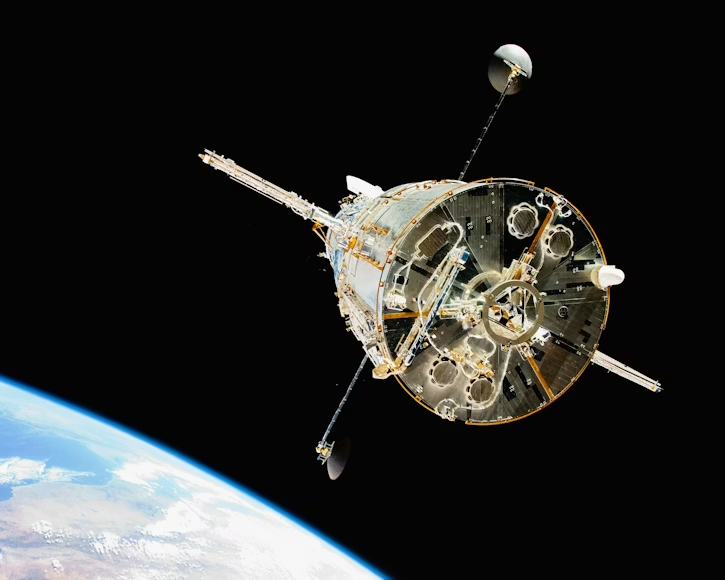
Building effective satellite observation systems requires integrating multiple technologies into cohesive platforms. The optical assembly includes mirrors, lenses, and filters manufactured to tolerances measured in nanometers. Surface imperfections invisible to human eyes would degrade image quality unacceptably in space-based observation applications.
Sensor arrays convert light into digital data with remarkable efficiency. Modern cameras use time-delay integration, where electronic charges shift across the sensor in sync with ground motion below. This technique dramatically increases light-gathering capability, enabling detailed imaging even in low-light conditions. Space-based observation of polar regions during winter months depends entirely on this technology.
Onboard data processing compresses images before transmission to ground stations. Raw sensor data would overwhelm communication systems, so sophisticated algorithms reduce file sizes while preserving critical information. Some satellite camera platforms perform initial image analysis autonomously, identifying interesting features and prioritising their transmission.
Thermal management keeps sensors at optimal operating temperatures. Extreme cold improves signal-to-noise ratios in infrared detectors, so active cooling systems maintain sensors well below freezing while other spacecraft components operate at room temperature. This thermal engineering enables the sensitive measurements required for climate monitoring and environmental research.
Power systems must provide stable electricity despite orbital variations. Solar panel output fluctuates as satellites enter Earth's shadow, but imaging sensors demand a consistent voltage for accurate measurements. Battery systems and power conditioning electronics ensure satellite observation systems receive clean, regulated power regardless of orbital position.
Applications Transforming Through High-Resolution Earth Data
Space-based observation has transformed multiple fields. In agriculture, satellites provide precise field-level data on irrigation, fertilisation, and pest control, cutting costs while boosting yields and reducing environmental harm. Urban planners use long-term, high-resolution imagery to track city growth, infrastructure needs, traffic patterns, and green space changes.
Disaster response relies on rapidly retasked satellites to deliver up-to-date images of damage and access routes after hurricanes, earthquakes, or wildfires. Environmental scientists depend on long-term satellite records to monitor deforestation, glacier loss, reef bleaching, and other climate-driven changes, making space-based observation essential for understanding and protecting the planet.
What Earth observation application interests you most? Share your thoughts on how space-based imaging could benefit your work or community. We want to hear which perspectives from orbit you find most valuable for understanding our world.