Get all your news in one place.
100's of premium titles.
One app.
Start reading
The Conversation
The Conversation
Jean-Pierre Darnis, Full professor at the University of Côte d’Azur, director of the master’s programme in “France-Italy Relations”. Associate fellow at the Foundation for Strategic Research (FRS, Paris) and adjunct professor at LUISS University (Rome), Université Côte d’Azur
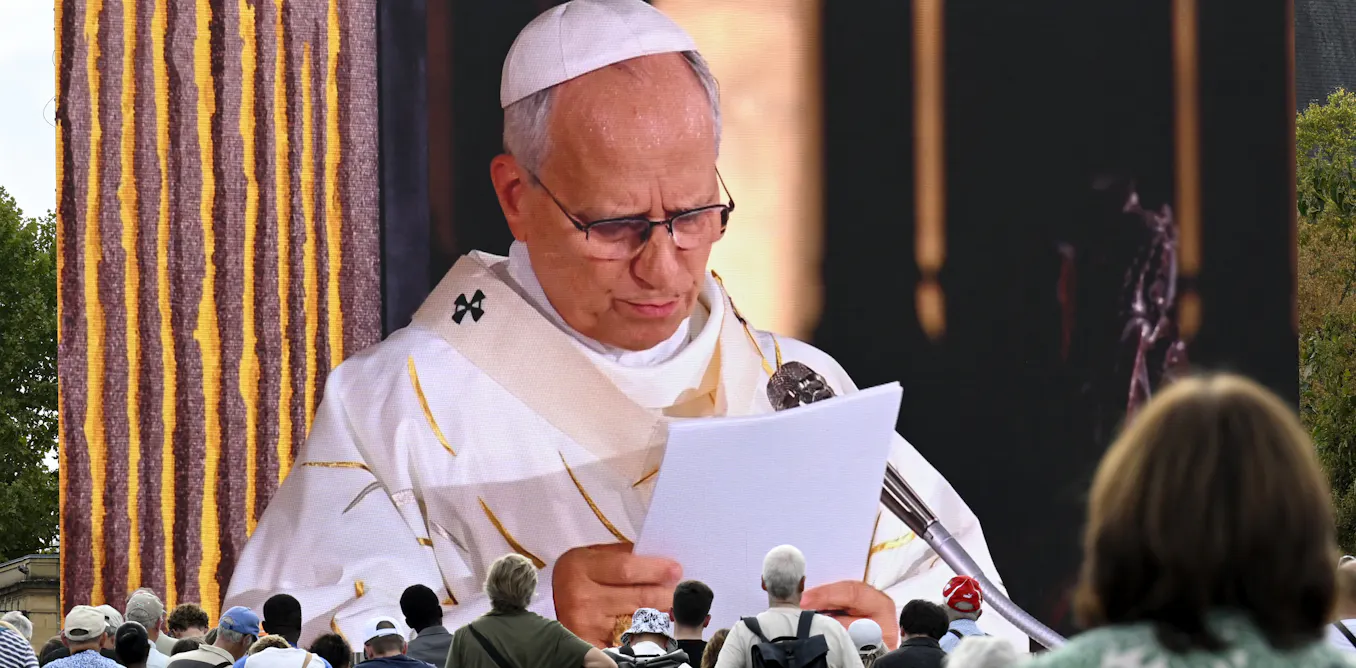

Pope Leo XIV’s Europe


KEY TAKEAWAYS

  • Pope Leo XIV’s views on international politics set out a vision that rejects the logic of power and imperialism in favour of diplomacy, the rule of law and multilateral institutions.

  • Europe occupies a central place in this vision: the Pope sees the European Union as a project that transcends national rivalries.

  • During his visit to France, he combined a celebration of the nation’s Christian heritage with a condemnation of nationalism, while emphasising that welcoming foreigners and those who are marginalised would be a hallmark of his pontificate.


Europe plays a central role in this vision: Pope Leo XIV champions the European Union as a means of overcoming national rivalries, while reinterpreting the continent’s Christian roots in the light of its history and cultural evolution.

In his visit to France, the Pope seeks a balance between identity and openness: he celebrates the nation’s Christian heritage while condemning nationalism and affirming the welcoming of foreigners and the marginalised as a hallmark of his pontificate.

His Magnifica Humanitas encyclical, published in May 2026, attracted attention primarily because in it the Pope tackled head-on the issue of artificial intelligence and its dangers. But this important text, Pope Leo XIV’s first encyclical, also sets out his stance on international politics. The Supreme Pontiff reiterated and elaborated on these ideas on September 28, during a speech he delivered in the eastern French city of Metz.

From Realpolitik to multilateralism

The culture of force and violence is rejected, leading to a condemnation of power politics and imperialism. Remarkably, this text draws on political theory to construct a moral narrative. The encyclical condemns pragmatism and cynical realism, setting them against the defence of multilateralism.

The explicit rejection of Realpolitik, moreover, harks back to a long-standing debate: the one that pitted the Vatican under Pius IX against 19th century Germany during Chancellor Otto von Bismarck’s rule. The dialectic of the Kulturkampf saw the Vatican’s transnational vision pitted against that of the modern nation-state. The resumption of the struggle against Realpolitik is therefore by no means insignificant. It represents a stance in which multilateralism, diplomacy and consultation appear as the only paths to peace in the face of a realism that almost automatically translates into the use of force: competition between states and the absence of a higher authority make power – and, ultimately, force – the preferred instruments of international action.

Thus, these historical and political definitions now help to define moral categories. From this perspective, it should be noted that defending multilateralism is not a defence of an abstract principle: it reflects an institutional vision held by the new Pope who, in Ankara in November 2025, during his first international visit, was already outlining a defence of multilateral institutions – a reference he reiterated in his speech delivered in Paris before UNESCO on September 25.

Europe as a means of transcending nationalism

Magnifica Humanitas lays the foundations for the stance on Europe as set out in the speech the Pope delivered in Metz. Already during his visit to Spain last June, the Pope had spoken of Europe’s “specific vocation”, calling for progress to be made in the European Union process, which he described as “a gift for the whole human family”. The EU appears to be a prime example of an appreciation of complexity: the ability to reconcile modern political demands with an awareness of the negative aspects of identity-based definitions – and consequently of nationalist vulnerabilities – is highlighted by this follower of Saint Augustine, who links this vocation to the mission that Europe must fulfil.

In his Metz address, we can also see how the Pope reinterprets the discourse on the “Christian roots of Europe”, interpreting it in a way that takes account of the historical and cultural developments he associates with religion in general and with the development of Christianity.

Here again, the approach involves invoking founding figures, such as Robert Schuman and Alcide De Gasperi, to link the perception of a personal history to the Christian dimension, which leads to institutional realisation. Leo XIV counters national narratives by quoting Schuman to emphasise the need to overcome the opposition between cultural identities and by stressing the Christian dimension of Europe, perceived as a process founded on law and peace, which aims to regulate power, or even to renounce it.

Reconciling national identity and project Europe

The implications of this vision are extremely clear: the rejection of imperialism and nationalism emerges as a very clear political message. It is worth noting, however, how during his vigil on September 25 at the Stade de France, Pope Leo framed his meeting with young people within the context of France’s sacred history. In some respects, the emphasis on the historical figures of a national Church might appear to contradict the political vision that rejects nationalism while supporting the process of European integration.

This is probably a sign of an attempt to reconcile the dimension of a national identity centred on the exemplary nature of religious figures – and thus detached from the political dimension – while the political project, the “mission” expressed by the Pope, finds in the EU and its institutions a privileged arena for its realisation. Against the backdrop of a French Church undergoing significant changes – which are at times a source of tension – and a society already shaped by the issues surrounding the 2027 presidential election, the Pope seeks to embody a vision capable of uniting all Catholics, while continuing to vigorously champion a message of welcoming foreigners and marginalised people. The Metz Declaration, which places particular emphasis on this point, and the visit to the Bakhita House in Paris bear witness to this. He also intends to distance himself clearly from nationalist tendencies.

A Church that stands against the world’s brutalisation

The Metz address is imbued with the specific symbolism associated, on the one hand, with Robert Schuman and, on the other, with a region in France – the Moselle – which encapsulates how deadly rivalries between France and Germany were overcome. The message therefore extends across the Rhine and to the whole of Europe, where nationalist forces are currently experiencing a resurgence that could have centrifugal consequences for the EU.

This is probably not a matter of engaging in a violent rejection that would separate the wheat from the chaff, but instead offering an inclusive interpretation that allows the fundamental messages of a Church opposed to the brutalisation of the world – and, more specifically, to the resurgence of nationalism in Europe – to be heard across all sections of society, including believers.

The great enthusiasm surrounding Pope Leo XIV’s visit to France is certainly interpreted by the Pope as a sign in this regard, the significance of which will need to be analysed in the coming months.


A weekly e-mail in English featuring expertise from scholars and researchers. It provides an introduction to the diversity of research coming out of the continent and considers some of the key issues facing European countries. Get the newsletter!


This article was originally published on The Conversation. Read the original article.

Sign up to read this article
Read news from 100's of titles, curated specifically for you.
Already a member? Sign in here
Related Stories
Top stories on inkl right now
One subscription that gives you access to news from hundreds of sites
Already a member? Sign in here
Our Picks
Fourteen days free
Download the app
One app. One membership.
100+ trusted global sources.