Get all your news in one place.
100's of premium titles.
One app.
Start reading
The Conversation
The Conversation
Environment
Temitope O. Sogbanmu, Lecturer I, Ecotoxicology and Conservation Unit, Department of Zoology, Faculty of Science, University of Lagos

Plastic pollution in Nigeria is poorly studied but enough is known to urge action

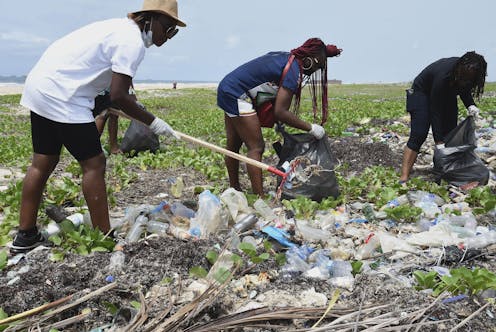
Plastic waste from land based sources pollute the beaches and other water bodies. Pius Utomi Ekpei/AFP via GettyImages

In recent years, the amount of plastic in the environment has become a global concern. With the world population approaching eight billion, more and more plastic and plastic-derived products are being used and discarded. An estimated 367 million tonnes (367 billion kg) of plastic were produced in 2020 alone – about 12 tonnes (12,000kg) of plastic waste produced every second that year.

With about 2.5 million tonnes of plastic waste annually, Nigeria ranks ninth globally among countries with the highest contributions to plastic pollution. Unfortunately, over 88% of the plastic waste generated in Nigeria is not recycled. Instead, much of it ends up in water bodies – rivers, lakes, drains, lagoons and the ocean.

Sign up to read this article
Read news from 100's of titles, curated specifically for you.
Already a member? Sign in here
Related Stories
Top stories on inkl right now
One subscription that gives you access to news from hundreds of sites
Already a member? Sign in here
Our Picks
Fourteen days free
Download the app
One app. One membership.
100+ trusted global sources.