
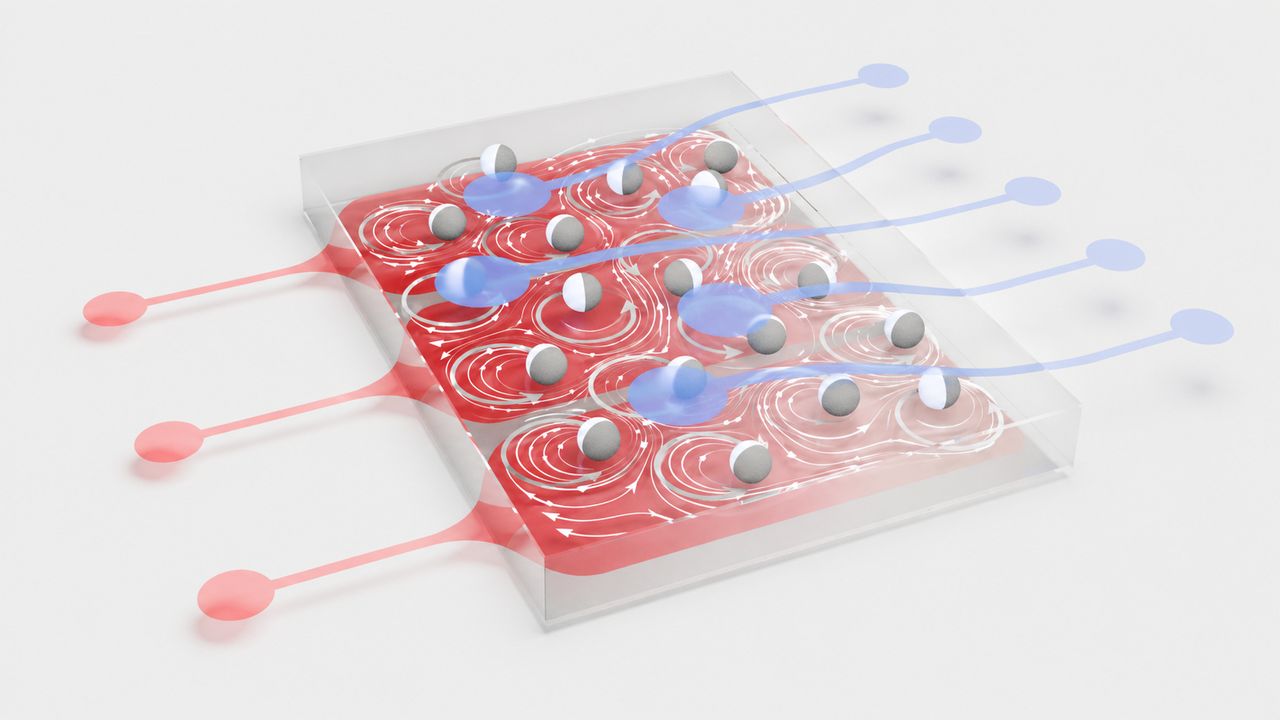
Physicists at the Universities of Konstanz and Stuttgart have run chaotic-signal forecasting and anomaly detection on 400 microscopic particles orbiting in a drop of liquid, in work published in Communications AI & Computing. The array predicted a chaotic Mackey-Glass series and picked out anomalies that leave a signal's mean, variance, and short-time autocorrelation untouched, scoring an F1 of 0.90 on that harder task. It also came in roughly 10 times less accurate than memristor-based reservoirs, a gap the paper admits candidly.
Each oscillator is a silica sphere of 3μm radius, capped on one side with 80nm of carbon and suspended in a water-lutidine mixture held at 28°C. A 532nm laser heats the cap and drives the particle toward an assigned target point, but the delay between imaging a particle and repositioning the beam means it overshoots and settles into a small orbit instead. Flow fields in the liquid couple neighboring orbits, and data enters the system as displacements of the target points.














