Get all your news in one place.
100's of premium titles.
One app.
Start reading
The Conversation
The Conversation
Ashutosh Mangalam, Associate Professor of Pathology, University of Iowa

Out-of-balance bacteria is linked to multiple sclerosis − the ratio can predict severity of disease

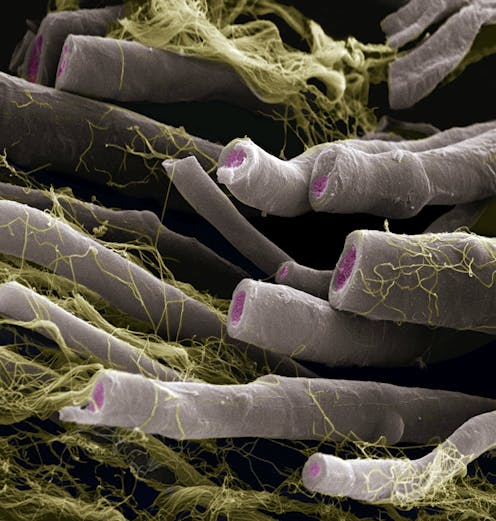
The myelin sheaths insulating neurons are damaged in multiple sclerosis. Steve Gschmeissner/Science Photo Library/Brand X Pictures via Getty Images

Multiple sclerosis is a disease that results when the immune system mistakenly attacks the brain and spinal cord. It affects nearly one million people in the U.S. and over 2.8 million worldwide. While genetics play a role in the risk of developing multiple sclerosis, environmental factors such as diet, infectious disease and gut health are major contributors.

The environment plays a key role in determining who develops multiple sclerosis, and this is evident from twin studies. Among identical twins who share 100% of their genes, one twin has a roughly 25% chance of developing MS if the other twin has the disease. For fraternal twins who share 50% of their genes, this rate drops to around 2%.

Sign up to read this article
Read news from 100's of titles, curated specifically for you.
Already a member? Sign in here
Related Stories
Top stories on inkl right now
One subscription that gives you access to news from hundreds of sites
Already a member? Sign in here
Our Picks
Fourteen days free
Download the app
One app. One membership.
100+ trusted global sources.