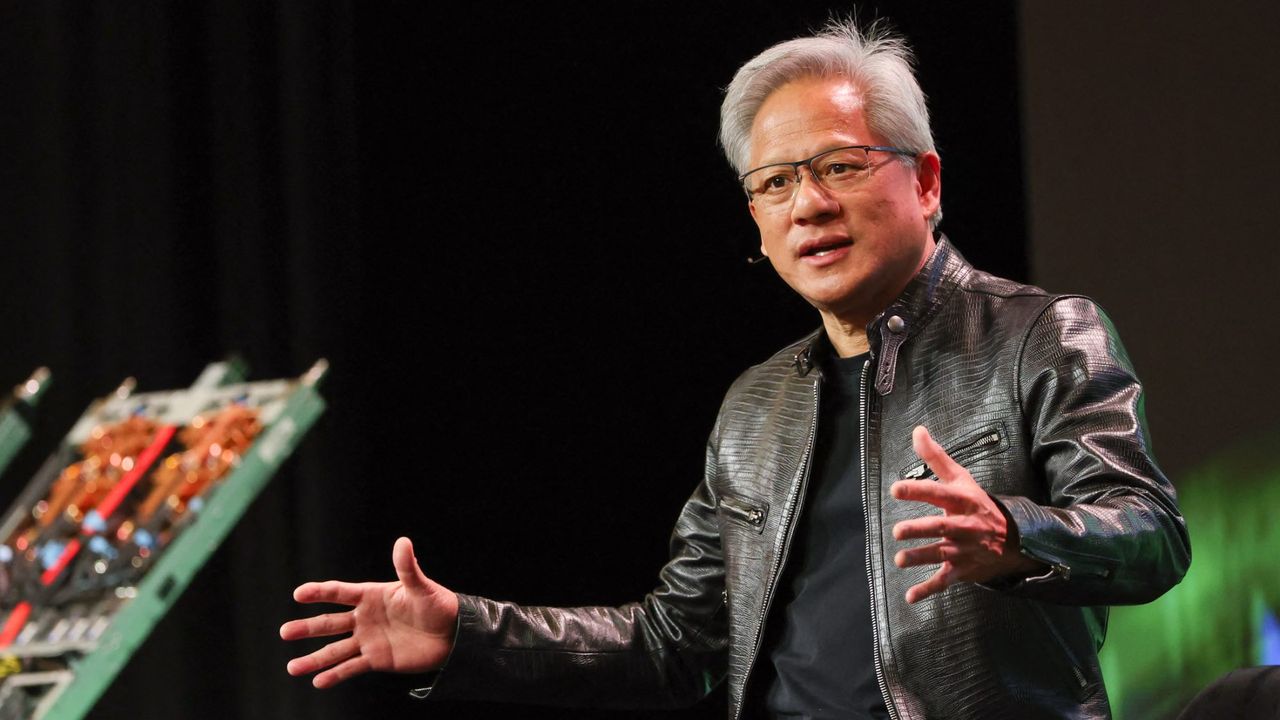
During the Nvidia GTC 2026 keynote, CEO Jensen Huang debuted DLSS 5 calling it the "fusion of 3D graphics and artificial intelligence." The announcement was met with immediate backlash across social media.
For the unaware, DLSS is a "deep learning super sampling" feature on Nvidia graphics cards that is used to upscale the resolution of video games. We went eyes-on with version 4.5 recently and my colleague Jason England said it was "the final piece of the puzzle that brings the vision of smooth, responsive AI fueled gameplay to life."

DLSS 5 takes those engines and uses AI and neural rendering to infer how games would look in more photorealistic environments, or as one colleague put it, "They added more light."
Huang faced questions over the criticism of DLSS 5 during a Q&A at GTC 2026. Our friends at Tom's Hardware were able to ask about the backlash.
"Well, first of all, they're completely wrong," Huang said.
"The reason for that is because, as I have explained very carefully, DLSS 5 fuses controllability of the of geometry and textures and everything about the game with generative AI," Huang added.
To be fair to Huang, he was clear about this during the keynote and said nearly the same thing.
They're completely wrong. The reason for that is because, as I have explained very carefully, DLSS 5 fuses controllability of the of geometry and textures and everything about the game with generative AI.
Jensen Huang, Nvidia CEO
"DLSS 5 is the GPT moment for graphics — blending hand-crafted rendering with generative AI to deliver a dramatic leap in visual realism while preserving the control artists need for creative expression,” Huang said in his introduction.
Between the introduction and the Q&A, Huang had been adament that DLSS 5 and its generative capabilities "doesn't change the artistic control."
"It’s not post-processing, it’s not post-processing at the frame level, it’s generative control at the geometry level," he said.
The video does no favors
Part of the problem is that the demonstration video shows DLSS 5 with its max sliders turned on. And as critiques pointed out, just about every "upgrade" from DLSS off to DLSS 5 turned on looks like someone slapped a terrible Instagram filter on top of the game.
In some cases, as with Hogwarts Legacy, everything received more of a cartoon-y look. The Resident Evil: Requiem differences seemed to turn Leon and Grace into looksmaxxing influencers.

I would argue the best use of DLSS5 is actually shown off in EA's FC26. That game is going for a more photorealistic look with the players. The lighting and skintone improvements look particularly impressive on the Netherlands' Virgil van Dijk.
Again, Tom's Guide's Jason England was able to take a look at more images that show off DLSS 5 not just on AI faces but also in environments. "DLSS 5 is absolutely a breakthrough," he said. However, he noted that he has questions, and just running DLSS 5 on its own can take away what may have been intentional shading or lighting.
Huang says it's a tool that developers can choose to use. We'll know more this fall when DLSS 5 is set to launch. And I'm certain more demos will be provided between now and release.
More from Tom's Guide
- Nvidia says PC gaming will ‘look like a film’ — GTC 2026 could herald 1 million times better path tracing for GPUs
- Nvidia GTC 2026 LIVE — Jensen Huang reveals DLSS 5, OpenClaw partnership, and an Olaf robot
- Nvidia won't release new gaming GPU for 'first year in three decades' due to RAM shortage — and it's also slashing RTX 50 production