
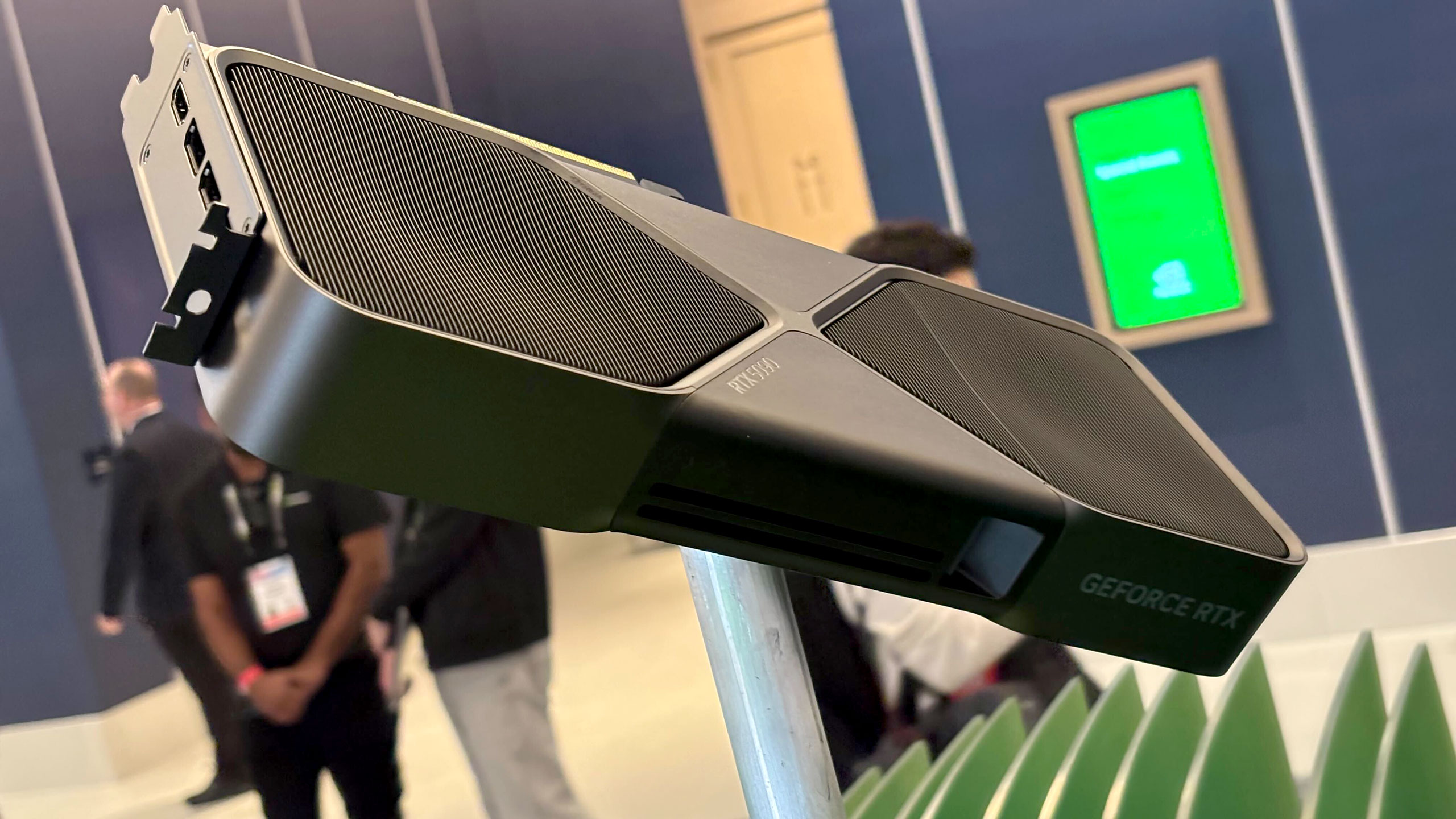
The Blackwell RTX 50-series GPUs mark the end of the more than two long years of waiting since the RTX 40-series Ada Lovelace GPUs launched in late 2022. Nvidia announced its upcoming GeForce RTX 50-series cards during the CES 2025 keynote, providing the specifications, pricing, and even a preview of performance. Big claims were made, with new technologies like DLSS 4 playing a major role in those claims. As the new halo part, the RTX 5090 takes over from the RTX 4090, boasting more memory, more compute, more features, and more power. It's not yet available, but there's a lot going on that's worth dissecting before cards go on sale.
Will the RTX 5090 be one of the best graphics cards when it arrives? If by "best" you mean "fastest" then yes, there's little doubt it will surpass it's predecessor. Will it be twice as fast? Depending on how you want to measure performance, maybe, but that's putting a lot of trust in AI techniques that aren't the same as traditional rendering. Let's dig into the specifications and features that we know about to discuss how the old and new kings of the GPU world stack up.
Let's talk raw specs first. The RTX 5090 has 170 Blackwell Streaming Multiprocessors (SMs), compared to 128 SMs on the 4090. That's a 33% increase in GPU cores — and the number of CUDA cores, tensor cores, RT cores, texture units, etc. is directly tied to the SM counts, so that's basically a 33% increase overall.
Clock speeds also play a role, however, and the 4090 has a 2520 MHz boost clock compared to (based on calculations and Nvidia's official specs) a 2407 MHz boost clock. That means for raw compute, the 5090 'only' offers a 27% improvement over the 4090. However, that's assuming no other architectural differences exist, which almost certainly isn't a good assumption.
Memory capacity, speed, and bandwidth are all higher with the RTX 5090, thanks to GDDR7 as well as a bigger, beefier chip. The RTX 5090 has 33% more VRAM than the 4090, clocked 33% higher, for a net 78% improvement in raw bandwidth. We don't know the L2 cache size or if there are any other changes that could impact bandwidth, and both of those are important considerations. Still, that's a big increase in raw memory bandwidth.
Nvidia is betting big on AI with the RTX 50-series, and that's where we see some of the biggest changes. The RTX 4090 has 661 TFLOPS of FP16 tensor compute (with sparsity), and 1321 TOPS (teraops) of INT8 tensor compute (again with sparsity). That's far more than AMD's RX 7900 XTX that only offers 123 TFLOPS / TOPS of FP16 / INT8 compute (without sparsity). But it still pales in comparison to the RTX 5090.
We're not certain on the FP16 figure, but assuming Nvidia follows the same ratios as the prior generation, the RTX 5090 will deliver up to 1676 TFLOPS of tensor FP16 compute, and double that for 3352 TOPS of tensor INT8 compute (both with sparsity). That's a 154% increase (2.54X) in AI computational performance with the new generation. And Nvidia intends to put the AI potential to good use.