Get all your news in one place.
100's of premium titles.
One app.
Start reading
The Conversation
The Conversation
Science
Artemis Spyrou, Professor of Nuclear Physics, Michigan State University

Nuclear isomers were discovered 100 years ago, and physicists are still unraveling their mysteries

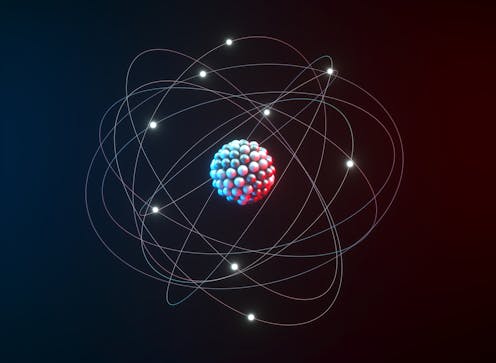
Protons and neutrons in an atom's nucleus can be arranged in different configurations, creating nuclear isomers. KTSdesign/SciencePhotoLibrary via Getty Images

Nobel laureate Otto Hahn is credited with the discovery of nuclear fission. Fission is one of the most important discoveries of the 20th century, yet Hahn considered something else to be his best scientific work.

In 1921, he was studying radioactivity at the Kaiser Wilhelm Institute for Chemistry in Berlin, Germany, when he noticed something he could not explain. One of the elements he was working with wasn’t behaving as it should have. Hahn had unknowingly discovered the first nuclear isomer, an atomic nucleus whose protons and neutrons are arranged differently from the common form of the element, causing it to have unusual properties. It took another 15 years of discoveries in nuclear physics to be able to explain Hahn’s observations.

Sign up to read this article
Read news from 100's of titles, curated specifically for you.
Already a member? Sign in here
Related Stories
Top stories on inkl right now
One subscription that gives you access to news from hundreds of sites
Already a member? Sign in here
Our Picks
Fourteen days free
Download the app
One app. One membership.
100+ trusted global sources.